
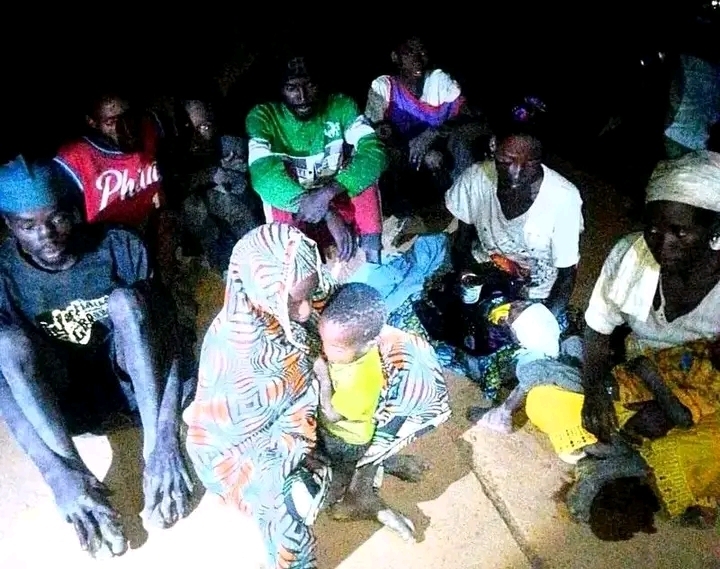
In a decisive blow against the criminal gangs terrorising the nation’s heartland, troops of the Nigerian Army have successfully rescued eleven kidnapped victims in Kaduna State. The high-stakes operation, which unfolded under cover of darkness on Monday night, marks a significant tactical victory along the critically important—and often perilous—Kaduna–Abuja road corridor.
According to an exclusive briefing provided to the News Agency of Nigeria (NAN) by a senior military source on Tuesday, the rescue was precipitated by the vigilant surveillance of troops stationed at the Forward Operating Base (FOB) Doka. Utilizing a sophisticated long-range CCTV camera system mounted strategically in the area, operatives detected suspicious movement through the dense bushland along the Gidan Duna–Amale axis.
The operation commenced at approximately 2300 hours, after the surveillance team identified a group of armed terrorists shepherding a number of visibly distressed civilians through the remote terrain. The victims, it was later confirmed, had been abducted from the Gada Mallam Maman community in Kachia Local Government Area (LGA) just days prior, on 26th October 2025.
“Upon confirming the hostile movement and the presence of captives, the troops immediately mobilised for a swift intervention,” the military source stated. “The primary objective was to secure the safe release of the civilians while engaging and neutralising the threat posed by the kidnappers.”
Demonising exceptional coordination and rapid response capabilities, the troops moved in with a convoy of vehicles and tactical support. The sight of the advancing military force proved enough to break the terrorists’ resolve. Upon sighting the approaching troops, the armed assailants abandoned their captives and fled precipitately into the surrounding bush, opting for escape over confrontation.
“The troops secured the immediate area and fired probing shots to forestall any possible counterattack, but no further contact was made with the fleeing terrorists,” the source detailed, highlighting the operation’s effectiveness in prioritising victim safety. The area was subsequently sanitised and secured, ensuring no immediate threat remained to the rescued individuals or the responding forces.
The eleven rescued victims, comprising five adult males, three adult females, and three children, were found to be in stable condition despite their ordeal. They were promptly provided with initial medical checks and psychological first aid at the scene. Following necessary debriefing, the elated individuals were conveyed back to their home community of Gada Mallam Maman, where they were formally reunited with their anxious families in the early hours of Tuesday morning. The reunion scene, described by onlookers as emotionally charged, brought profound relief to the community, which had been gripped by fear since the abduction.
This successful mission underscores the strategic importance of technology-enhanced policing in the fight against insecurity. The deployment of long-range CCTV at FOB Doka represents a critical force multiplier, enabling proactive threat detection rather than reactive response. Military analysts suggest that the integration of such advanced surveillance assets along key national infrastructure is a vital component in degrading the operational capabilities of terrorist and kidnapping syndicates plaguing the North-West region.
The Kaduna–Abuja road has, regrettably, gained notoriety as a hotspot for such criminal activities, causing immense hardship for travellers and stifling economic activity. This rescue, therefore, carries symbolic weight beyond the immediate humanitarian triumph. It serves as a public demonstration of the Nigerian Army’s reinforced commitment to dominating these volatile spaces. The military source reaffirmed this stance, stating, “This operation reaffirms the commitment of the Nigerian Army to sustained, intelligence-driven operations aimed at decisively degrading criminal elements and ensuring the safety of lives and property along our major routes and adjoining communities.”
The security architecture in Kaduna State remains complex, with ongoing joint operations involving the Army, Air Force, Police, and Department of State Services (DSS). This latest success is likely to be leveraged to bolster public confidence and encourage greater collaboration with civilian populations in sharing timely intelligence. Community leaders in Kachia LGA have already praised the military’s swift action, calling for a permanent increase in such agile, technology-backed deployments.
While the rescued victims begin their process of recovery and reintegration, search and clearance operations in the general area are continuing. The military high command has pledged that efforts to track the fleeing terrorists and dismantle their network will be intensified. The message from the defence establishment is unequivocal: those who threaten the peace and security of citizens will find no sanctuary.
This incident brings into sharp focus the persistent challenges of rural insecurity and banditry in Nigeria’s North-West. It also highlights the evolving tactics of security forces adapting to these threats. As the nation continues to grapple with these security concerns, the precision and success of the Kaduna 11 rescue operation will undoubtedly be studied as a model for future counter-kidnapping missions, proving that with robust intelligence, rapid deployment, and unwavering resolve, the tide can be turned against the agents of fear and instability.
The Defence Headquarters is expected to issue a formal statement on the operation later today, which may provide further operational details and casualty figures, if any, on the side of the terrorists. For now, however, the narrative is one of relief and strategic victory—a night when technology, timing, and tactical courage converged to restore eleven souls to freedom and reaffirm the state’s duty to protect its citizens.