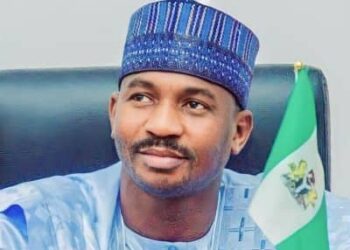
The National Chairman of the All Progressives Congress (APC), Nantewe Yilwatda, has assured legacy members that political defectors will not be permitted to take over the party’s leadership structures.
Speaking to journalists after a closed-door meeting with the party’s Federal Capital Territory (FCT) stakeholders on Tuesday in Abuja, Mr Yilwatda drew a clear distinction between founding members and recent entrants, stating that while both groups’ interests would be protected, neither would be allowed to subsume the other.
“It is a home that we built. If the house were not built, nobody would come, so nobody should come as a warrior and take over,” he said.
He emphasised that the solution lies in a deliberate power-sharing formula that guarantees inclusion across both blocs, adding: “We must have everybody included. There will be a sharing formula that will ensure that all members of the legacy group and defectors are properly carried along.”
Regarding the APC FCT party structure, Mr Yilwatda outlined a five-dimensional sharing formula encompassing gender inclusion—with women holding substantive executive positions rather than merely serving as women leaders—geopolitical representation across all six zones of the country, inclusion of the FCT’s indigenous tribes, and youth engagement.
The chairman confirmed the establishment of a committee chaired by the Minister of Special Duties and Inter-Governmental Affairs, Zephaniah Jisalo, describing its members as bona fide APC members. He noted that the committee had conducted zoning for the FCT APC and that its work had been followed to the letter.
He added that no APC member had so far complained of being cheated, and that the party’s constitution would be strictly enforced in forthcoming congresses. Defectors seeking executive positions must produce resignation letters formally accepted by their former party chairmen.
Mr Yilwatda also reiterated the constitutional rule on tenure, stating that any member who had spent eight consecutive years in one office must step down or, at best, change office.
Articulating his core political philosophy, he said inclusion is a non-negotiable organisational principle: “We must accommodate all tribes, including the geopolitical resource. I am chairing this party because of inclusion. If there is no inclusion, I can’t be here because my tribe is only found in two local governments of this country. I am a minority.”
He further noted that women, as great mobilisers, should not be used only during election periods but included on the list of experts.