
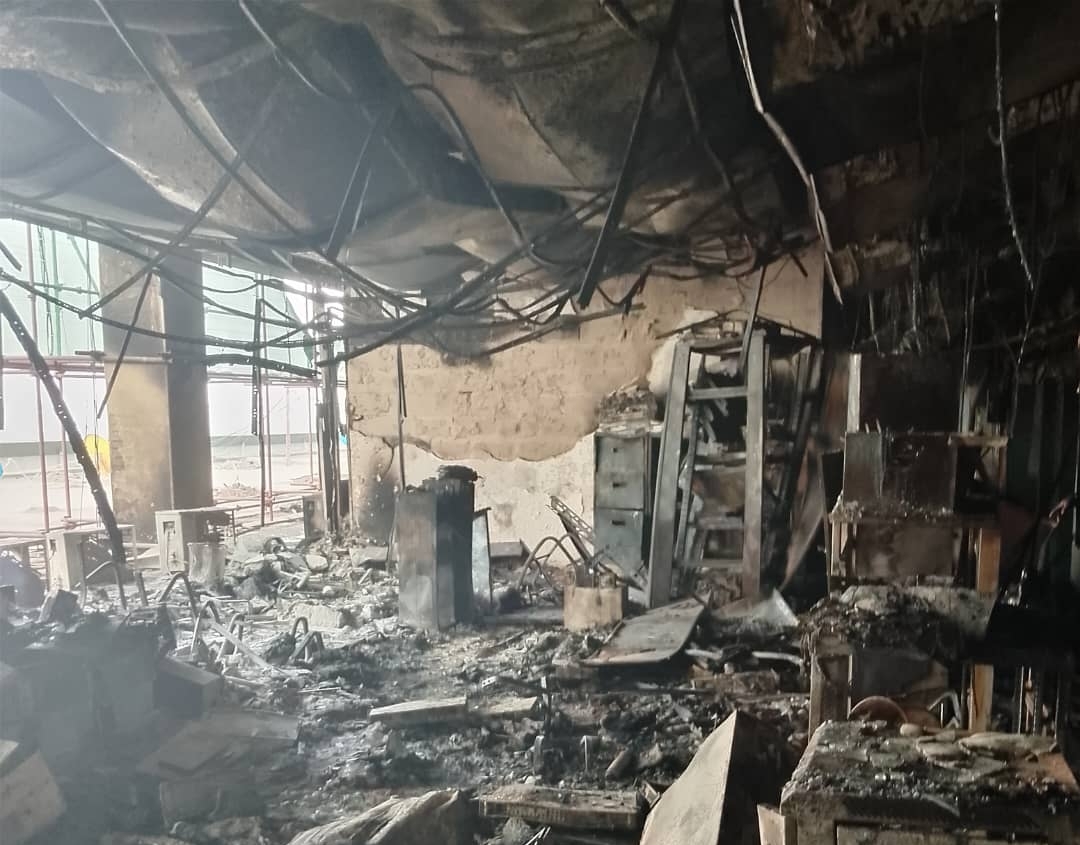
A catastrophic fire at Terminal 1 of Murtala Muhammed International Airport (MMIA) in Lagos has severely impacted the Nigerian Airspace Management Authority (NAMA), destroying essential operational equipment and causing significant flight disruptions.
In a press briefing following an inspection of the damage, NAMA’s Managing Director, Umar Farouk, revealed that the blaze obliterated the agency’s primary air-to-ground communication system—a crucial link between pilots and air traffic controllers. This loss has led to considerable challenges in maintaining air traffic services.
Farouk stated, “The fire has completely incapacitated our air-to-ground communication. Currently, we are relying on backup systems and support from other operational centres across Nigeria to manage air traffic in Lagos.”
The incident unfolded rapidly, prompting NAMA to implement contingency measures. At the height of the crisis, the authority made the precautionary decision to suspend inbound flights to ensure passenger safety, acknowledging the critical nature of the compromised communication infrastructure.
“What we witnessed was a significant loss in terms of communication capabilities. Other air traffic services were also affected, leaving us no choice but to halt incoming aircraft,” Farouk explained.
In response to the emergency, the Director of Operations and Engineering was dispatched immediately to evaluate the situation, and protocols were activated to restore partial stability within a short timeframe.
Despite the extensive damage, Farouk reassured airlines, passengers, and stakeholders that Nigeria’s airspace remains secure. “While we do not anticipate emergencies, we uphold rigorous operational standards and are always prepared for unforeseen incidents,” he emphasised.
Assessing the financial implications of the fire will take time, given the complexity and value of the aviation communication equipment involved. “Determining the monetary value of the losses is challenging at this stage. We are diligently working on a comprehensive assessment,” he added.
The activation of backup systems and support from other centres has mitigated what could have become a prolonged disruption at Nigeria’s busiest airport. Terminal 1 at MMIA plays a vital role in the Lagos aviation network, making this incident a significant operational setback for numerous stakeholders within the aviation ecosystem.
As NAMA works to restore normalcy, the incident serves as a stark reminder of the vulnerabilities within critical infrastructure and the importance of robust emergency preparedness in the aviation industry.