
The International Monetary Fund has projected that Nigeria’s economy will grow by 4.3 per cent in 2027, surpassing growth forecasts for eight advanced economies.
The projection, contained in the fund’s World Economic Outlook report unveiled in Washington DC on Wednesday, signals a steady recovery for Africa’s largest economy.
According to the report, Nigeria’s growth will rebound from 4 per cent in 2025 to 4.1 per cent in 2026 before rising to 4.3 per cent in 2027.
At that rate, Nigeria is expected to outpace countries such as the United States (2.1 per cent), Canada (1.9 per cent), Spain (1.8 per cent), the United Kingdom (1.3 per cent), Germany (1.2 per cent), France (0.9 per cent), Japan (0.6 per cent) and Italy (0.5 per cent).
However, the IMF clarified that faster growth does not translate to a larger economic size compared to those nations.
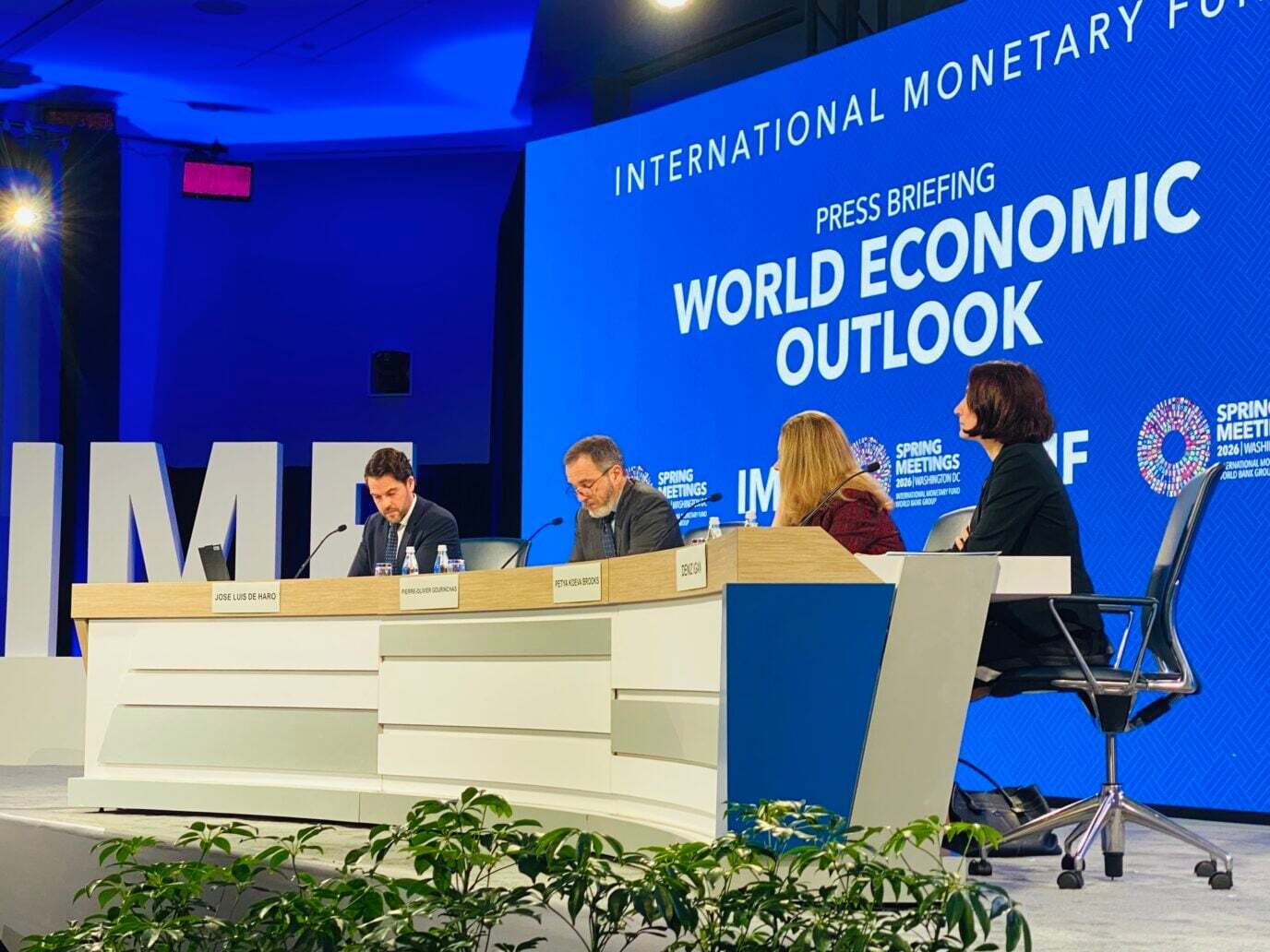
Speaking during a media briefing, IMF official, Deniz Igan, attributed Nigeria’s 2026 downgrade to external pressures, particularly rising costs linked to global conflicts.
“We have revised Nigerian growth by 0.3 percentage point to 4.1 per cent in 2026, reflecting a balance of two forces,” she said.
“One is that war-related higher fuel and fertiliser prices and higher shipping costs are going to weigh on oil activity in Nigeria.”
She added that while higher oil prices may provide some relief, the overall impact would slow growth in the short term before recovery in 2027.
On inflation, the IMF stressed the need for tight monetary policy, noting that exchange rate movements and inflation expectations must be closely monitored.
Nigeria’s apex bank had earlier outlined plans to reduce inflation to a single-digit range of between six and nine per cent under a medium-term framework.
Globally, the IMF said growth would slow to 3.1 per cent in 2026 and 3.2 per cent in 2027, down from about 3.4 per cent recorded in 2024 and 2025.
The fund attributed the slowdown largely to disruptions caused by the Middle East conflict, which has pushed up energy and commodity prices.
Igan noted that sub-Saharan Africa, despite recording strong performance in 2025, is now facing fresh headwinds.
These include weaker commodity prices, declining foreign aid, and worsening trade conditions for oil-importing countries.
She said, “We have a downgrade on growth by 0.4 percentage point cumulatively for 2026 and 2027.”
The IMF also warned that inflation in the region could rise from 3.4 per cent in 2025 to 5 per cent in 2026, driven by high fuel and fertiliser costs as well as persistent shortages.
Meanwhile, the IMF Chief Economist, Pierre-Olivier Gourinchas, said the fund is working with global partners to monitor energy market developments.
He called for an immediate end to hostilities in the Middle East to stabilise global markets.
“We’re calling for a very swift end to the hostilities and normalisation in energy markets,” he said.
The International Energy Agency had earlier warned that prolonged conflict and disruption in key oil routes could worsen economic conditions for many countries.