

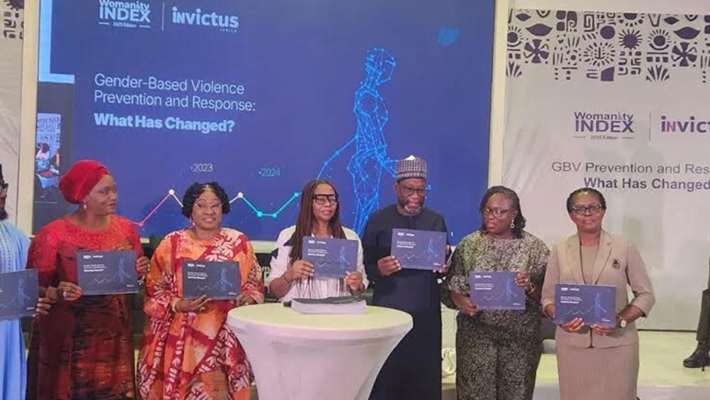
The 2025 Womanity Index report (WIR) has revealed that on the average, Nigeria spent N365 on each woman and girl for preventing and responding to gender-based violence (GBV) in 2024.
The 2025 WIR, an annual, data-driven report in its third edition, was undertaken by Invictus Africa, an NGO, and was unveiled on Tuesday in Abuja.
It measures state governments’ performances in preventing and responding to GBV.
The report is to assess state governments’ efforts across five core indicators: laws and policies, access to legal justice, support services, information and awareness, and budget and spending.
Bukky Shonibare, executive director, Invictus Africa, described the amount as grossly inadequate to address the scale of violence affecting women and girls nationwide.
She said, ”On average, Nigeria spent only N365.60 on each woman or girl for GBV prevention and response in 2024.
“This is a small rise from N310.89 in 2023 and N213.27 in 2022.
“Akwa Ibom recorded the highest per capita spending at N1,872.18, followed by Bayelsa at N1,716.00. The lowest was in Rivers at N34.41 and Anambra at N46.42.”
Ms Shonibare said that declining budget performance, weak spending, and minimal allocations to state ministries of women affairs contribute to reduced awareness, weaker support services, and limited access to justice for survivors.
”We saw an improvement in the number of people who are willing to testify as witnesses or who know someone who has been convicted of cases.
“However, when we come to issues around budget and spending, they are now a big problem.
”In terms of budget and spending, across Nigeria, the average percentage of allocation to the Ministry of Women’s Affairs is 0.6 per cent,” she said.
Ms Shonibare said that the implication was that there are states where all they have allocated to the ministry of women affairs is just 0.1 per cent of their total budget.
”Only Borno State allocated 2.3 per cent of its 2024 total budget to its women affairs ministry,” she said.
While the number of states providing GBV-specific budget lines increased from 25 in 2023 to 31 in the 2024 budget, she said that allocation alone was not enough.
“The problem is not the allocation. The problem is the release and the spending. It is not enough for you to just allocate. What is important is that you are spending.
”The implication of that is that when we do not have enough money to spend or release, there will be less awareness of GBV laws and policies.
“There will be fewer people who are willing to come out to serve as witnesses simply because we do not have robust witness protection programmes in states,” she said.
Ms Shonibare said that many states still lacked Sexual Assault Referral Centres, adding that where they exist, they are mostly run by NGOs or supported by donor funding.
She urged the federal and state governments to introduce specific GBV budget lines, ensure that funds are released on time, and guarantee that expenditure is tracked and used for its intended purpose.
“There is no point spending money on campaigns every 16 Days of Activism, and nothing happens thereafter.
”The government should budget more and spend more, but also but make sure that spending is tracked and used for its intended purpose,” she said.
Chichi Aniagolu-Okoye, regional director for West Africa at the Ford Foundation, urged states to rely on accurate data and increase domestic funding to tackle GBV effectively.
“Data tells you the magnitude, the nature, the extent, and the type of problem.
“Many times, we are making policies without really understanding these details, which is why the Womanity Index is extremely important.
“It provides very granular information, state-level and local government-level, showing how each state is progressing and what impact their GBV budgets are having,” she said.
She said that consistent local funding, guided by accurate data, was essential for reducing GBV to the barest minimum across Nigeria.
“If states are serious about addressing GBV, the allocation does not have to break the bank.
“Donors have been doing it, and the money is not that much. The state governments must take more responsibility,” she said.
Bisi Adeleye-Fayemi, co-founder of the Amandla Institute for Policy and Leadership Advancement and former first lady of Ekiti State, stressed the need for collective action to end GBV.
”Every single one of us has a role to play. Whether we are policymakers, legislators, community leaders, faith leaders, researchers or youth leaders.
“Whatever position we occupy, there is something we can do because this affects all of us,” she said.
Dapo Oyewole, senior special assistant on international cooperation to President Bola Tinubu, said that evidence-based insights were essential for strengthening institutions, improving accountability, and ensuring that every survivor receives timely, life-saving support.
Mr Oyewole is also the pioneer secretary-general of the Conference of Speakers and Presidents of African Union Legislatures.
He urged the government and the societies to rise to the challenge.
”As Invictus Africa and its partners have shown, progress does not happen by accident but through deliberate, evidence-driven, and survivor-centred investments in our institutions,” he said.
Hauwa Samuel Jugbo, Nasarawa State commissioner for women’s affairs, said that low state budgets kept women trapped in violent households.
According to her, without shelters, safe spaces or funded legal pathways, survivors have nowhere to go.
“When a state does not invest in GBV response, the home becomes a prison,” he said.
The data was from 40,111 survey respondents across 399 of the 774 local government areas.
There were also 321 interviews with government officials, service providers, and GBV stakeholders, complemented by reviews of policy documents and budget data.
It revealed that three in five Nigerians (59 per cent) have either experienced GBV themselves or know someone who has. It also shows that eight states report rates above 70 per cent
The states are Lagos (99 per cent), Kwara (96 per cent), Plateau (89 per cent), Enugu (85 per cent), Zamfara (83 per cent), Nasarawa (76 per cent), Ogun (74 per cent), and Sokoto (73 per cent).
(NAN)