

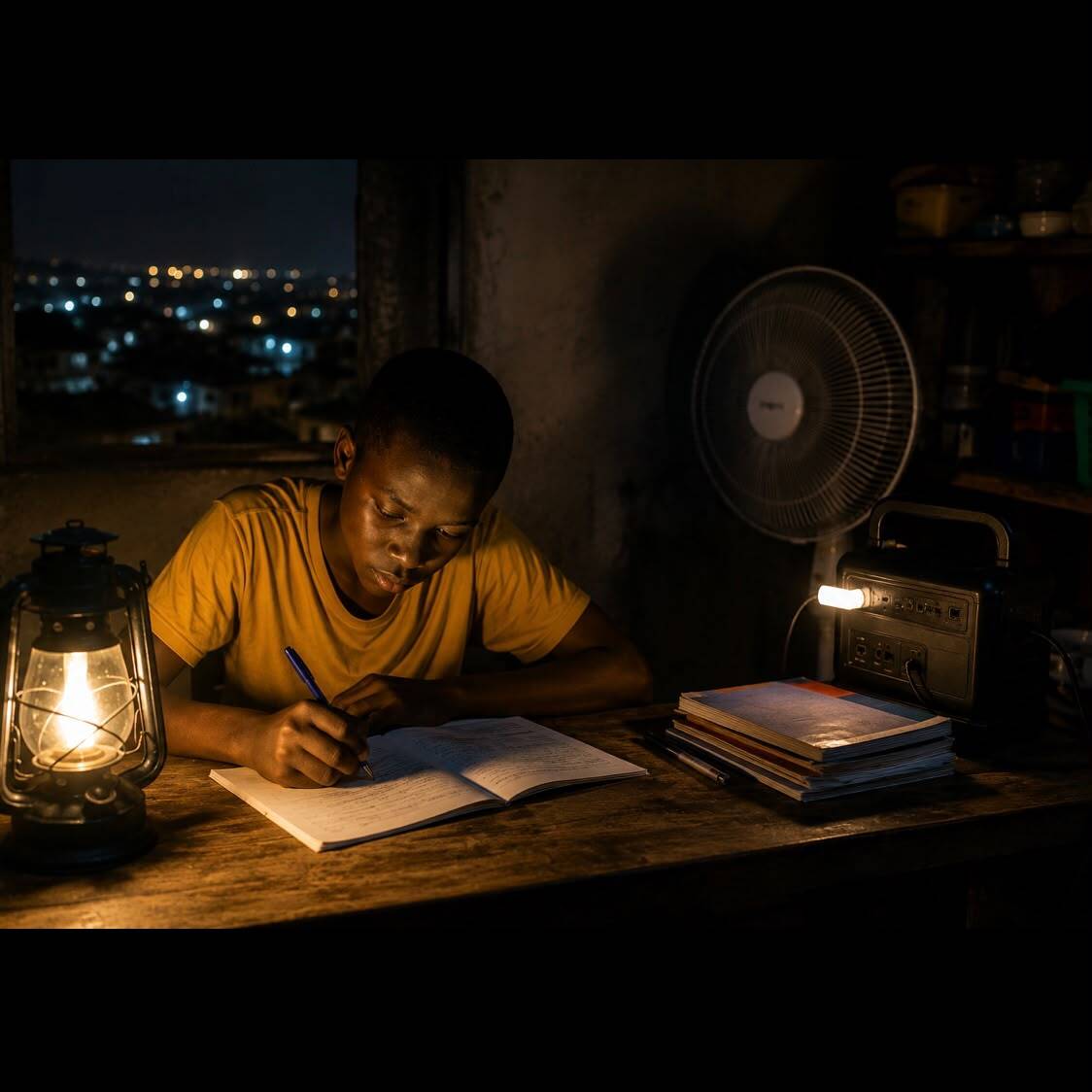
As power outages persist nationwide, millions of Nigerian households and businesses are investing in solar systems, inverters and other alternatives — quietly building a life beyond the national grid.
By Fatima Mohammed
Electricity is one of the most basic services expected of any modern society. It powers homes, keeps businesses running, supports healthcare, enables learning and drives economic activity. Yet for millions of Nigerians, reliable electricity has become increasingly uncertain.
Instead of planning their daily lives around a dependable public power supply, many households now organise their routines around blackouts. Phones are charged whenever electricity suddenly returns, businesses rush to complete tasks before another outage, and many families have accepted that darkness is no longer an occasional inconvenience but part of everyday life.
Across the country, a quiet transformation is under way. Solar panels now sit on rooftops that once carried only television antennas. Inverters have become common household appliances, while rechargeable lamps, batteries and portable power stations are increasingly replacing candles and kerosene lanterns.
According to the Nigerian Electricity Regulatory Commission (NERC), average electricity generation on the national grid improved during the first quarter of 2025 to about 4,770 megawatt-hours per hour, yet the sector continues to face operational and infrastructure challenges affecting supply across the country.
A FAMILY’S QUIET SWITCH
For Amina Ibrahim, a resident of Maiduguri, investing in solar power was never part of the family’s original plan. Like many households, they spent years adjusting daily activities to irregular electricity supply — chores depended on when power happened to be available, water was pumped only during brief supply windows, and evenings were often spent waiting for electricity that sometimes never came.
“We kept waiting for electricity that hardly came. After some time, we realised we had to find another solution.” — Amina Ibrahim, Maiduguri resident
Eventually, the family installed a modest solar system. Today, electricity in their home depends less on the national grid and more on sunlight captured during the day. Her experience is becoming increasingly common — for many households, the switch to solar is no longer driven by convenience but by necessity.
BUSINESS OWNERS FEEL THE STRAIN
The same reality is unfolding among small businesses. For Amina Yusuf Abdullahi, who sells soft drinks in Maiduguri, electricity determines whether her products remain cold enough for customers. Prolonged outages often force her to spend more on alternative power sources to prevent losses.
“I just want stable electricity,” she said. “Whether it comes from the government or another reliable source, what matters is being able to keep my business running.” Her experience reflects the challenges facing thousands of small business owners whose daily income depends on reliable power.
SOLAR DEMAND SURGES
The growing demand has also transformed the solar installation business. Obinna Michael, a solar installer based in Maiduguri, said interest in solar systems has increased significantly over the past few years, with more households, schools, offices and small businesses making enquiries than ever before.
Although many customers initially worry about the high installation cost, he said they often change their minds after comparing it with what they spend on fuel, generator repairs and other recurring electricity expenses. For many Nigerians, solar is no longer a luxury but an investment in peace of mind.
‘A COMPLEMENT, NOT A SUBSTITUTE’
According to Engr Stephen James Yarakuwa, Regional Operations Manager of the Yola Electricity Distribution Company (YEDC), Maiduguri District, solar energy should be seen as a complement to public electricity rather than a substitute for it. He said the national grid remains the backbone of power distribution, especially for industries, hospitals, schools and large commercial centres requiring stable, large-scale supply.
“The government should continue investing in power infrastructure, strengthen transmission and distribution networks, and create policies that encourage greater investment in the power sector,” he said, while urging households and businesses to use electricity efficiently and support the sector through prompt payment of bills.
A WIDENING GAP
For families who can afford the initial cost, solar and inverters offer greater stability and peace of mind. For many others, the high cost of installation remains a major obstacle, leaving them to continue relying on an electricity supply they cannot predict — a gap creating a new reality where access to reliable power increasingly depends on personal income rather than public infrastructure.
For businesses, the impact goes beyond convenience. Reliable electricity determines productivity, profitability and even survival: a tailor cannot sew without power, a cold-room operator cannot preserve food, a barber cannot serve customers, and students preparing for examinations cannot always study comfortably after dark.
As households and businesses continue to adapt, Nigeria’s electricity story is becoming less about waiting for power and more about finding ways to generate it independently. Yet the growing popularity of solar tells two stories at once — one of resilience and innovation, and a quiet reminder that adaptation should not replace accountability. Millions of Nigerians continue to look forward to a future where reliable electricity from the national grid is no longer the exception, but the standard.