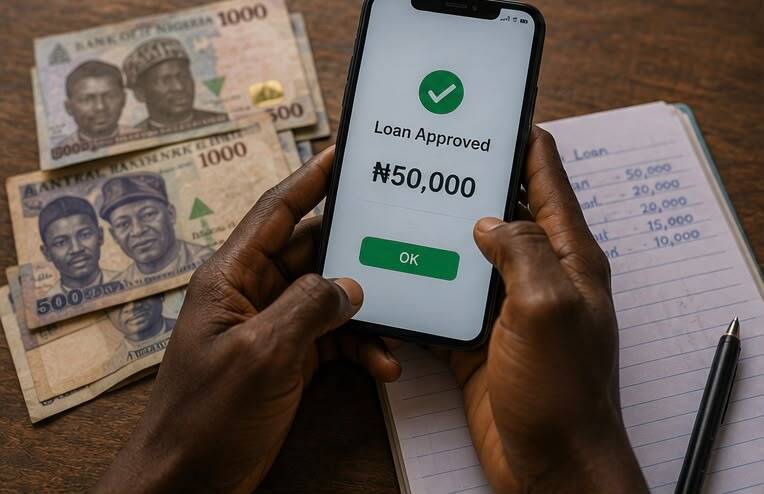
With just a few taps on a mobile phone, young Nigerians can access instant loans without collateral or paperwork. But behind that convenience lies a growing reality: quick credit is fast becoming a road into debt, anxiety and financial dependence.
By Fatima Mohammed
For Joseph Yusuf, what began as an attempt to solve a financial problem ended in one of the most difficult experiences of his life. As a student, Joseph obtained an instant loan through a digital lending platform, convinced he could repay it within a short period. Rather than using the money for an emergency or a productive investment, he hoped to multiply it through sports betting.
The plan failed. Believing a second attempt would help him recover his losses, he used his school fees to place another bet. He lost again. Within weeks, Joseph had exhausted both the borrowed money and the funds meant for his education. Unable to repay the loan, he came under intense pressure as debt recovery efforts began — and what he thought would remain a private mistake soon became known to members of his family.
“I thought borrowing would solve my problem quickly. Instead, it created even bigger problems for me. There are no shortcuts to financial success. Hard work is always better than trying to make quick money.” — Joseph Yusuf
Joseph’s experience is not an isolated one. Across Nigeria, many young people are increasingly relying on digital loans to cope with financial pressures, only to discover that easy access to credit can quickly become difficult debt.
A JOB MARKET THAT CANNOT KEEP UP
Professor Tahiru Ibrahim, an economist, says the country’s labour market is producing far more graduates than available jobs. Every year, thousands complete their education, yet employment opportunities remain limited. While a university degree remains valuable, he said, it no longer guarantees employment — many graduates spend months or years searching for work, while others accept jobs that do not fully use their qualifications simply to survive.
For those without stable incomes, borrowing often becomes a way of paying rent, covering transportation, settling school fees or meeting everyday expenses. The challenge is that temporary borrowing can easily become a permanent cycle when income does not improve.
Human resource professional Mr Friday Chukwemeka agrees that the employment market has become increasingly competitive. He said employers now look beyond academic certificates, placing greater value on practical experience, communication skills, adaptability and professionalism — and that a single graduate vacancy can attract hundreds of applications, making it difficult for many qualified young people to secure employment quickly.
THE DEBT TRAP
Financial experts say borrowing itself is not the problem — the danger lies in borrowing without a realistic plan for repayment. As digital lending platforms continue to expand, many young borrowers find themselves taking new loans to repay existing ones. Interest charges accumulate, repayment deadlines become harder to meet, and financial pressure steadily increases.
For some, the burden extends beyond money. Debt can affect emotional well-being, strain family relationships and reduce productivity at work or school. The fear of default, constant reminders and financial uncertainty can leave borrowers feeling trapped.
According to recent data from the National Bureau of Statistics, unemployment and underemployment remain significant challenges among young Nigerians, while inflation and the rising cost of living continue to place additional pressure on household incomes. In such an environment, access to easy credit often becomes a coping mechanism rather than a carefully planned financial decision.
BEYOND RESPONSIBLE BORROWING
Many financial analysts caution that borrowing cannot replace sustainable income. Without stable employment or reliable earnings, loans intended to provide temporary relief may instead deepen financial hardship. Experts believe addressing the growing dependence on easy loans requires more than encouraging young people to borrow responsibly.
Professor Ibrahim argues that creating more employment opportunities remains one of the most effective ways of reducing financial vulnerability among young people, giving individuals the ability to earn, save and plan for the future without relying heavily on borrowed money. Mr Chukwemeka also encourages graduates to continue developing practical skills, gain experience through internships and volunteering, and remain open to entry-level opportunities that can build long-term careers.
Financial literacy is equally important, experts say. Young people need a better understanding of responsible borrowing, budgeting and debt management before taking loans, particularly through digital platforms where access to money is almost immediate. Stakeholders also want regulators to strengthen consumer protection, ensuring digital lending practices remain fair, transparent and respectful of borrowers’ rights.
Used responsibly, easy loans can help families overcome temporary financial difficulties, support small businesses and provide emergency assistance. But when borrowing becomes the only way to survive, it signals a deeper economic problem. For many young Nigerians, the real challenge is no longer how quickly they can access a loan, but how quickly they can build a life where borrowing is no longer necessary.
Until more decent jobs are created, financial education is strengthened and young people have greater economic opportunities, many will continue borrowing from tomorrow simply to survive today. And for some, tomorrow may arrive carrying a debt far heavier than they ever imagined.
Fatima Mohammed writes this from Maiduguri