

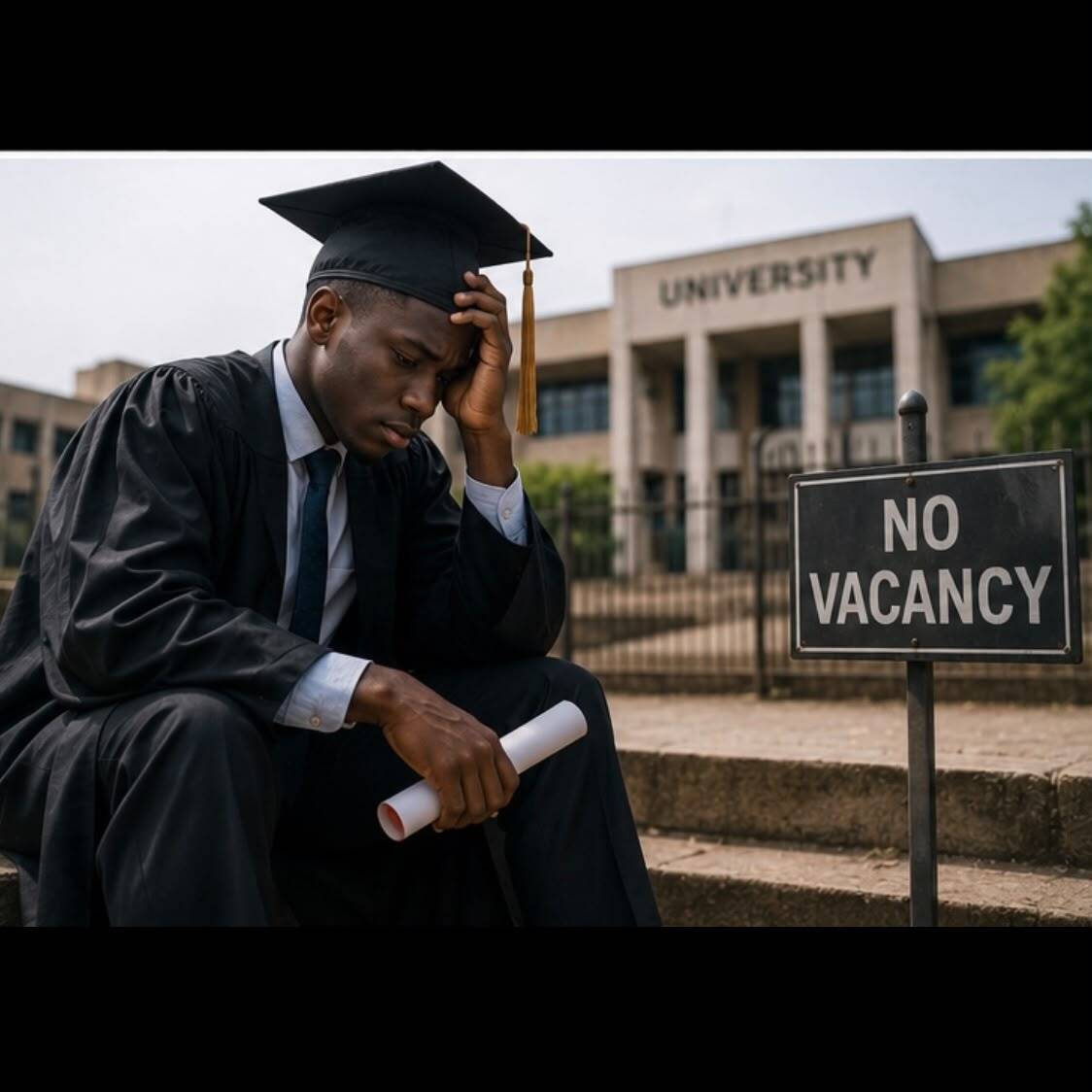
Four years after graduating with a Second Class Upper in Mass Communication, Musa Maina now earns a living as an OPay agent, a reality that mirrors the struggle of thousands of qualified Nigerian graduates searching for meaningful work.
When Musa Maina graduated from the University of Maiduguri four years ago, few doubted that success would come quickly.
Inside the Mass Communication department’s radio and television studios, he was known for his confidence behind the microphone, his ease anchoring programmes and reading news, and his skill operating broadcast equipment. To lecturers and classmates alike, he looked like someone already prepared for the newsroom.
He graduated with a Second Class Upper, one of the highest classifications awarded in the department. Those who knew him believed his transition from classroom to workplace would be smooth. That future never arrived. Months passed without a job offer. Then one year, and eventually four, slipped by.
Today, instead of writing news stories or presenting radio programmes, Musa spends his days moving from one location to another as an OPay agent, helping customers open accounts and complete financial transactions. “I never thought life after graduation would be this difficult,” Musa said. “I believed that if I worked hard in school and graduated with a good result, getting a job would only be a matter of time.”
Like many young Nigerians, he submitted application after application, hoping each would bring the breakthrough he had worked so hard for. Some received no response; others ended in unsuccessful interviews. As months turned into years, hope gave way to the reality that survival could no longer wait.
“I had to do something,” he said. “Waiting at home was no longer an option. This may not be the profession I studied for, but it helps me earn a living while I continue searching for better opportunities.”
For Musa, becoming an OPay agent was never the dream. It became the alternative a choice increasingly forced on Nigerian graduates by limited employment opportunities and rising living costs.
Thousands are accepting jobs outside their fields of study not because they have abandoned their ambitions, but because they cannot afford to remain unemployed.
Musa’s story is personal, but far from unique. Every year, Nigerian universities and other tertiary institutions produce thousands of graduates carrying hopes of launching meaningful careers after years of lectures, examinations and practical training. Increasingly, that expectation collides with a difficult labour market.
According to the National Bureau of Statistics’ Labour Force Survey, unemployment among Nigerians with post-secondary education stood at 9.0 per cent in the first quarter of 2024, while time-related underemployment was estimated at 10.6 per cent. The report also found that 14.4 per cent of young Nigerians aged 15 to 24 were not in education, employment or training.
Economists describe such situations as underemployment where people are employed but unable to make full use of their education, skills or earning potential. Across the country, graduates trained as teachers, engineers, journalists, accountants and scientists are increasingly taking jobs outside their professions, not for lack of ability but for lack of opportunity.
Prof. Tahiru Ibrahim of the Department of Economics, University of Maiduguri, said one of the biggest challenges is that the economy is not creating jobs fast enough to absorb the thousands of graduates entering the labour market annually.
“The number of graduates keeps increasing every year,” he explained, “but the number of available jobs has not grown at the same pace. As a result, many qualified candidates compete for very few vacancies.”
He added that inflation, slow business growth and uncertainty in the private sector have forced many organisations to reduce hiring or postpone expansion plans, contributing to a rise in underemployment. While a university degree remains important, he argued that today’s labour market increasingly rewards graduates who combine academic qualifications with practical skills, relevant experience and a willingness to adapt.
Beyond the shortage of jobs, employers say many graduates leave university with strong academic records but struggle to demonstrate practical workplace skills. Mr Friday Chukwemeka, a Human Resources Officer at Guaranty Trust Bank (GTBank), Maiduguri, said employers now weigh communication skills, critical thinking, professionalism, adaptability and problem-solving heavily in recruitment decisions. “A degree may help you get shortlisted,” he said, “but it does not automatically get you the job.”
He said a single vacancy can attract several hundred applications, forcing employers to become highly selective. “When we advertise graduate positions, it is not unusual to receive hundreds of applications for a single opening,” he explained. “In that situation, employers naturally look beyond academic results. They want candidates who can demonstrate practical experience, confidence and the ability to contribute from the first day.”
He added that many graduates underestimate the importance of interview preparation and tailoring their CVs to specific roles.
Not every graduate has struggled. Yasir Abdullahi Isa, a Mass Communication graduate who now works at Al-Ansar Radio, began building his career while still a student, volunteering at the station after lectures and taking freelance media jobs to strengthen his portfolio.
“I didn’t wait until I graduated before learning the practical side of the profession,” he said. “The experience I gained while I was still in school gave me confidence and prepared me for opportunities when they came.”
Balancing academics with volunteering was not easy, he admitted, but he viewed the sacrifice as an investment. He now encourages undergraduates not to postpone learning until after graduation. “Your degree is important,” he said, “but experience, skills and a willingness to keep learning can help you stand out.”
His journey does not guarantee every volunteering graduate will find work, but it illustrates how practical experience can improve a graduate’s chances in a competitive market. His story stands in quiet contrast to Musa’s two men, one discipline, two very different outcomes.
For many families, sending a child to university represents one of the biggest investments they will ever make. When years of study end in unemployment or underemployment, the disappointment extends beyond the graduate to become a burden shared by entire families.
Experts insist the solution cannot rest on graduates alone. While young people must continue developing practical skills through internships, volunteering and lifelong learning, broader economic reforms are needed to stimulate investment, encourage entrepreneurship and create sustainable jobs for the growing number of graduates entering the market each year.
For Musa, hope has not disappeared. He still applies for vacancies whenever they arise, still believing the education he worked hard to obtain will one day open the door to the career he dreamed of.
“Until then, he continues to work,” not because it is the destination he envisioned, but because life cannot be put on hold while waiting for employment. His resilience reflects the determination of many young Nigerians who refuse to give up despite repeated setbacks.
As Nigeria continues to discuss education, youth development and economic growth, the more pressing question may no longer be how many students graduate each year, but what happens after the graduation gown is folded away. A university degree should represent the beginning of opportunity, not the beginning of uncertainty.
By Abigail Ijapari Ijai and Fatima Muhammed, 300 level Mass Communication Student, University of Maiduguri.