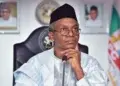


President Bola Tinubu has presented a budget proposal of ₦58.18 trillion for the 2026 fiscal year to a joint session of the National Assembly, with capital recurrent (non-debt) expenditure set at ₦15.25 trillion.
The proposal, unveiled on Friday, allocates ₦26.08 trillion for capital expenditure and sets a crude oil benchmark at US$64.85 per barrel.
Tinubu indicated that the anticipated total revenue is ₦34.33 trillion, with ₦15.52 trillion earmarked for debt servicing. The budget deficit stands at ₦23.85 trillion, representing 4.28% of GDP.
This proposal is based on a projected crude oil production of 1.84 million barrels per day, and an exchange rate of ₦1,400 to the US Dollar for the upcoming fiscal year.
#### ‘National Priorities’
In terms of sectoral allocation, defence and security receive the largest share at ₦5.41 trillion, followed by infrastructure at ₦3.56 trillion. Education is allocated ₦3.52 trillion, while health receives ₦2.48 trillion, under the proposal titled “Budget of Consolidation, Renewed Resilience and Shared Prosperity.”
Addressing lawmakers, the former governor of Lagos State described the budget proposal as more than mere “accounting lines.”
“They are a statement of national priorities,” the president declared. “We remain firmly committed to fiscal sustainability, debt transparency, and value-for-money spending.”
He reiterated, “Expected total revenue is ₦34.33 trillion; projected total expenditure is ₦58.18 trillion, including ₦15.52 trillion for debt servicing; recurrent non-debt expenditure is ₦15.25 trillion; capital expenditure will be ₦26.08 trillion.”
#### A Commitment to Security
The presentation comes amid rising insecurity in various parts of the country, with mass abductions and other crimes dominating the headlines.
Outlining his government’s plan to tackle these challenges, Tinubu, aged 73, reminded attendees that security “remains the foundation of development.”
He highlighted measures to enhance security, including modernising the Armed Forces, adopting intelligence-driven policing, and implementing joint operations, border security, and technology-enabled surveillance alongside community-based peacebuilding and conflict prevention.
“We will invest in security with clear accountability for outcomes—because security spending must yield security results,” the president, who assumed office in 2023, stated.
“To secure our country, our priority will continue to be increasing the fighting capability of our armed forces and other security agencies by boosting personnel and procuring advanced platforms and equipment.”
Since taking office in May 2023, President Tinubu has removed fuel subsidies, resulting in increased costs for this essential item. His administration also floated the naira, actions that contributed to a rise in inflation.
However, the president believes the economy has stabilised over the past two years, assuring Nigerians that better days are on the horizon.
“I acknowledge these difficulties plainly, and I assure Nigerians that their sacrifices are not in vain,” he said. “The path of reform is seldom smooth, but it is the surest route to lasting stability and shared prosperity.”
Tinubu committed to investing in critical infrastructure and ensuring food security in Nigeria, which he described as “strategic investments that unlock private capital.”
“We will take decisive steps to strengthen agricultural markets. Food security is national security,” the president emphasised.
“The 2026 Budget prioritises input financing and mechanisation; irrigation and climate-resilient agriculture; storage and processing; and agro-value chains.”
Through these measures, Tinubu aims to reduce post-harvest losses, improve incomes for smallholders, deepen agro-industrialisation, and foster a more resilient, diversified economy.