
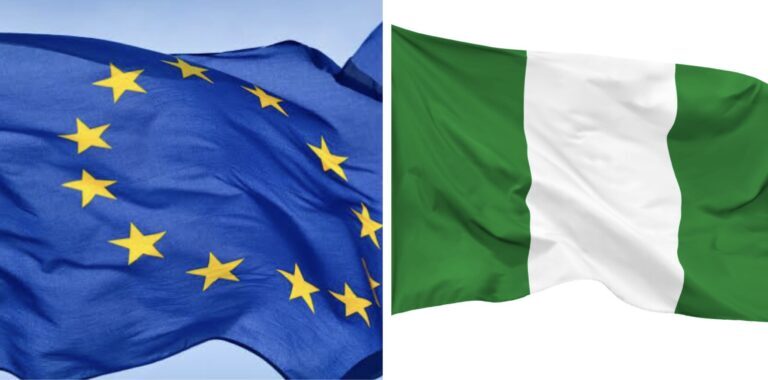
The federal government and the European Union (EU) are collaborating to improve food security and food systems in Nigeria through climate-smart technologies.
The Minister of State for Agriculture and Food Security, Aliyu Abdullahi, stated this at the unveiling of the EU–Nigeria Twinning Project on Wednesday in Abuja.
The project is part of the European Union’s support for improving food security and food systems, using climate-smart technologies for enhanced value chain development in Nigeria.
Mr Abdullahi said the project represented another important milestone in the long-standing cooperation between Nigeria and the EU.
He said that agriculture remains the backbone of Nigeria’s economy and a critical pillar for national development.
“The sector employs a large proportion of our population and plays a central role in ensuring food security, poverty reduction, and economic growth.
“However, like many countries around the world, Nigeria’s agricultural sector faces increasing challenges arising from climate change. Variability in rainfall patterns, droughts, floods, land degradation, and emerging pests and diseases are affecting agricultural productivity and threatening the livelihoods of farmers.
“It is therefore imperative that we strengthen our agricultural systems to become more resilient, productive, and sustainable. This is where climate-smart agriculture becomes extremely important,” he said.
He explained that climate-smart agriculture is not only about responding to climate change but also about transforming agriculture to ensure that farmers can increase productivity while protecting the environment and adapting to changing climatic conditions.
He said that under the leadership of President Bola Tinubu, the federal government had placed food security at the top of its national priorities under the Renewed Hope Agenda.
“Agriculture has been identified as a strategic sector for economic diversification, job creation, and national stability.
“In line with this commitment, the Federal Ministry of Agriculture and Food Security is implementing a range of reforms and programmes designed to boost food production while strengthening resilience to climate change,” he said.
Mr Abdullahi said the ministry continues to advance the National Agricultural Resilience Framework, which provides strategic guidance for promoting climate-resilient agriculture across the country.
“The Twinning Project being inaugurated today aligns perfectly with these national priorities. Through this initiative, Nigeria will benefit from valuable technical expertise and knowledge exchange with European partners,” he said.
He said that Nigeria was actively working to strengthen its agricultural systems in response to emerging challenges, particularly those posed by climate change.
He stated, “We will continue to work closely with the European Union delegation and the consortium partners to ensure that the objectives of this initiative are achieved.”
In a goodwill message, Ambassador and Head of Delegation of the EU to Nigeria and ECOWAS, Gautier Mignot, said the twinning project was timely.
He said that agriculture remains central to Nigeria’s food systems.
In a presentation, Deputy Director, State Plant Protection Service of LATVIA (SPPS), Vents Ezers, said that the partnership with Nigeria was strategic.
Mr Ezers said that the initiative would support farmers’ resilience and create a pathway for mainstreaming climate-smart agriculture across Nigeria’s agricultural and food system.
He said that Nigeria was facing challenges such as climate change, adding that climate-smart agriculture would help Nigeria become climate-resilient.
Earlier, Director, Planning and Policy Coordination Department, Ministry of Agriculture, Ibrahim Tanimu, said the initiative came at a very crucial time, as Nigeria was working actively to strengthen its agricultural systems in response to emerging challenges.
(NAN)