By Ankeli Emmanuel, Sokoto
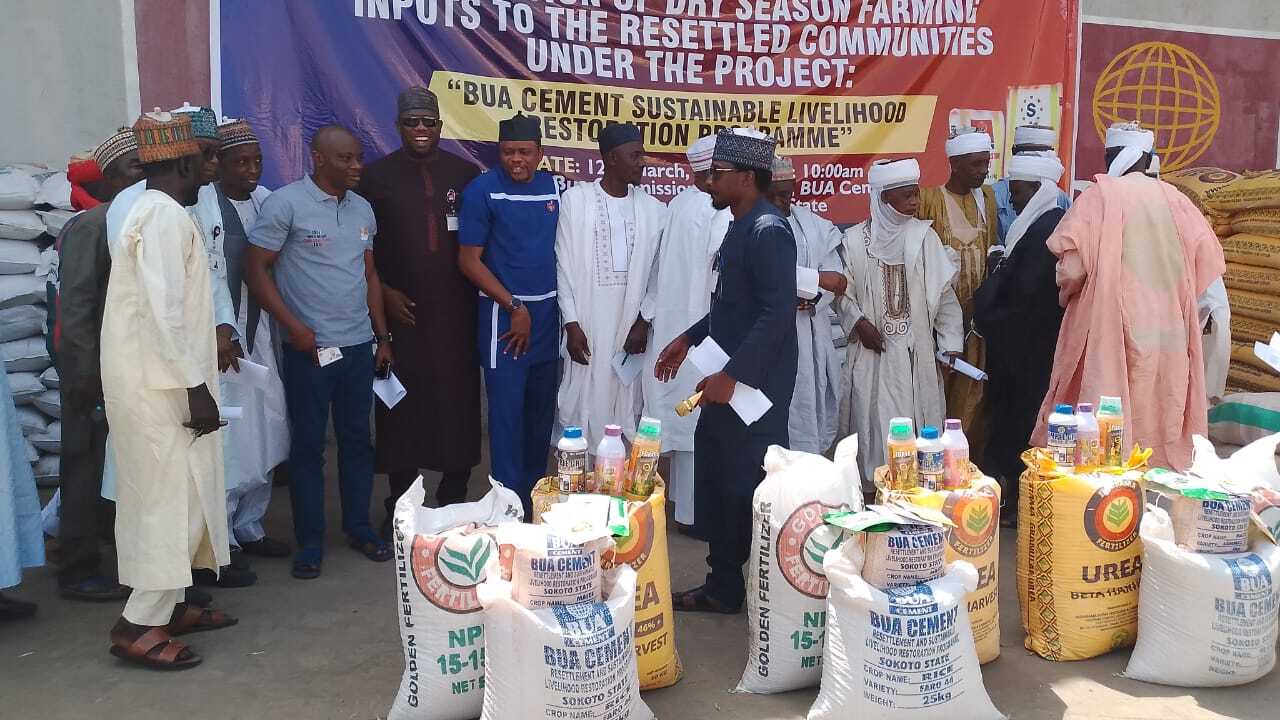
In a significant move to bolster food security and restore livelihoods, BUA Cement Plc has launched the distribution of dry season farming inputs to no fewer than 300 farmers from resettled communities in Sokoto State. The initiative, which took place on Thursday under the company’s Sustainable Livelihood Restoration Programme, is designed to empower individuals and families who were relocated from their ancestral lands to pave the way for industrial expansion.
The event, which drew commendation from beneficiaries and community leaders alike, underscores BUA Cement’s commitment to ensuring that displacement does not translate to destitution. Instead, the company has adopted a comprehensive model that seeks to improve the agricultural productivity and economic standing of affected farmers.
Restoring Livelihoods After Relocation
Addressing beneficiaries during the distribution exercise, the Chief Executive Officer and Managing Director of BUA Cement Plc, Engineer Yusuf Haliru Binji, articulated the rationale behind the intervention. He acknowledged that while industrial growth is essential for economic development, it must not come at the expense of the communities that host such enterprises.
“As you are aware, the expansion of our industrial operations, particularly our quarrying activities, sometimes necessitates the relocation of settlements to ensure safety and access to raw materials,” Engineer Binji explained. He noted that the company recognises the profound disruption that such relocation can cause to agrarian communities whose very existence depends on access to fertile land.
The Managing Director, who was represented at the event by the Assistant Director of Administration and Corporate Services, Alhaji Sada Suleiman, emphasised that BUA Cement’s responsibility does not end with the provision of alternative shelter. He stressed that the company is equally committed to ensuring that displaced farmers not only recover their means of earning a living but are also empowered to improve upon their previous economic status.
Bridging the Gap in Modern Agriculture
Engineer Binji highlighted the contemporary challenges confronting smallholder farmers in Nigeria, particularly those engaged in dry season farming. Access to quality seeds, affordable fertilisers, and appropriate farming tools remains a significant hurdle for many, limiting their capacity to maximise yields and achieve food security.
“We understand the challenges facing modern farmers, such as access to quality seeds, affordable fertilisers and the right tools, hence the resolution to step in and bridge that gap,” the Managing Director stated. He assured the 300 beneficiaries that the inputs provided have been carefully selected to meet the specific agronomic needs of the dry season farming cycle in Sokoto State.
The gesture is expected to enable the farmers to cultivate their new plots of land productively, ensuring that they can continue to provide for their families and contribute to the local economy despite their relocation from original settlements.
Five-Year Prosperity Plan Unveiled
In a significant revelation, Engineer Binji announced that BUA Cement has formalised its commitment to host communities through a structured five-year agreement spanning 2025 to 2030. This framework, which forms part of the company’s shared prosperity plans, is designed to provide predictable and sustainable support to communities affected by its operations.
The Managing Director listed the key pillars of this agreement, which extend well beyond agricultural support. They include structured assistance for healthcare delivery, scholarship programmes for indigenes, skills acquisition and vocational training initiatives, as well as the development of critical infrastructure such as roads and water supply systems.
This holistic approach, he explained, is intended to address the multifaceted needs of host communities and ensure that the benefits of industrial activity are widely shared among the population.
Commitment to Corporate Social Responsibility
Earlier in his welcome address, BUA’s Head of Department for Health, Community, Safety, and Environment (HCSE) reiterated the company’s unwavering dedication to its corporate social responsibility mandate. He noted that the Sustainable Livelihood Restoration Programme is a testament to BUA Cement’s recognition that its long-term success is inextricably linked to the well-being of the communities in which it operates.
The HCS E officer assured the gathering that the company would continue to prioritise initiatives that directly impact the lives of ordinary people, particularly those who have made sacrifices to accommodate industrial growth. He urged the beneficiaries to make optimal use of the inputs provided and to embrace modern farming techniques that can enhance their productivity.
Community Leaders Express Gratitude, Seek More
Responding on behalf of the benefiting communities, the District Head of Arkila (Ubandoman Arkila), Alhaji Aliyu Hassanan, expressed profound appreciation for BUA Cement’s sustained engagement with host communities. He noted that the company’s consistency in delivering on its promises has earned it the respect and goodwill of the local population.
“We are not surprised by BUA Cement Company’s continuous assistance to the host communities. They have demonstrated over the years that they are a responsible corporate citizen that values the relationship with its neighbours,” the royal father stated.
However, while commending the company for its agricultural support and other interventions, Alhaji Hassanan used the opportunity to advocate for greater inclusion of indigenes in the company’s workforce. He appealed to management to consider employing qualified individuals from host communities in substantive positions, rather than concentrating on engaging them merely as casual labourers.
“We pray for the continued progress of BUA Cement Company, but we appeal further that the company should try to employ qualified workforce from the host communities and not the usual concentration on engaging us as mere labourers,” the District Head appealed, highlighting a common concern regarding the quality of employment opportunities available to community members.
Local Government Chairman Commends Initiative
Lending his voice to the development, the Chairman of Wamakko Local Government Area, Honourable Farouk Dundaye, thanked BUA Cement on behalf of all beneficiaries. He described the agricultural input distribution as timely and strategic, particularly as farmers prepare for the dry season farming cycle.
The chairman assured the company of the local government’s continued support and cooperation, noting that such partnerships between the private sector and host communities are essential for sustainable development. He encouraged the beneficiaries to justify the company’s investment by working hard to achieve bountiful harvests.
The event concluded with the formal distribution of agricultural inputs to the 300 farmers, who expressed optimism about the prospects for the upcoming dry season farming activities. For BUA Cement, the exercise represents yet another milestone in its ongoing efforts to build a model of industrial development that is both profitable and socially responsible.
(NAN)