The Federal Government has set an ambitious target of securing over $50 billion in trade and investment agreements when Lagos hosts the fifth Intra-African Trade Fair (IATF) in November 2027, signalling Nigeria’s determination to cement its position as the continent’s economic powerhouse.
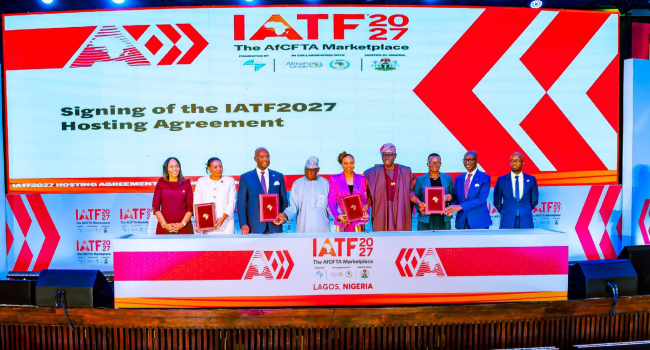
The projected deal value represents a significant increase from the $48.3 billion in agreements signed during the fourth edition of the fair, held in Algiers, Algeria, in September 2025. The announcement came during the signing of the IATF 2027 Hosting Agreement in Lagos on Monday, an event that formally confirmed Nigeria’s commitment to welcoming the continent’s premier trade gathering.
Nigeria’s Economic Renaissance Takes Centre Stage
Speaking at the ceremony, Minister of Industry, Trade and Investment, Dr Jumoke Oduwole, outlined the government’s vision for the event, emphasising its potential to transform Nigeria’s economic landscape while advancing continental integration.
“We’re expecting to host over 100,000 physical and virtual guests. We’re expecting to have over $50 billion worth of deals from IATF 2027,” the minister disclosed. “The IATF has made connections with the Caribbean and the diaspora, and we are positioning Nigeria to lead economically in this renaissance.”
The minister described the trade fair as a major platform for advancing the objectives of the African Continental Free Trade Area (AfCFTA), which aims to create a unified African market comprising 1.4 billion people with a combined gross domestic product of $3.4 trillion. By hosting the event, Nigeria seeks to leverage its large market size and entrepreneurial culture to drive intra-African trade and attract investment across multiple sectors.
Dr Oduwole added that the Federal Ministry of Industry, Trade and Investment is leading coordination efforts for the event, working with agencies such as the Nigerian Export Promotion Council (NEPC) and other stakeholders to ensure successful delivery. This whole-of-government approach reflects the priority the administration attaches to diversifying the economy away from oil dependence and expanding non-oil exports.
Building on Algiers Success
The fourth edition of the Intra-African Trade Fair, held in Algiers from September 4 to 10, 2025, set a high benchmark for its Lagos successor. The event recorded $48.3 billion in trade and investment deals, attracted more than 112,000 visitors—both physical and virtual—from 132 countries, and featured 958 buyers hosting 2,148 exhibitors from across Africa and beyond.
Algeria, as host nation, accounted for $11.4 billion of the deals signed, representing 23.6 per cent of the total—a testament to the economic benefits that accrue to host countries. The fair featured multiple activities, including trade exhibitions, a four-day trade and investment forum, the Creative Africa Nexus (CANEX) programme covering fashion, music, film, and arts, as well as the Africa Automotive Show. Business-to-business and business-to-government matchmaking sessions were also organised to promote partnerships and unlock new investment opportunities across the continent.
President and Chairman of the Board of Directors of Afreximbank, George Elombi, noted that the trade fair has generated an average of $40 billion in deals across its previous four editions. He said such success stories demonstrate the transformative power of the trade fair in creating partnerships, driving innovation, and improving Africa’s global economic image.
Strategic Implications for Nigeria
For Nigeria, hosting IATF 2027 represents more than a ceremonial gathering—it is a strategic opportunity to showcase the country’s economic potential to investors from across Africa and the diaspora. With the largest economy on the continent and a population exceeding 200 million, Nigeria offers a substantial market for goods and services, as well as a platform for manufacturing and re-export to other African countries.
The event comes at a crucial juncture for the Nigerian economy, which is undergoing significant reforms under the current administration. The removal of fuel subsidies, unification of exchange rates, and efforts to improve the business environment are all aimed at attracting investment and stimulating non-oil exports. The trade fair provides an opportunity to demonstrate the results of these reforms to a continental audience.
Sectoral opportunities abound. Nigeria’s creative industries—film, music, fashion, and arts—have already gained continental and global recognition, and the CANEX programme at IATF 2027 could further boost these sectors. The Africa Automotive Show also aligns with Nigeria’s efforts to develop local vehicle assembly and manufacturing, reducing dependence on imported vehicles while creating jobs.
Agriculture presents another significant opportunity. With vast arable land and a growing population, Nigeria has the potential to become a major food exporter within Africa, reducing the continent’s reliance on food imports from outside the region. The trade fair could facilitate partnerships that unlock this potential.
AfCFTA and Continental Integration
The IATF is inextricably linked to the AfCFTA, which entered into force in 2019 and aims to create a single continental market for goods and services. By reducing tariffs and non-tariff barriers, the agreement seeks to increase intra-African trade, which currently stands at approximately 15 per cent of total African trade—significantly lower than intra-regional trade in Europe, Asia, and the Americas.
The trade fair serves as a practical platform for businesses to explore opportunities under the AfCFTA, connecting buyers and sellers, investors and project promoters, across borders. The $50 billion target for IATF 2027 reflects growing confidence that the AfCFTA is beginning to deliver on its promise of boosting intra-African trade.
For Nigerian businesses, the AfCFTA offers access to a market of 1.4 billion people, but it also brings competition from other African countries. The trade fair provides an opportunity for Nigerian firms to understand the competitive landscape, identify partnerships, and position themselves for success in the continental market.
Diaspora Engagement and Global Connections
The minister’s reference to connections with the Caribbean and the diaspora highlights an important dimension of the IATF. Africa’s diaspora, estimated at over 150 million people, represents a significant source of investment, skills, and market access. The Caribbean, with its large population of African descent, has been designated as the sixth region of the African Union, reflecting the continent’s commitment to engaging with its diaspora.
By facilitating connections between African businesses and diaspora entrepreneurs, the IATF aims to channel diaspora resources toward African development. This could include investments in startups, partnerships with established firms, and trade links that give African products access to Caribbean and other diaspora markets.
Preparation and Coordination
With nearly two years until the event, the Federal Government has begun preparations in earnest. The Ministry of Industry, Trade and Investment is leading coordination efforts, working with the Nigerian Export Promotion Council, the Nigerian Investment Promotion Commission, and other agencies to ensure seamless organisation.
Private sector engagement will be crucial to the success of IATF 2027. Manufacturing associations, chambers of commerce, and industry groups are expected to play active roles in mobilising businesses to participate in the fair. The target of over 100,000 attendees, both physical and virtual, requires extensive marketing and outreach across Nigeria and the continent.
Infrastructure preparation is also essential. Lagos, as host city, must ensure that venues, transportation, and accommodation facilities can accommodate the influx of visitors. The event provides an impetus for improvements that could benefit residents and businesses long after the fair concludes.
Looking Ahead
President Elombi expressed confidence that the Lagos edition in 2027 could exceed the $50 billion target and create stronger economic linkages across Africa. His optimism reflects the trajectory of the IATF, which has grown steadily since its first edition in 2018.
For Nigeria, the stakes are high. Success could accelerate economic diversification, attract investment, and create jobs. Failure to meet expectations could undermine confidence in the country’s ability to host major international events and deliver on its economic promises.
The government’s target of over $50 billion in deals is ambitious but achievable, given Nigeria’s market size, entrepreneurial dynamism, and the growing interest in intra-African trade. As preparations intensify over the coming months, all eyes will be on Nigeria to deliver an IATF that advances not only its own economic interests but also the broader goal of African economic integration.
The countdown to November 2027 has begun. For Nigerian businesses, investors, and policymakers, the next two years present an opportunity to position the country as the undisputed hub of African commerce and trade.