
In a powerful message to mark International Women’s Day 2026, Princess Adejoke Orelope-Adefulire, the Senior Special Assistant to the President on Sustainable Development Goals (SSAP-SDGs), has called for a paradigm shift in how the nation values its female population. She insists that strategic investment in women and girls is not merely a matter of social justice, but the most effective lever for pulling Nigeria towards its sustainable development targets.
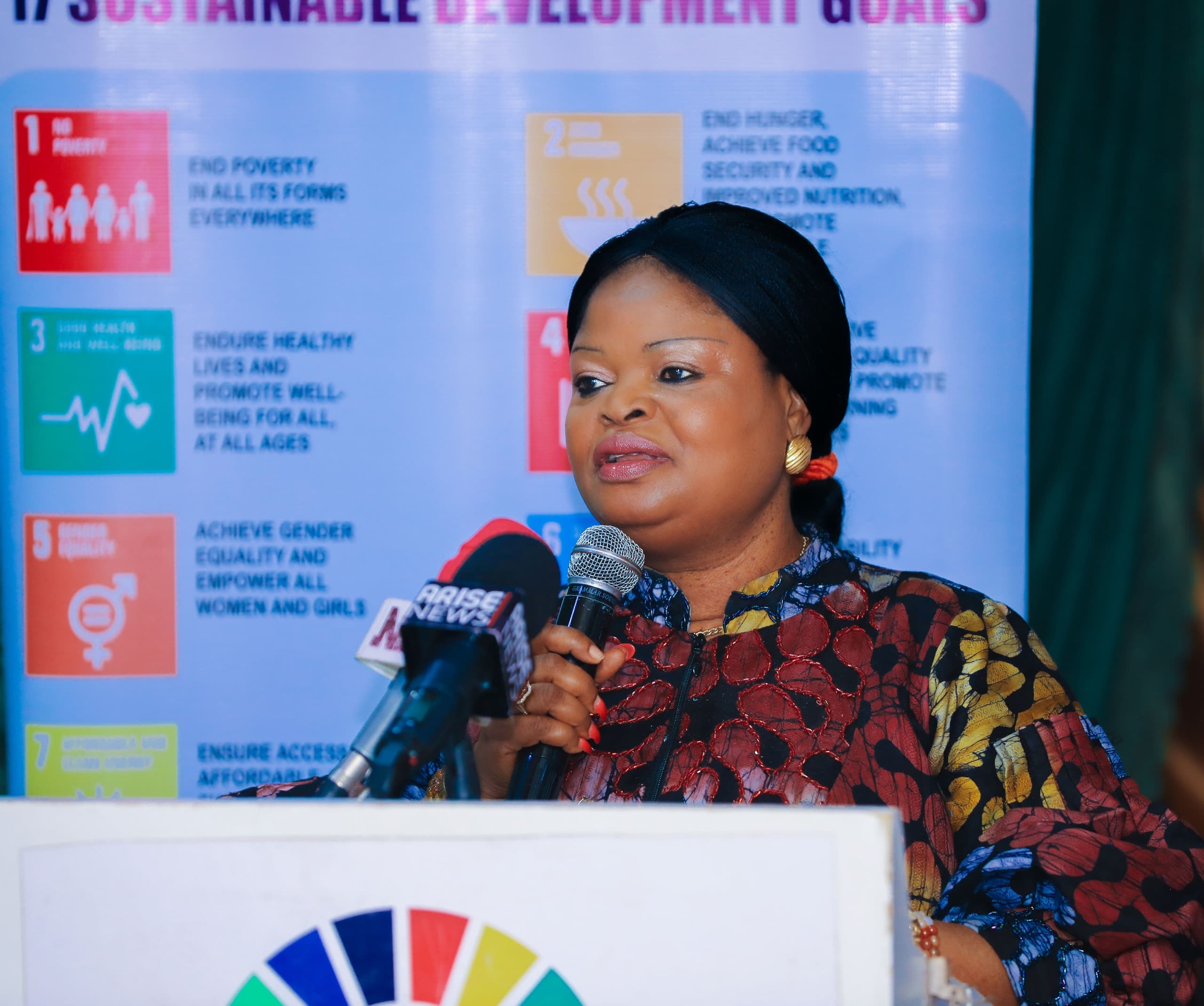
In a world still grappling with economic volatility and social inequality, the clarion call from the heart of Nigeria’s government is one of deliberate action. Speaking at an event in Abuja to commemorate the 2026 International Women’s Day (IWD), Princess Orelope-Adefulire stood as a formidable advocate for gender equality, framing it as the cornerstone of national progress.
This year’s global theme, “Give To Gain,” serves as a powerful antithesis to zero-sum thinking. It posits that resources channelled into the empowerment of women and girls are not expended, but rather invested, yielding exponential dividends for society at large. The presidential aide championed this ethos, urging governments, corporate bodies, and individuals to re-evaluate their commitment to fostering an environment where the female half of the population can flourish.
The SDG Multiplier Effect
Princess Orelope-Adefulire articulated a clear vision rooted in the 2030 Agenda for Sustainable Development. She noted that while the focus is often on SDG 5—which specifically targets gender equality and the empowerment of all women and girls—the impact of this goal permeates every other development objective.
“International Women’s Day serves as a vital checkpoint on our collective journey,” she stated. “It is a moment to reflect on the undeniable truth that empowering women and girls transcends moral obligation; it is a fundamental development imperative. The theme ‘Give To Gain’ captures the essence of sustainable economics. When you invest in a woman, you are not just supporting an individual; you are strengthening a family, stabilising a community, and building a nation.”
She elaborated on the multiplier effect, explaining that educated girls lead to healthier families and delayed marriages. Economically empowered women reinvest up to 90% of their income back into their households, funding better nutrition, healthcare, and education for their children. This creates a virtuous cycle that directly combats poverty (SDG 1), promotes good health and well-being (SDG 3), and ensures quality education (SDG 4).
Government’s Renewed Hope and Gender Inclusion
The SSAP-SDGs highlighted the current administration’s commitment under the Renewed Hope Agenda of President Bola Ahmed Tinubu. She pointed to a suite of policies and programmes deliberately designed to dismantle barriers and expand the horizons for Nigerian women.
“The Federal Government is acutely aware that inclusive growth is the only sustainable growth,” Princess Orelope-Adefulire explained. “Our approach to human capital development is intentionally gender-responsive. We are seeing increased representation in various sectors, from entrepreneurship and agriculture to governance and technology. These are not coincidences; they are the results of targeted interventions and social protection programmes aimed at uplifting our most vulnerable—who are often women and girls.”
She cited ongoing collaborations between the Office of the SSAP-SDGs and various line ministries, ensuring that gender perspectives are woven into the fabric of national policy, from budget allocations to programme implementation.
A Call for a Whole-of-Society Approach
While lauding governmental strides, the presidential aide was unequivocal that the task cannot rest on the shoulders of the public sector alone. She issued a passionate plea for a “whole-of-society approach,” urging the private sector, civil society organisations, development partners, and individual citizens to become active participants in this transformative project.
“Achieving the SDGs, and particularly gender equality, requires a symphony of effort,” she said. “Governments can set the stage and provide the resources, but the private sector holds the key to economic empowerment through fair hiring and supply chain inclusion. Civil society organisations are the foot soldiers on the ground, and our communities must challenge the cultural norms that hold girls back.”
She cited the ongoing work of her office in coordinating grassroots interventions, from skills acquisition centres to health outreach programmes, as examples of what can be achieved when stakeholders converge. However, she stressed that scaling these successes requires a unified and intensified push.
Celebrating Resilience, Demanding Action
Beyond the policies and statistics, Princess Orelope-Adefulire took a moment to honour the intrinsic resilience of the Nigerian woman. From the rural farmer working the land to feed the nation, to the tech innovator disrupting the status quo, and the young girl striving for excellence in her studies, she painted a picture of a demographic ready to soar, provided the tethers of inequality are cut.
“I want to encourage every Nigerian woman and girl to continue breaking barriers,” she urged. “Pursue excellence with relentless determination. Your place in governance, in science, in the creative industry, and in leadership is not a favour to be granted, but a right to be asserted. Your contributions are indispensable to the Nigeria we all dream of building.”
As the world marked IWD 2026 under the banner of “Give To Gain,” the message from the SSAP-SDGs was a resonant echo of that theme. It was a reminder that in the grand equation of national development, investing in women is the variable that solves for prosperity. It is a call not to simply celebrate women for a day, but to commit to them every day, ensuring that the Nigeria of the future is one built on the solid foundation of equality and shared opportunity.