
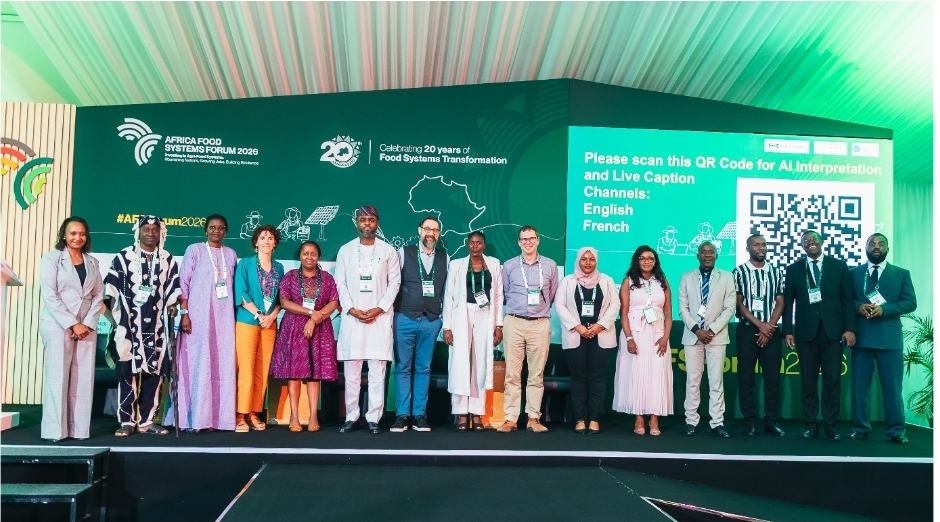
Inside the Youth Dome at the ongoing Africa Food Systems Forum (AFSF) 2026, young African agricultural founders took the stage and delivered an audit of the financial bottlenecks faced by their enterprises.
The session, convened under the theme “Special Investment Programs for Youth and Women in Agrifood Systems,” highlighted AGRA’s Youth Entrepreneurship for the Future of Food and Agriculture (YEFFA) initiative—a strategic multi-country partnership with the Mastercard Foundation designed to break structural barriers to finance, mechanization, and market access across the continent.
Significantly, discussions at the forum confirmed that the YEFFA delivery architecture is now set for a major expansion into Nigeria, Africa’s largest agribusiness market, providing a timely operational blueprint for scaling youth-led agro-enterprises under the country’s national economic and food security priorities.
Catherine Rusagara, Head of Program Delivery for YEFFA at AGRA, framed the strategic shift driving the initiative’s scale: moving decisively beyond piecemeal development pilots to construct interconnected systems that anchor youth within high-value agricultural supply chains.
“What is clearly emerging from our implementation across multiple countries is the sheer power of interconnectedness,” Rusagara told the forum. “When an enterprise operates in isolation, it looks high-risk to commercial banks. But when you embed youth into structured ecosystems—linking them to physical mechanization assets, input aggregation hubs, and corporate off-takers—you fundamentally transform the risk profile and create bankable businesses.”
Reacting to the continental momentum, Rufus Idris, AGRA’s Country Director for Nigeria, noted that domesticating the YEFFA model is critical to addressing Nigeria’s dual challenge of youth underemployment and agricultural productivity gaps.
“The expansion of the YEFFA framework into Nigeria comes at a defining moment for our agrifood sector,” Idris remarked on the margins of the forum. “Nigeria’s food sovereignty agenda cannot be realized by treating youth as peripheral actors or short-term project beneficiaries. By bringing YEFFA’s bundled approach—pairing structured capital aggregation and asset-sharing hubs with guaranteed market linkages—we are establishing a sustainable pipeline that transitions Nigerian youth from informal hustles into competitive, commercial agribusiness owners.”
That systemic backing was brought to life through the lived testimonies of the young founders on stage.
Juliette Nyiranzeyimana, Founder of JSH Ltd in Rwanda, offered a vivid demonstration of how targeted ecosystem support transforms smallholder agriculture into an economic powerhouse. Moving past the constraints of informal farming, her agribusiness expanded into a major employer of 1,100 people and now anchors a direct off-take supply chain with 2,800 smallholder farmers.
“With structured support, my small enterprise grew into a sustainable, scalable business,” Nyiranzeyimana shared. “When you give young entrepreneurs the right tools to build processing and aggregation capacity, the multiplier effect reaches thousands of rural farming families immediately.”
Yet, scaling to that level remains an uphill battle for millions across Africa due to archaic banking conditions. Tony Lutere, a young agripreneur and YEFFA participant from Malawi, openly challenged financiers on their lending terms, calling out punitive interest rates and inflexible repayment structures.
“We are asking financial institutions to engage us as genuine business partners, not high-risk gambles,” Lutere stated. “Charging interest rates north of 20% to a young farmer is a structural trap. If lenders can offer concessionary windows around 10% and align repayment timelines with our biological harvesting seasons rather than rigid calendar months, young Africans will transform food production from Malawi to West Africa.”
From Tanzania, YEFFA participant Salma Salim Mtoi dismantled the assumption that handing out capital alone solves enterprise mortality.
“Finance alone is simply not enough,” Mtoi warned the room. “Without foundational business training—proper bookkeeping, financial record management, and targeted mentorship—capital injected into an agribusiness just disappears into operating leaks. Through the YEFFA model, we learned how to present audit-ready books and structure our operations to attract patient private capital.”
Reinforcing that perspective, Baba Djibo, a Malian agripreneur and founder of Djiboservices, highlighted the crippling obstacle of fixed collateral demands that disproportionately penalize youth.
“Young entrepreneurs have the technical skills, the market demand, and the resilience, but we are consistently disqualified by banking requirements asking for land titles and physical real estate we do not yet own,” Djibo argued. “Governments and development finance institutions must back youth through credit guarantees and asset-financing mechanisms, like machinery-sharing schemes, so that equipment itself serves as security.”
The direct testimonies from Kigali underscore a central pillar of the newly endorsed CAADP 2026–2035 Strategy and Action Plan: that Africa’s food sovereignty will not be achieved through top-down declarations, but through bankable, youth-led agribusinesses operating across rural corridors.
By connecting the institutional capacity of AGRA and the Mastercard Foundation with real-world enterprise models on the ground, and now channeling that momentum into Nigeria, YEFFA is proving that when systemic barriers fall, Africa’s youth do not just participate in food systems; they lead them.