

By Sabo Kpade
The tower stretches toward the sky in silence. This composition prompt questions: How long has the tower stood there? What stories could it tell if it could speak?
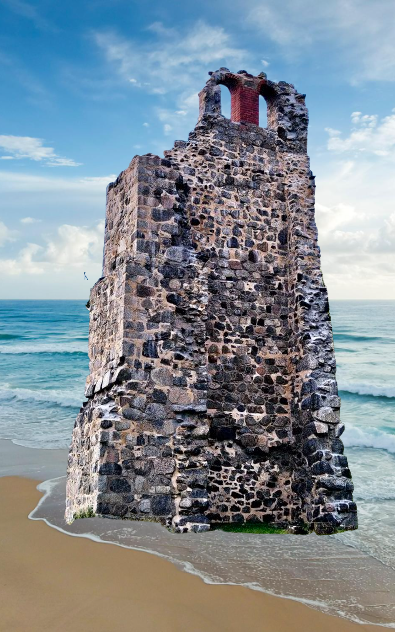
Precious Ozemoya’s fine art photograph ‘Ruins in the Deep’, presented as part of the Insert There Exhibition at the Fringe Art Bath Festival 2025, United Kingdom, running May 23 – June 8 2025, captures a solitary, weathered stone tower rising starkly against the serene backdrop of an expansive beach and the gently lapping waves. Its crumbling form, though rooted in the earth, seems to teeter on the edge of oblivion. The tension between the tower’s rugged decay and the peaceful vastness of the beach evokes a striking sense of isolation yet also hints at history — a forgotten narrative suspended in time.
The artist composition is dominated by the strong verticality of the tower, which occupies the frame’s center, stretching toward the sky. This vertical dominance serves to exaggerate the contrast between the resilient stone structure and the boundless horizon, heightening the tower’s isolation and its struggle against the natural world. Yet, there is a contrast between the rugged ruin and the serene environment, which evokes a feeling of time passing, decay, and solitude.
The contrast between the organic vastness of the beach and the fragile ruin of the tower underscores the inexorable passage of time. The surrounding beach, with its smooth sands and placid ocean, exudes tranquility, yet it stands in sharp contrast to the jagged, eroded textures of the stonework, evoking feelings of time passing, decay, and solitude. There is an undeniable pull between stability and decay, a juxtaposition that speaks to the impermanence of all things — human and natural alike.
In terms of scale, the tower’s disproportionate size relative to its environment gives the photograph a unique, unusual quality. The artist could have achieved this through compositional technique. This exaggeration elevates the tower to a symbolic level, a looming presence that dominates the scene, yet remains, at its core, alone. The artist’s use of a shallow focus directs the viewer’s attention squarely to the tower. Precious uses the shallow depth of field technique to isolate the tower, focusing all attention on the crumbling structure, while the soft blur of the ocean and sky in the background further emphasizes the tower’s estrangement. It is as though the tower, once a monumental edifice, is now a relic adrift in a different world, forgotten by time.
The artist’s intricate details of the tower’s weathered stones are richly rendered, with the rough textures and uneven surfaces bearing witness to years of exposure to the elements. Notably, the bricks in the upper section of the tower reveal a change in color, suggesting either repairs or a shift in materials, hinting at the complex history that this structure might hold. Precious interplay of realism with possible digital manipulation invites the viewer into a surreal, dream-like realm where past and present seem to blur.
The artist’s composition of this fine art photograph also speaks to the duality of time. The verticality of the tower, juxtaposed against the horizontal sweep of the sea and sky, echoes a subtle tension between the permanence of nature and the fragility of human architecture. The stones, jagged and misshapen, suggest an edifice that once held grandeur, now eroded and slowly surrendered to the relentless forces of nature. Below, the smooth, undisturbed sand of the beach offers a stark contrast, inviting contemplation of the cyclical process of erosion and renewal.
Precious deploys color in this artwork to play a critical role in conveying mood and narrative. The photograph’s muted palette, with earthy browns, greys, and greens of the stone, contrasts gently with the soft blues and whites of the ocean and sky. The diffused light gives the scene a calm feel, enhancing the atmosphere of quiet introspection. No harsh shadows disturb the tranquillity; instead, the entire composition seems bathed in a soft, almost otherworldly glow. This tonal harmony heightens the image’s surreal quality, allowing the viewer to both admire the beauty of the moment and reflect on the quiet feelings it evokes.
The artist’s placement of the tower at the water’s edge creates a delicate tension between stability and fragility. The subtle movement of the ocean, captured with what appears to be a long exposure, creates a unique texture of the water, blurring its edges and lending a sense of permanence to the scene. In contrast, the crumbling structure of the tower speaks to the fleeting nature of human achievement, where even the strongest structures are eventually overcome by the forces of nature, suggesting that no matter how enduring we believe our creations to be, nature will eventually reclaim all.
In its quiet, meditative stillness, Ruins in the Deep serves as a poignant commentary to anyone who has ever pondered the gap between solitude, decay, and impermanence, memory and forgotten past, combined with the power of nature and the fragility of human creations.