
By Ankeli Emmanuel, Sokoto — Elanza News
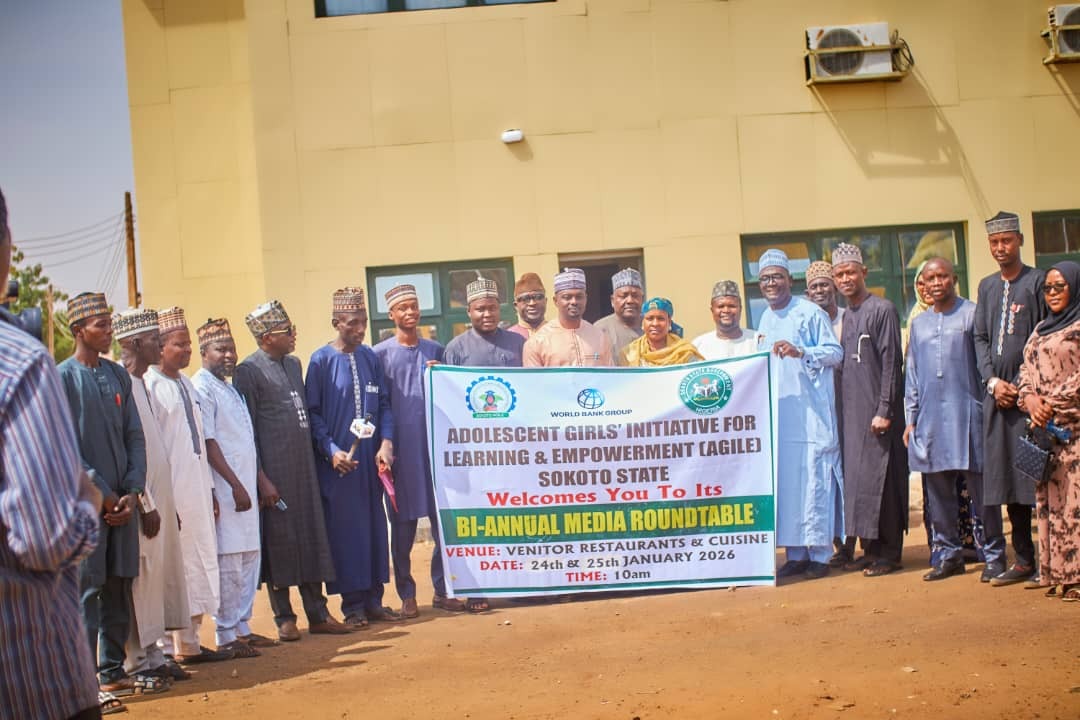
The Adolescent Girls Initiative for Learning and Empowerment (AGILE) has spent N8,456,963,000 in Sokoto State during 2025 and completed 94 of 161 planned activities, the project’s Sokoto coordinator, Dr Mansur Buhari, announced at a media roundtable on Thursday.
Dr Buhari — represented at the briefing by Malam Suleiman Musa, Assistant System Strengthening Manager — said the expenditure reflects a concentrated effort to improve access to education, sanitation and learning resources across Sokoto’s 23 local government areas. “We have prioritised infrastructure and learning materials to ensure adolescent girls can attend school in safer, better-equipped environments,” he said.
Major infrastructure works and sanitation
AGILE’s 2025 report details a series of capital and rehabilitation works across both primary and secondary schools. Key achievements include:
– Renovation of 749 classrooms.
– Construction of 1,652 toilet units across the state.
– Installation of 214 solar-powered boreholes serving 240 schools.
– Planting of 4,480 trees on school premises in 224 schools.
Dr Buhari emphasised the link between infrastructure and attendance: “Improved water supply and sanitation, along with repaired classrooms, reduce barriers to attendance—especially for adolescent girls.”
Education inputs and enrolment
The project supplied a wide range of educational materials and furniture to bolster teaching and learning. AGILE provided 97,446 teaching and learning materials to 240 secondary schools and delivered 11,221 desks to schools across Sokoto State.
On enrolment, AGILE has registered 16,528 adolescent girls this year against a target of 17,000. “We are close to our annual enrolment target and continue targeted outreach to bring the remaining girls into school,” Dr Buhari said.
Conditional Cash Transfer and community engagement
The Conditional Cash Transfer (CCT) component reached 41,821 beneficiaries in 2025, Dr Buhari added. The CCT scheme supports households to keep girls in school by linking financial assistance to regular attendance and performance.
AGILE has also engaged the community through School-Based Management Committees (SBMCs). The project trained 2,240 SBMC members on governance, school environment and social compliance, aiming to strengthen local oversight and sustainability.
Addressing the secondary school gap
Dr Buhari drew attention to the disproportionate distribution of schools across Sokoto State: “Sokoto has more than 2,000 primary schools but fewer than 600 secondary schools. This imbalance constrains progression for girls completing primary education.” To mitigate the shortfall, AGILE is establishing 58 additional “smart secondary” schools to expand capacity and create a smoother transition from primary to secondary education.
Programme status and monitoring
Muhammed Mainasara, AGILE Monitoring and Evaluation (M&E) Component Officer, provided a project-status breakdown. Of 161 activities planned for 2025, he reported:
– 78 activities completed (43%)
– 16 activities in progress (10%)
– 1 activity delayed (1%)
– 7 activities moved or re-scheduled (7%)
“Taken together, 94 activities have been implemented this year, representing 53% of the annual plan,” Mainasara said. He described the trajectory as positive, noting that the remaining activities are on staggered timelines and subject to ongoing monitoring.
Gender-based interventions and life-skills training
Hajiya Rabi Gwadabawa, a component lead, highlighted AGILE’s focus on gender-based violence prevention and life-skills education. “We regard the media as essential partners in enabling informed public engagement with our work,” she stated in opening remarks, thanking journalists for amplifying project messages and correcting misinformation.
Rabi explained that the Gender-Based Violence (GBV) component employs safe-space methods to deliver life-skills modules. These sessions cover communication, menstrual hygiene management, climate-change awareness, sexually transmitted infections, reproductive health, nutrition and decision-making. “These life-skills empower adolescent girls to make informed choices and build resilience,” she said.
Accountability and sustainability measures
Project leads reiterated commitments to transparency and community ownership. Training of SBMCs, local procurement of materials where possible, and engagement with state education authorities form central pillars of AGILE’s sustainability strategy. Dr Buhari said the project will continue to align activities with state priorities and maintain regular reporting to stakeholders.
Challenges and next steps
Despite progress, AGILE faces logistical and systemic challenges. Dr Buhari acknowledged constraints including school distribution imbalances, infrastructure maintenance needs and the necessity of sustained community buy-in. He stressed the importance of complementary government investment to scale and sustain gains: “AGILE’s interventions are catalytic; long-term impact requires continued collaboration with state and local authorities.”
Mainasara noted several pending activities will be completed in the coming quarters and that the M&E team will publish detailed progress reports to track outcomes and impacts, especially on enrolment and learning indicators.
Significance for Sokoto and policy implications
AGILE’s work in 2025 underscores the critical role of integrated interventions—combining infrastructure, cash transfers, materials and life-skills training—to improve educational access for adolescent girls. The project’s multi-pronged approach addresses both supply-side constraints (classrooms, water, sanitation) and demand-side barriers (household costs, social norms).
For policymakers, the Sokoto experience offers lessons on prioritising secondary school expansion and investing in school sanitation and water systems as central to girls’ retention. The strategic placement of solar-powered boreholes and the construction of additional toilets are tangible measures likely to yield measurable improvements in attendance, particularly during menstruation and in remote communities.
Conclusion
AGILE’s reported N8.456bn expenditure and the completion of more than half of its annual activities signal a substantial investment in Sokoto’s education sector for 2025. While challenges remain, project leaders say the focus on infrastructure, enrolment, conditional cash transfers and life-skills training positions AGILE to make a lasting contribution to girls’ education in the state.
The project team urged continued collaboration with media, communities and government to sustain momentum and scale impact. “We ask stakeholders to join us in consolidating gains so every adolescent girl in Sokoto can access safe, quality education,” Dr Buhari concluded.