
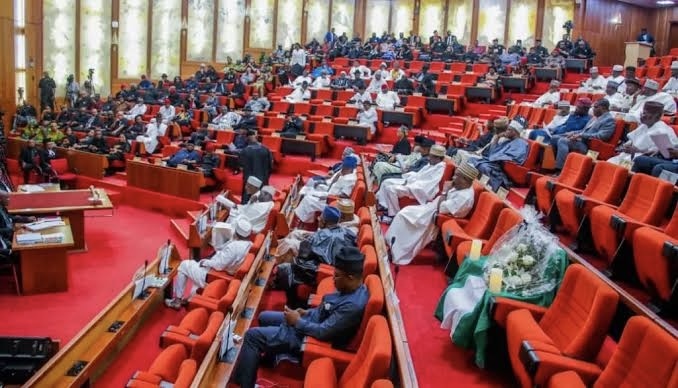
The Senate on Tuesday approved the 2025-2026 external borrowing plan of $21.5 billion presented by President Bola Tinubu for consideration.
The Senate’s approval followed the presentation of the report of the Committee on Local and Foreign Debts at plenary by the committee chairman, Aliyu Wamakko (APC-Sokoto).
According to the president, the loan request is aimed at funding various critical national development projects across key sectors of the economy.
Also approved by the Senate was a loan request of ¥15 billion and a €65 million grant.
The Senate also approved the issuance of a federal government bond of ₦757 billion for the payment of accrued rights pension arrears as of December 2023 for the Contributory Pension Scheme (CPS).
It equally approved Mr Tinubu’s request to raise capital of up to $2 billion through a foreign currency-denominated instrument in the domestic market.
Mr Wamakko, in his report, said the loan requests were part of the already approved Medium Term Expenditure Framework (MTEF) and Fiscal Strategy Paper (FSP) for the 2025 budget.
He said MTEF and FSP contained most of the items in the borrowing plans.
The senator also said that, based on the findings, the committee recommended that the Senate approve the president’s request.
Solomon Adeola (APC-Ogun), who seconded the motion, said the approval was largely a formality, as most of the items had already been outlined in the MTEF and 2025 budget previously passed by the National Assembly.
Mr Adeola, the Senate Committee on Appropriations chairman, said, “The borrowing is already embedded in the 2025 Appropriation Act.
“With this approval, we now have all revenue sources, including loans, in place to fully fund the budget.”
Sani Musa (APC-Niger) said the borrowing plan covered a six-year disbursement period, not just the 2025 fiscal year. He added that Nigeria had not defaulted on any of its existing loan repayments.
“There’s no economy that grows without borrowing. What we are doing is in line with global best practices,” Mr Musa said.
Adetokunbo Abiru (APC-Lagos) also said the loan requests complied with the Fiscal Responsibility Act (FRA) and the Debt Management Act, stressing that the funds were for capital projects and human development.
“These loans are long-term, concessional, and come with favourable repayment terms. Some stretch between 20 and 35 years,” Mr Abiru said.
However, Abdul Ningi (PDP-Bauchi) raised concerns that the committee, in its document, did not indicate how the loan would be repaid.
Mr Ningi stressed the need to detail how the loan being sought would be used to impact constituents, as people would ask lawmakers how the funds were expended.
He said the document failed to provide a specific breakdown of what each state or agency would receive and how the loans would be repaid.
“We need to tell our constituents exactly how much is being borrowed in their name and for what purpose,” Mr Ningi said, citing constitutional provisions regarding borrowing oversight.
However, Victor Umeh (LP-Anambra) expressed strong support for the plan, highlighting the provisions on investment in the eastern corridor.
“This is the first time I’ve seen three billion dollars allocated to rebuild the eastern rail line; that alone justifies my full support,” Mr Umeh said.
Deputy Senate President Jibrin Barau (APC-Kano), who presided over the plenary, lauded the committee’s inputs.
According to him, the entire country is carried along in the borrowing plan.
“This shows that the Renewed Hope Agenda is working; no region is left out.
“With the borrowing plan now approved, implementation of the 2025 Appropriation Act can begin in full,” he said.
Mr Barau further stated that all the funds disbursed under the facility must be utilised strictly for capital and development projects, which is in line with the laws governing public finance.
(NAN)