

BY Solomon Attah, Jalingo
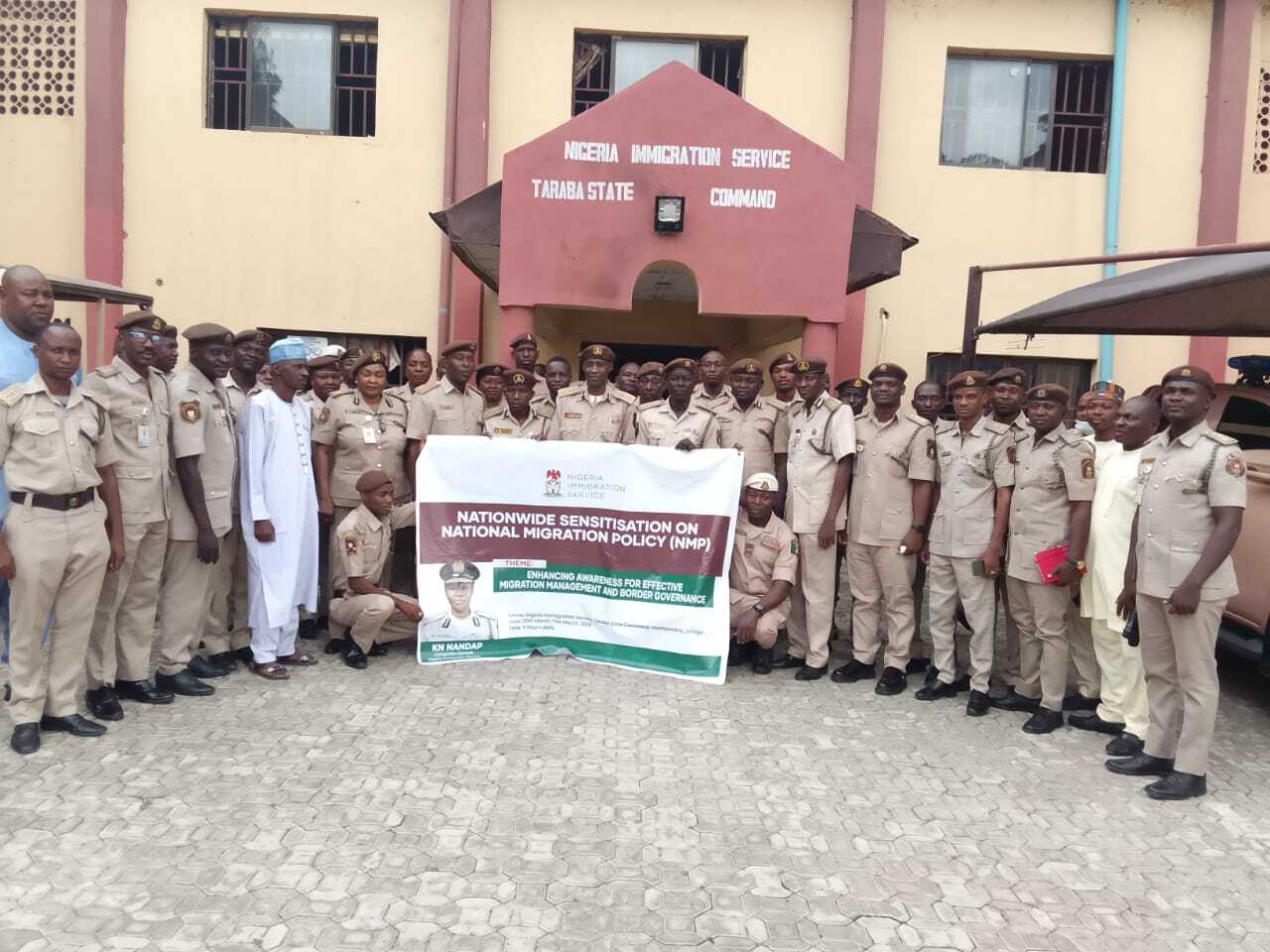
The Nigeria Immigration Service (NIS) has commenced a nationwide sensitisation and capacity-building programme on the newly validated National Migration Policy (2025), aimed at strengthening migration governance, national security, and international cooperation.
Speaking at the flag-off of the exercise, the Comptroller-General of Immigration, Kemi Nanna Nandap, described the initiative as a critical step in aligning Nigeria’s migration framework with evolving global realities and national priorities.
She noted that the Service had played a key role in the development of the policy, stressing that migration remains a vital driver of national development, security, and international collaboration.
The Comptroller-General highlighted several reforms undertaken by the Service in response to changing migration dynamics.
These include the introduction of the e-Visa regime, the Contactless Passport Application System, the e-Border infrastructure, the Passport Personalisation Centre, and the rollout of the ECOWAS National Biometric Identity Card (ENBIC).
According to him, the increasing complexity of global migration trends demands a proactive and coordinated approach to border governance.
He explained that Nigeria’s borders serve as both a frontline defence against transnational crimes such as human trafficking, migrant smuggling, and terrorism, and as critical gateways for legitimate trade, tourism, and investment.
“This underscores the need to maintain a delicate balance between national security and facilitation of lawful movement, anchored on sustained inter-agency collaboration,” he said.
The Comptroller-General recalled that the 2015 National Migration Policy provided a solid framework for managing migration in a safe, orderly, and regular manner.
She added that the updated 2025 policy builds on this foundation by addressing emerging challenges, enhancing institutional coordination, and aligning with global commitments such as the Sustainable Development Goals (SDGs) and the Global Compact for Migration (GCM).
He further stressed that the success of the new policy would depend largely on effective implementation by officers across all commands, urging personnel to demonstrate professionalism, commitment, and adaptability.
Describing the sensitisation programme as a strategic capacity-building initiative, she encouraged participants to actively engage with the policy content and apply the knowledge gained to improve operational efficiency.
The NIS boss reaffirmed the Service’s commitment to building a migration system that is secure, efficient, and humane, in line with Nigeria’s broader development agenda.
END