By Bukola Idowu
Background
With great pleasure, we welcome you to this press conference organised by the Kimpact Development Initiative (KDI) in respect to the Nigeria Election Violence Report (NEVR) Project for the 2025 bye-elections. The objective of this press conference is to inform the public and major stakeholders on the preliminary findings and observations of KDI on the election processes, procedures and incidence reports from the ongoing bye-election and make recommendations based on our observations, as KDI is committed to democratic integrity, voter awareness, and peaceful conduct of the election.
On Saturday, 16 August 2025, the Independent National Electoral Commission (INEC) conducted bye-elections across twelve states of the Federation: Adamawa, Edo, Kaduna, Ogun, Oyo, Jigawa, Kano, Anambra, Kogi, Taraba, Niger, and Zamfara, and re-run elections in Enugu and Kano based on court orders.
These bye-elections are being held to fill vacant seats in two senatorial districts, five federal constituencies, and nine State Houses of Assembly. They are taking place in a total of 32 local government areas, 356 wards, and 6,987 polling units.
The bye-elections are held under INEC’s established guidelines, which require that only individuals with a valid Permanent Voter Card (PVC) can vote, and only at their registered polling units. From INEC’s release, approximately 3,553,659 registered voters across the 13 states are eligible to participate in the elections.
About The Nigeria Election Violence Report Project
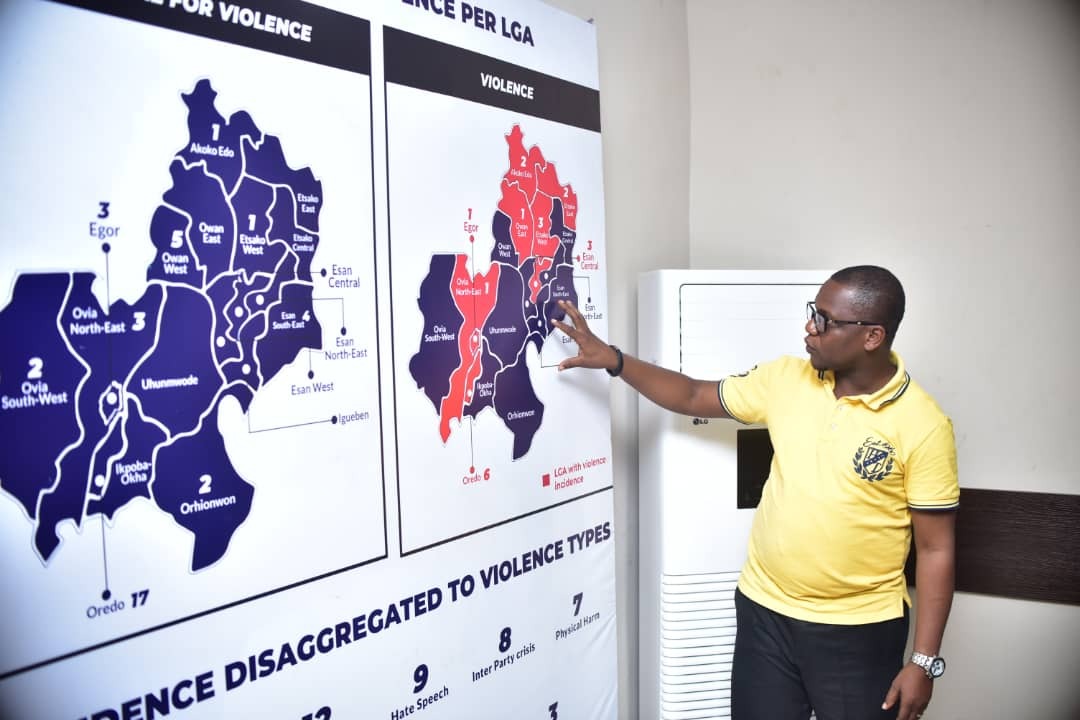
KDI is a non-profit organization implementing the Nigeria Election Violence Education and Resolution (NEVR) Project in the 2025 bye-election with the support of the UK Foreign, Commonwealth & Development Office (FCDO). NEVR establishes an Election Security Early Warning System (ESEWS) in each state of its operation to assess the pre-election environment to identify early warnings – deploying security monitors week in and week out to gather security information that feeds into the ESEWS based on globally accepted indicators that have been tested in over 11 countries through the EVER methodology. On the election day, NEVR monitors the election-day processes and procedures, incidences of violence and potential for violence, as well as the post-election environment to determine peaceful conduct, or otherwise. KDI uses data-driven advocacy and bilateral engagements with election stakeholders, party leaders, socio-cultural leaders, security forces, and other civil society organisations to mitigate electoral violence.
Kdi Election Day Data Room
For the 2025 bye-elections, KDI set up its Election Day Data Room (EDDR) to gather and analyse real-time information obtained from 364 trained observers who have been deployed across the 12 states, 32 local government areas and 356 wards where the elections are being held, including the states where re-run elections are being held. These trained observers send live updates from the field to our EDDR data analysts to sift, verify and analyse.
Our goal is to document incidences of electoral violence and potential for violence and assess the overall electoral environment.
Key observations/findings:
Bimodal Voter Accreditation System (BVAS) Functionality:
KDI’s observation shows that the BVAS functioned effectively in the majority of polling units observed, and we commend INEC for this improvement in the electoral process. Only a negligible number of polling units reported minor malfunctions, mostly linked to network challenges. In most of these cases, the issues were quickly resolved, allowing the process to continue.
While the impact of these glitches was limited, it is important to note that even isolated delays can inconvenience voters and, if not promptly addressed, may create tension at polling units. We encourage INEC to continue strengthening technical support and rapid response mechanisms to sustain voter confidence in the system.
Commencement of polls; conduct of INEC officials:
74.5% of the report from the KDI’s field observation noted that the commencement of polls was significantly delayed. This was primarily due to the late arrival of INEC officials. Our observation found that only a handful of polling units were open between 8:30am and 8:45am, while the majority commenced between 8:45am and 10:00am. This delay raises concerns that voting may extend beyond the scheduled period, particularly in polling units with high voter turnout.
As of 10:35am, elections had yet to begin in several areas. Notably, in Kujama and Nasarawa registration areas of Kaduna State, the election commenced late due to the late arrival of election officials and a late setup. Also, in Kano State, the presence of the Yan-Banga group, armed with dane guns and sticks, patrolling in the street created an atmosphere of fear, discouraging both electoral officials and voters from participating. Similarly, in Edo State, Ovia North East LGA, at Ogheghe polling units 12 and 19, officials arrived but failed to set up and eventually left without explanation, resulting in no elections being held in those locations till the time of this statement.
Potentials for Violence
Vote Trading:
KDI’s trained observers recorded widespread instances of vote trading across many of the polling units visited. The inducements offered to voters ranged from cash payments (from four thousand naira upwards) to material items, including food and snacks. There was also the verified report of a vote trader who was arrested with over 25-million-naira cash in Kaduna State.
This practice undermines the integrity of the electoral process, as it compromises the ability of citizens to freely exercise their franchise and make independent choices. When votes are commodified, the outcome of the election ceases to reflect the genuine will of the people and instead becomes a product of financial or material influence.
Incidences of Violence:
Our observation identified seven incidences of electoral violence in Kogi, Anambra and Enugu states: five in Kogi State and one each in Enugu and Anambra states. In Kogi State for example, there were serious disruptions and records of intimidation at the Registration Area Centre (RAC) for Okura State Constituency, located at Our Lady of School in Ayingba. Security agents, together with political thugs reportedly affiliated with a political party (APC), cordoned off the RAC, preventing the deployment of election materials and ad hoc staff. Sporadic gunshots were observed around the facility, and party agents attempting to access the centre were violently assaulted. In one case, the agent of the Allied Peoples Movement (APM) was beaten so severely that he required hospitalisation. There are also credible reports of ballot box stuffing which took place within the RAC. As a result, voting has been effectively stalled across the four wards of the constituency.
Also, in Anambra, there were credible reports of the relocation of polling units from wards Iseke, Lili, Mbosi, Ubuluisiuzer, Azia and Osimoru to Ihiala LGA secretarial.
The Enugu state narrative is not far from the aforementioned, reports indicate that a party agent of the APC was attacked at Enugu South Urban, Ward 5, Polling Unit 8. Additionally, in Sharuruwa, Shanono Local Government Area of Kaduna State, there are disturbing reports of voter suppression, intimidation, and harassment. The Yan-Banga group, armed with dane guns and sticks, continues to roam the streets, creating fear among both voters and election officials, and obstructing the conduct of the polls.
Positive Indicators
Conduct of Security Agencies:
KDI notes that security agencies largely conducted themselves with professionalism during the ongoing bye-election. Except for the incident recorded in Kogi State, there were no reports of interference in the electoral process. We commend the security personnel for their efforts in maintaining order and ensuring a generally peaceful atmosphere at most polling units observed.
We, however, encourage security agencies to remain vigilant and sustain their neutrality throughout the electoral process. Continued professionalism and impartiality are essential to guaranteeing voter confidence and safeguarding the credibility of the elections.
Concerns
Voter Turnout:
KDI’s observation so far indicates that voter turnout has been generally low across the polling units monitored. This trend raises concerns about citizen participation in the electoral process and emphasises the need for sustained voter engagement and confidence-building measures to strengthen democratic participation.
Ballot Integrity
Conclusion
The bye-election is another litmus test of our democratic health and the strength of INEC in conducting elections. As the Anambra guber election draws closer, there is a need for INEC to rebuild trust.
Call To Action:
KDI calls on all stakeholders, including voters, party agents, security personnel, and electoral officials, to maintain peace, calm, and decorum throughout the electoral process. We reiterate the importance of transparency at every stage of the election and emphasise that the final results must truly reflect the will of the people.
We urge voters to remain calm, queue patiently, and follow the instructions of election officials to ensure a smooth process. Citizens are also encouraged to report any irregularities they observe through official channels, such as the INEC helpline, KDI monitors, and other credible civic platforms. Collective vigilance, patience, and adherence to due process are vital to safeguarding the credibility of the polls.
Signed,
Bukola Idowu
Executive Director
Kimpact Development Initiative (KDI)
16 August 2025.