
The Federal Government of Nigeria has successfully secured a vital funding pledge from the African Development Bank (AfDB) for the second phase of its Special Agro-Industrial Processing Zones (SAPZ) initiative.
This expansion will broaden the project from its initial scope of eight states and the Federal Capital Territory to include an additional 24 states, representing a significant nationwide effort to enhance agro-industrial development.
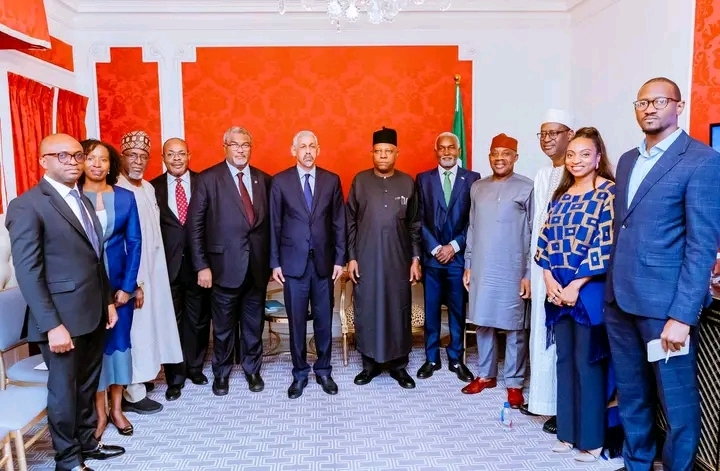
Vice President Kashim Shettima achieved this commitment during a bilateral meeting with AfDB President Dr. Sidi Ould Tah, held on the sidelines of the 80th Session of the United Nations General Assembly (UNGA) in New York. This meeting provided a forum for high-level discussions aimed at accelerating Nigeria’s economic transformation through agricultural initiatives.
In justifying Nigeria’s request for increased support, Vice President Shettima emphasized the country’s position as the bank’s largest shareholder, boasting a portfolio of over $10 billion. Adopting an “Oliver Twist” approach, he expressed appreciation for the initial $300 million contribution from the bank for the first phase, while earnestly seeking additional funds to support the ambitious expansion.
“We are determined to diversify our mono-product economy into agriculture, particularly through value-added agricultural exports,” Shettima remarked. He highlighted Nigeria’s vast agricultural potential, stating, “From the mangrove forest swamps in the south to the Sahelian region in the far north, virtually anything can be cultivated,” with particular emphasis on the exceptional fertility found in states like Kebbi.
The Vice President also pointed out Nigeria’s resourceful youth demographic as a ready workforce eager to engage in the 21st-century economy.
Beyond the SAPZ initiative, Shettima urged the AfDB to also focus on innovation-driven enterprises, asserting that the digital sector holds substantial opportunities for continental development. He noted that five of Africa’s eight unicorn companies, including Moniepoint and Jumia, are based in Nigeria, reflecting a dynamic sector poised for further investment.
In response, Dr. Sidi Ould Tah reassured the Nigerian delegation of the bank’s unwavering support under his leadership. He articulated a vision for the AfDB that extends beyond being a mere lending institution, positioning it as a catalyst for mobilizing global capital to facilitate Africa’s transformation.
“My vision for the bank is to act as a catalyst institution, mobilizing resources and capital from across the globe to enhance Africa’s development,” Dr. Tah stated.
He outlined four key priorities: mobilizing large-scale capital through partnerships, reforming Africa’s financial systems, transforming the continent’s demographic dividend into economic strength for job creation, and industrializing Africa by leveraging its natural resources to add value and develop resilient infrastructure. He expressed optimism that, with Nigeria’s backing, the bank could orchestrate this transformation.
The high-level meeting also included appeals from other members of the Nigerian delegation. The Minister of Environment, Mallam Balarabe Lawal, requested support for the Pan African Great Green Wall Initiative, specifically Nigeria’s initiatives aimed at combating desertification in its eleven frontline states. He also highlighted a proposal for a clean cooking policy, connecting it to deforestation reduction and public health improvements.
Similarly, the Minister of Housing and Urban Development, Alhaji Ahmed Dangiwa, called for substantial AfDB assistance to address Nigeria’s pressing housing deficit, underscoring the government’s comprehensive agenda for infrastructural development.
In a separate diplomatic engagement, Vice President Shettima met with the Prime Minister of St. Kitts and Nevis, Dr. Terrance Drew, reaffirming Nigeria’s commitment to strengthening its historical and economic ties with Caribbean nations. Shettima assured Prime Minister Drew of President Bola Tinubu’s resolve to “rekindle friendship and brotherhood,” emphasizing that the shared heritage, language, and Commonwealth membership greatly surpass any differences.
Prime Minister Drew echoed this sentiment, lamenting the current low levels of trade and contact between the Caribbean and Africa, and expressing his country’s eagerness to collaborate closely with Nigeria to enhance trade throughout the African continent.