
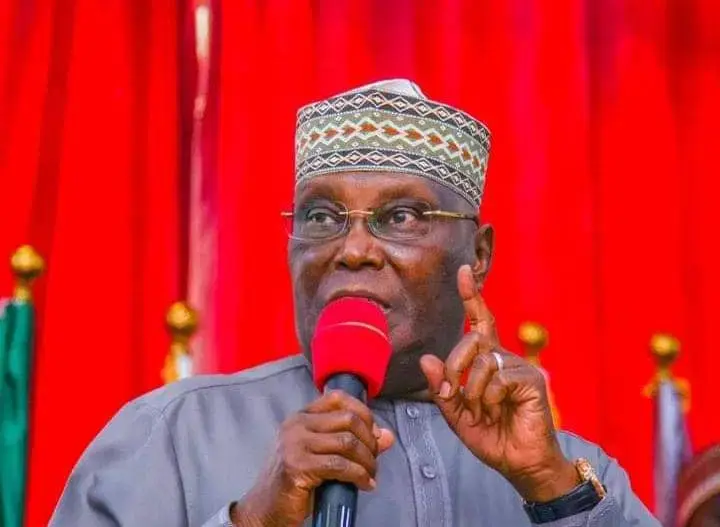
In a stark intervention on the nation’s electoral process, former Vice-President and statesman Atiku Abubakar has issued a forceful warning that Nigeria’s current hybrid system of transmitting election results is fundamentally flawed and presents a grave danger to the credibility of the democratic system. Speaking exclusively to journalists in Minna on Tuesday, Mr Abubakar asserted that the mixture of electronic and manual methods compromises integrity and sows unacceptable confusion.
The presidential candidate of the People’s Democratic Party (PDP) in the 2023 elections made these remarks shortly after paying a customary visit to former Military President, General Ibrahim Babangida (rtd). His comments arrive at a critical juncture, as the National Assembly undertakes a decisive phase in amending the Electoral Act 2022.
“What Nigerians were expecting was electronic transmission of results across the various levels of the election,” Mr Abubakar stated, his tone one of unequivocal concern. “What we have been presented with instead is a mixture of electronic and manual transmission. This combination is not a solution; it is a potent threat. It will cause more confusion and could jeopardise our entire electoral transmission system.”
The former Vice-President’s critique centres on a persistent vulnerability in Nigeria’s elections: the collation process. He argued that real-time, end-to-end electronic transmission remains the non-negotiable gold standard for credible, transparent, and trustworthy polls. The existing hybrid model, he contends, opens avenues for manipulation and disputes during the critical phase where results are moved from polling units to ward, local government, and state collation centres.
“The integrity of any election is only as strong as its most vulnerable link,” Mr Abubakar elaborated. “When you introduce manual handling into a chain that begins electronically, you create weak points—points where delays can occur, where ‘mathematical corrections’ can be introduced, and where the will of the people as initially expressed at the ballot box can be subtly undermined. This erodes public confidence, and without public confidence, an election loses its legitimacy.”
Mr Abubakar’s warning serves as a direct challenge to legislators currently reconciling the final version of the amended Electoral Act. Coincidentally, on the same day as his Minna address, the Senate President, Senator Godswill Akpabio, announced the composition of a 12-member Electoral Act Conference Committee. This committee is tasked with the urgent mandate of harmonising the differences between the Senate and House of Representatives’ versions of the amendment bill, to produce a unified document for final passage.
The conference committee will now interface with its counterpart in the lower chamber to reconcile discrepancies on several contentious clauses, with the methodology of results transmission undoubtedly being a paramount issue. Political observers note that Mr Abubakar’s public intervention is strategically timed to apply pressure on this legislative process, urging the committee to entrench a fully electronic system without ambiguity.
Beyond addressing the legislators, the former Vice-President issued a clarion call for collective action from Nigeria’s political opposition. He urged opposition parties to transcend partisan differences and form a united front to advocate for this crucial reform.
“There is a pressing need for all opposition political parties to come together to pursue this issue with a single voice,” he declared. “Electoral integrity is not a partisan matter; it is the bedrock of our democracy. We should not allow the push for a transparent system to rest where some vested interests might prefer it to rest. I, for one, do not support allowing this matter to be swept aside.”
When questioned on the speculation surrounding his political future ahead of the 2027 general elections, Mr Abubabatkar was dismissive, stating such talk was premature. “The issue of whether I will be contesting the 2027 election has not even arisen,” he said, redirecting focus to his immediate political engagements.
He disclosed that his current party, the African Democratic Congress (ADC), is intensely focused on internal strengthening and grassroots mobilisation. “We are busy building a solid foundation,” he explained. “Our work involves strengthening party structures from the ward level up through local government and state levels to the national. We are mobilising people and registering them simultaneously, ensuring our organisational framework is robust and rooted in the people.”
In a final noteworthy point, Mr Abubakar clarified that the ADC’s constitution does not prescribe zoning of political offices, a statement that will fuel further discussion on the party’s strategy for future elections.
The confluence of a senior statesman’s grave warning, ongoing delicate legislative work, and a call for opposition unity creates a significant moment for Nigerian democracy. The outcome of the National Assembly’s harmonisation process on the Electoral Act, particularly regarding the electronic results transmission clause, will be scrutinised as a definitive test of the political establishment’s commitment to learning from past electoral controversies. As Atiku Abubakar has framed it, the choice is between embracing a clear, modern system that fosters trust or persisting with a hybrid model that carries, in his words, a “potent threat” to the nation’s democratic future.