
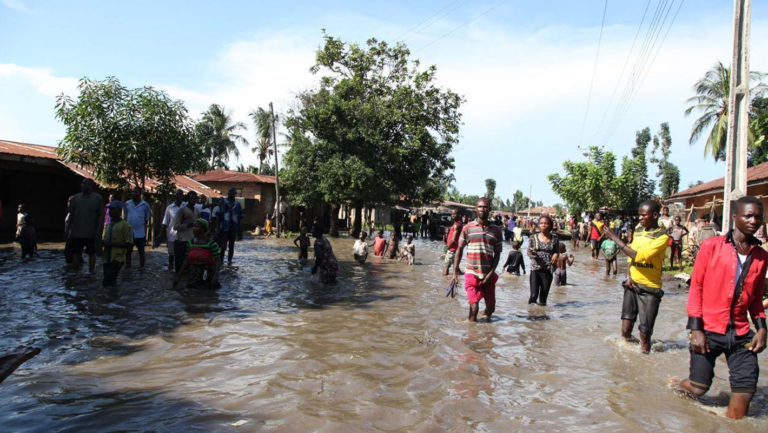
Various Federal and state agencies in Kaduna, Kano, and Katsina are ramping up efforts to mitigate flooding.
This is being achieved through a variety of plausible efforts, including stormwater drainage management, riverbank protection, and bolstering climate resilience initiatives. These efforts aim to prevent or mitigate the impact of floods, but challenges persist, as recent floods have caused destruction, displacement, and loss of life across Nigeria.
The Nigerian Meteorological Agency, in its 2025 flood forecast, predicted flood disasters across the nation, including the three states. It had also taken some precautionary measures, including clearing drainage systems, relocating residents, and constructing flood barriers, among others.
In Kaduna, the government, in collaboration with federal agencies and development partners, has ramped up preparedness efforts to mitigate the impact of projected heavy rains and potential flooding across the state.
Usman Mazadu, the executive secretary of the Kaduna State Emergency Management Agency, stated that the state had activated its 2025 Flood Emergency Operation and Response Strategic Team, along with a fully equipped Emergency Coordination Centre.
Mr Mazadu said the centres were stocked with tents, food, non-food items, and basic medical supplies to serve as temporary shelters in the event of displacement. Mr Mazadu also confirmed that the state had updated its 2022 Flood Risk Map and Contingency Plan, in line with the latest forecasts by NiMet.
At NEMA’s zonal office in Kaduna, its head of operations, Sulaiman Muhammad, said the federal agency had pre-positioned emergency relief items and deployed search-and-rescue teams across strategic locations.
In a similar move, the Kaduna State Ministry of Environment announced that it had commenced dredging and clearing of waterways in flood-prone areas, including Barnawa, Kigo Road, Bashama Road, and Ungwan Rimi.
The Commissioner for Environment, Abubakar Balarabe, stated that notices had been issued to residents in low-lying areas, warning them to relocate ahead of the peak rains.
Hadiza Halid, the coordinator of ACReSAL, stated that the World Bank-supported project was addressing the root causes of flooding through catchment protection and landscape restoration.
NiMet had earlier warned of a high probability of flash floods in parts of Kaduna, including Chikun, Igabi, Jema’a, Zaria, and Soba LGAs. Officials expressed confidence that the coordinated response would minimise risks and enhance resilience as the rainy season peaks.
In Kano, the State Emergency Management Agency said it has developed comprehensive strategies and an emergency response plan to mitigate flooding across the state. The executive secretary of the agency, Isyaku Abdullahi-Kubarachi, disclosed this in an interview in Kano.
He said a high-powered committee, chaired by Deputy Governor Aminu Abdussalam, was set up to oversee the desilting of drainages across the 44 local government areas of the state.
According to him, the initiative had significantly reduced flooding in Kano in 2024.
He said the state government had also organised several stakeholders’ engagements on disaster risk management and flood mitigation to enhance coordination, collaboration, and response during emergencies.
Mr Abdullahi-Kubarachi said SEMA had embarked on sensitisation campaigns across radio, television, markets, emirate councils, and communities to encourage residents to clear waterways and reduce flood risks. He added that the agency had prepared temporary shelters for internally displaced persons ahead of any emergency.
Mr Abdullahi-Kubarachi said the state government would continue to collaborate with the NEMA to address flood-related challenges and safeguard lives and property. He urged the public to adhere to safety guidelines and avoid actions that could expose them to disasters, noting that such incidents could lead to economic hardship, loss of lives, and destruction of property.
He commended Governor Abba Yusuf for his proactive approach to disaster risk reduction and his continued support for emergency management efforts in the state.
NEMA’s Kano territorial coordinator, Nura Abdullahi, affirmed the agency’s unwavering support in advancing disaster preparedness, mitigation, and response efforts. He emphasised the need to collaborate with stakeholders to reduce community vulnerability to various hazards, noting that failing to take swift and appropriate action can often escalate emergency situations.
In Katsina, the state government, through its emergency management agency, had spent over N451 million to assist approximately 1,064 flood victims in the state in 2024. Governor Dikko Radda disclosed this on July 23, while receiving a donation from NEMA.
(NAN)