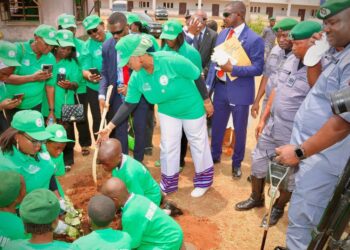

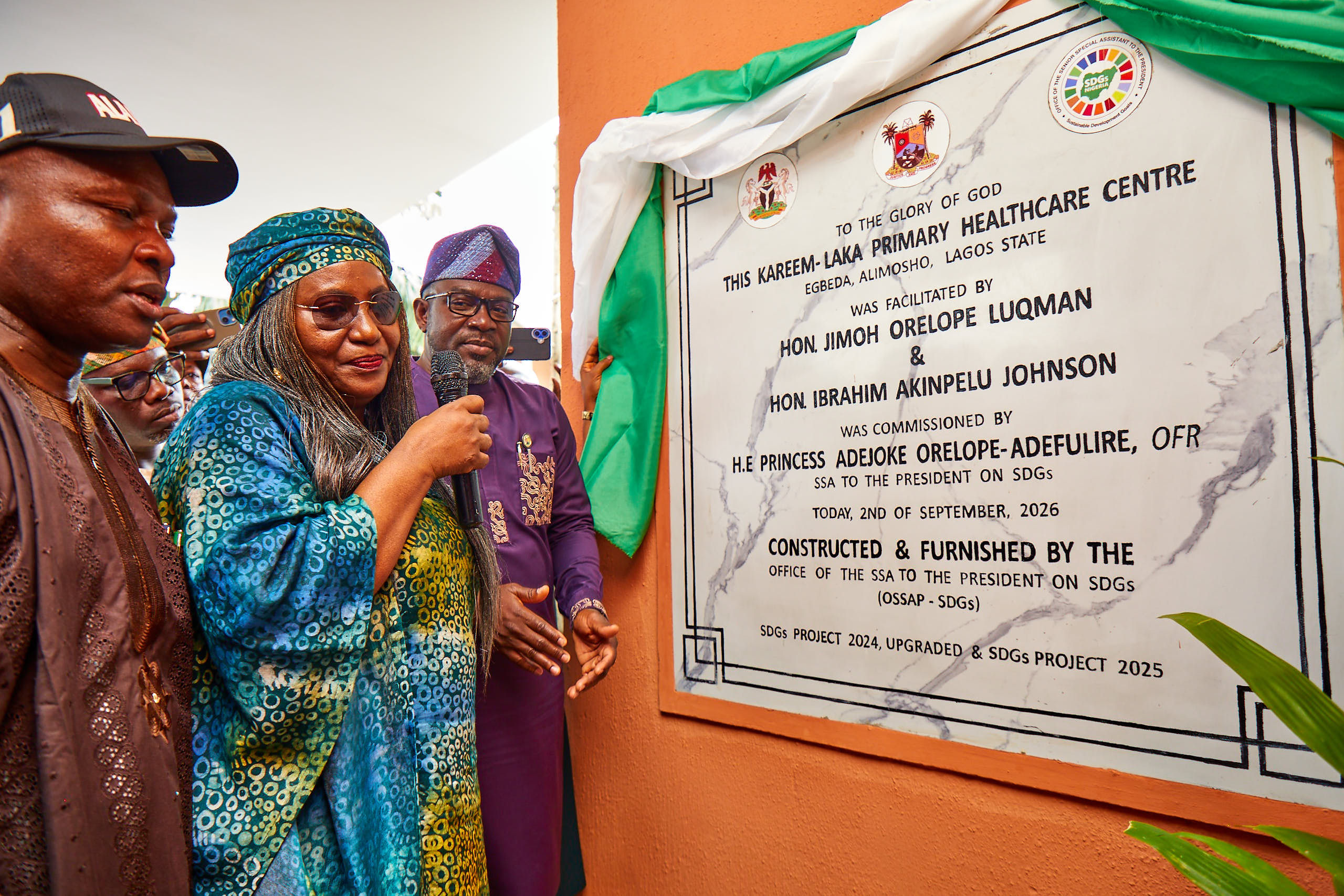
The Office of the Senior Special Assistant to the President on Sustainable Development Goals has commissioned a 50-bed Primary Healthcare Centre, a Children’s Recreational Centre and two blocks of 36 classrooms in Lagos State to improve healthcare, education and childhood development.
The projects, commissioned on Wednesday, September 2, 2026, are located in Egbeda and Orisumibare, with the healthcare and recreational centres situated in Egbeda and the classroom blocks at Orisumibare Primary School.
The projects were constructed, furnished and equipped by the Office of the Senior Special Assistant to the President on SDGs as part of interventions aimed at translating the Sustainable Development Goals into tangible services for communities.
Speaking through the Secretary of Programme, Ms Suzanne Iwongo Sado, the Senior Special Assistant to the President on SDGs, Princess Adejoke Orelope-Adefulire, said the projects reflected an integrated approach to human development under President Bola Ahmed Tinubu’s Renewed Hope Agenda.
She acknowledged the President’s support and provision of resources for the interventions, saying human capital development, social inclusion and access to essential services remained central to their delivery.
Orelope-Adefulire said healthcare, recreation and education were interconnected, particularly in shaping the future of children.
“A healthy child needs quality healthcare, safe opportunities to play and develop, and a conducive classroom in which to learn,” she said.
“By bringing these interventions together, we are investing in the full development of the child and strengthening the foundations of a healthier, safer, better-educated and more inclusive society.”
The 50-bed Primary Healthcare Centre is expected to expand access to affordable and quality healthcare for residents of Egbeda and surrounding communities.
Women, children, older persons and other vulnerable groups are expected to benefit significantly from the facility.
The centre is equipped with operating theatres, recovery rooms, private and general wards, a scanning room, consultation rooms and a delivery room.
It also has children’s and adult intensive care units, a laboratory, vacuum extractor delivery set, ultrasound machine, emergency section and an ambulance.
The facility also has 12 fully furnished staff quarters.
Orelope-Adefulire said the intervention would contribute to Sustainable Development Goal 3 on Good Health and Well-being by bringing essential medical services closer to residents.
She said it would also strengthen maternal and child healthcare and improve the capacity of frontline health workers to respond to community needs.
The SSAP-SDGs linked improved healthcare access to poverty reduction, gender equality and reduced inequalities.
She noted that difficulties in accessing medical treatment could place pressure on household finances, disrupt children’s education and affect the ability of adults to earn a living.
“Beyond the beds and physical structure, this centre represents dignity, timely intervention and renewed hope,” she said.
But Orelope-Adefulire warned that the commissioning should not be seen as the end of the responsibility attached to the project.
She called on relevant authorities and beneficiaries to ensure proper staffing, protection and maintenance of the facility.
“Sustainable infrastructure is not measured only by the day it is commissioned, but by the quality of service it continues to deliver over many years,” she stated.
The Children’s Recreational Centre, also located in Egbeda, was described as an investment in the physical, mental, social and emotional development of children.
Orelope-Adefulire said children needed safe spaces to interact, explore their abilities and develop outside formal learning environments.
“Play is not a luxury; it is an essential part of childhood and a powerful means through which children develop physically, mentally, socially and emotionally,” she said.
The facility is expected to promote creativity, teamwork, healthy habits and positive social interaction among children.
It will also provide opportunities for children to build friendships and develop a stronger sense of belonging.
The intervention supports SDGs 3, 4, 10 and 11, covering health, education, reduced inequalities, and sustainable cities and communities.
Local authorities, parents, teachers, community leaders and youth organisations were urged to ensure equitable access to the facility.
Particular attention was also drawn to girls, children with disabilities and those from vulnerable households.
They were equally encouraged to protect the equipment and maintain a safe and welcoming environment.
At Orisumibare Primary School, the two classroom blocks comprising 36 classrooms are expected to ease pressure on existing facilities and provide a more conducive learning environment for pupils and teachers.
Orelope-Adefulire said the investment supported quality education and the broader objective of expanding opportunities for children irrespective of their backgrounds.
“The true value of these classrooms will not be found in their walls alone, but in the dreams nurtured within them, the knowledge shared by committed teachers, and the futures transformed through learning,” she said.
Speakers at the handover called for effective deployment of teachers, adequate learning materials, sanitation, security and regular maintenance of the facilities.
Parents were also encouraged to ensure regular attendance by their children and maintain close collaboration with school authorities.
The Executive Chairman of Alimosho Local Government, Hon. Akinpelu Ibrahim Johnson, described the projects as investments in the future of the community.
Johnson thanked President Bola Ahmed Tinubu and Orelope-Adefulire for the interventions, describing them as significant milestones in the development of the communities.
He said the projects represented important investments in the health, well-being, education and future of residents, particularly women, children and other vulnerable groups.
“These classroom blocks will provide our pupils with a more conducive environment to learn, grow and fulfil their potential. Indeed, every investment in the education of our children is an investment in the future of our community,” Johnson said.
Formally accepting the projects, the council chairman pledged the local government’s support for their proper utilisation and maintenance.
He appealed to school authorities and residents to protect the facilities for future generations.
Johnson also acknowledged the contribution of His Royal Majesty, Oba Akeeb Adebowale Rauf, the Alaye of Orisumibare, who provided the land for the school.
He commended the Elegbeda of Egbeda, His Royal Majesty Oba Hammed Omogoriola Orelope Laka, for his leadership and support for the development of Egbeda and its people.
Johnson described the traditional rulers’ support as a major contribution to the projects, saying the interventions demonstrated the importance of cooperation between the Federal Government, local leadership and communities.