
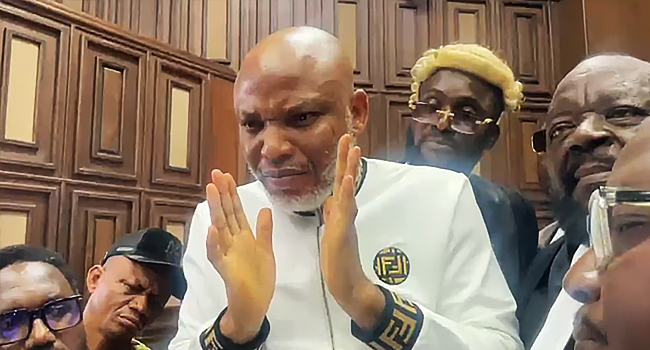
Nnamdi Kanu, the leader of the Indigenous People of Biafra (IPOB), has formally appealed his conviction and multiple sentences imposed by the Federal High Court in Abuja. In a notice of appeal submitted on February 4, 2026, Kanu contends that his trial was marred by significant legal errors, leading to a miscarriage of justice.
Kanu’s conviction on seven counts, including terrorism-related offences, resulted in five life sentences alongside additional prison terms after a guilty verdict on November 20, 2025. His appeal seeks to overturn these decisions, arguing that the trial process was fundamentally flawed.
In his grounds for appeal, Kanu asserts that the trial court failed to address what he describes as a “foundational disruption of the original trial process,” stemming from a military operation at his Afara-Ukwu residence in 2017. He claims that the court continued with proceedings and delivered a judgment while his preliminary objection regarding the trial’s legitimacy was unresolved.
Moreover, Kanu criticises the court for issuing a judgment while his bail application was pending, asserting that this procedural misstep compromised the fairness of the trial. He argues that he was wrongfully convicted under a law that had been repealed, specifically claiming, “the learned trial judge erred in law by convicting and sentencing the appellant under the Terrorism Prevention (Amendment) Act, 2013, despite its repeal by the Terrorism (Prevention and Prohibition) Act, 2022, prior to judgment.”
Kanu further alleges he experienced double jeopardy, in violation of Section 36(9) of the 1999 Constitution, as he was retried on facts that had previously been nullified by the Court of Appeal. He also claims he was denied the right to a fair hearing, stating he was not permitted to file or present a final written address before the judgment was rendered.
In his appeal, Kanu requests the Court of Appeal to quash his conviction and sentences, seeking “discharge and acquit” on all counts. He has expressed a desire to attend the appeal hearing personally, indicating, “I want to be present at the hearing of the appeal because I may be conducting the appeal in person.”
On November 20, 2025, Justice James Omotosho of the Federal High Court sentenced Kanu to life imprisonment. He is currently detained in a correctional facility in Sokoto State, following the denial of his request for a transfer to another facility.
As Kanu’s appeal progresses, the implications of the legal arguments presented will be closely monitored, both for their potential impact on his case and for broader discussions regarding judicial processes in Nigeria. The outcome may resonate significantly within the ongoing discourse surrounding IPOB and the legal landscape in the country.
Kanu’s appeal not only highlights his legal battles but also raises critical questions about the integrity of the judicial system and the rights of defendants in high-profile cases. The public and legal experts alike await the Court of Appeal’s response to these assertions, which could set significant precedents for future cases involving similar legal challenges.
The ongoing situation underscores the importance of ensuring fair trial standards and the necessity for transparent judicial processes, particularly in politically sensitive cases. As the legal proceedings unfold, they will serve as a focal point for discussions regarding justice, human rights, and the rule of law in Nigeria.
In conclusion, Nnamdi Kanu’s appeal against his conviction and sentences represents a pivotal moment not only for him personally but also for the broader legal context in Nigeria. The outcome will be closely scrutinised, with potential ramifications for both Kanu and the Indigenous People of Biafra movement. The appeal serves as a crucial reminder of the need for vigilant adherence to legal standards and the protection of individual rights within the judicial framework.