
In a decisive move to bolster Nigeria’s economic landscape, President Bola Tinubu has appealed to the World Bank for support in his administration’s ongoing reforms, particularly focusing on agriculture, youth employment, and private sector growth. This initiative aims to fortify the Nigerian economy and expand opportunities for its citizens.
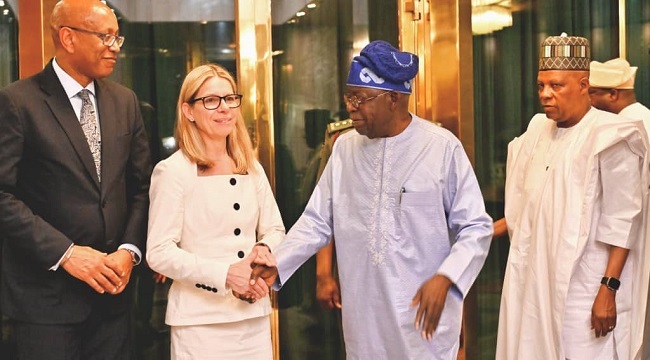
During a meeting held at the State House in Abuja on Tuesday, Tinubu addressed a delegation from the World Bank, led by Anna Bjerde, Managing Director of Operations. The president articulated his commitment to reforms, stating, “Since we embarked on this journey of reform, we have taken charge and we will not turn back. Although the initial phase was challenging, perseverance is key to success.”
Emphasis on Agricultural Modernisation
Central to Tinubu’s vision is the mechanisation and modernisation of agriculture, a sector crucial for enhancing productivity and creating jobs, particularly for Nigeria’s burgeoning youth demographic. He elaborated on the establishment of mechanisation centres aimed at providing farmers with improved seeds and fertilisers, thereby transforming small-scale farms into large cooperatives that can generate substantial opportunities for Nigerians.
“The objective is to elevate farmers from mere subsistence to large-scale operations,” Tinubu explained, highlighting the potential for economic growth through agricultural innovation.
Strengthening Domestic Industries
In addition to agriculture, the president pointed to the petrochemical sector and other local industries as vital areas for improvement. He emphasised that ongoing reforms must be anchored in principles of transparency, accountability, and stability. “The initial response to reforms was high inflation; however, it has significantly reduced, and the Naira has stabilised. Our aim is to facilitate ease of investment, minimise bureaucracy, and enhance the skills of our workforce,” he stated.
World Bank’s Recognition and Support
Anna Bjerde, in her address, commended the Tinubu administration for its consistent approach to reforms over the past two years. She noted that Nigeria has emerged as a global benchmark for reform implementation, inspiring confidence among investors and policymakers alike. “The achievements realised in the last two years are praiseworthy. Your clear communication regarding the necessity of reforms has instilled confidence, and there is no turning back,” Bjerde remarked.
Highlighting the urgency of job creation, especially for the youth, Bjerde pointed out the rapid growth of Africa’s young population and the pivotal role of small and medium-sized enterprises (SMEs) in employment generation. “Agriculture is a significant contributor to the economy and a primary source of employment. Innovations in mechanisation, cooperatives, and value-chain development can be scaled to create more opportunities,” she added.
Financial Investment in Nigeria
Bjerde also outlined the World Bank’s financial commitments to Nigeria, which include public sector financing of $17 billion, private sector support amounting to $5 billion through the International Finance Corporation (IFC), and investment guarantees exceeding $500 million. These financial instruments align with Nigeria’s reforms in trade, digital initiatives, and inflation management, all aimed at stimulating private sector growth and human development.
“We aspire to collaborate with Nigeria to expedite growth, enhance access to finance for SMEs, and support early childhood development as part of a comprehensive human development strategy,” Bjerde concluded.
Conclusion
This meeting underscores Nigeria’s ambition to attract foreign support for its strategic reforms, particularly in sectors that are instrumental in addressing youth employment, food security, and overall economic growth. The collaboration with the World Bank is poised to play a crucial role in actualising these goals, setting the stage for a resilient and prosperous Nigerian economy.
As Nigeria embarks on this transformative path, the focus remains on creating sustainable opportunities for its citizens and fortifying the nation’s economic foundation. The partnership with the World Bank represents a significant step towards achieving these objectives, fostering not only agricultural advancement but also comprehensive economic development across the country.
In a world where economic stability and food security are paramount, Nigeria’s proactive approach serves as a beacon of hope, illustrating the potential for growth and innovation in a rapidly evolving global landscape.