
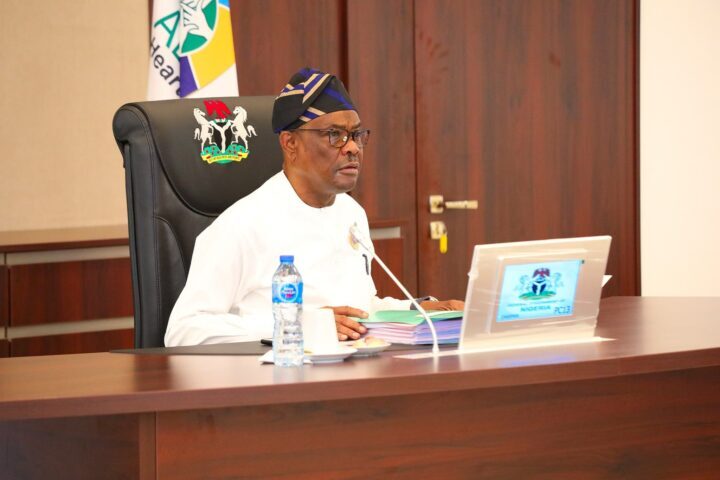
Abuja, Nigeria– Nyesom Wike, the Minister of the Federal Capital Territory (FCT), has issued a stern warning to Federal Capital Territory Administration (FCTA) workers participating in a strike. He stated that any worker who fails to comply with a recent court order to resume work will face serious repercussions, beginning Wednesday.
Wike’s remarks came following a court ruling that mandated the striking workers to end their industrial action. Speaking to journalists on Tuesday, he emphasised the importance of adhering to the law and the necessity of consequences for those who defy a valid court order.
### Enforcement of the Court Ruling
“Are there no consequences for disobeying the law? Must we allow people to break the law flagrantly?” Wike questioned, reinforcing the gravity of the situation. “I have given them a window, but from tomorrow, if they don’t come to work, we will apply the big stick,” he added, indicating a firm approach to enforcing the court’s decision.
The minister went on to warn that any worker attempting to disrupt operations by blocking access points would be singled out as a “scapegoat.” “The law must take its place,” he asserted, underlining the administration’s commitment to maintaining order and enforcing legal rulings.
Willingness to Engage in Dialogue
Despite his firm stance, Wike expressed that the FCTA remains open to dialogue with the workers. He noted that discussions between labour representatives and the management had already taken place, stating, “We have been disposed to dialogue. They have met with management, so what are the issues? If genuinely they want dialogue, then we’ll talk.”
However, he was clear that any negotiations must not be rooted in intimidation or blackmail. “If it’s on blackmail and intimidation, then we will not agree. If they like, they can hire all the civil servants in Abuja; it’s not my business,” Wike remarked, reinforcing his position that cooperation must be genuine and constructive.
Background of the Strike
The indefinite strike initiated by FCTA workers last week stemmed from grievances over long-standing labour and welfare demands that had reportedly gone unaddressed by the authorities. This industrial action has resulted in significant disruptions to government operations in Abuja, affecting various public services and offices.
In response to the strike, Wike took legal action against the Joint Unions Action Committee (JUAC), which represents the striking workers. The situation escalated to the National Industrial Court, where a ruling was delivered on Tuesday. Judge Emmanuel Subilim stated that although the matter constituted a trade dispute, the workers’ right to strike was not absolute. He ruled that, once a dispute is referred to the court, any ongoing strike must cease until the matter is resolved.
Implications of the Court’s Decision
The court’s decision aims to restore normalcy within the FCTA and ensure that public services are not impeded by industrial action. Wike’s warning serves as a clear signal to the workers that the government will not tolerate non-compliance with legal orders.
The Minister’s strong rhetoric reflects the administration’s broader commitment to upholding the rule of law while addressing the underlying issues raised by the workers. As enforcement actions begin, both the workers and the government will need to navigate the complexities of industrial relations to find a sustainable resolution.
Conclusion
As the situation unfolds, all eyes will be on the FCTA to see how the government balances enforcement with the need for dialogue and reform. The stakes are high, not only for the striking workers but also for the administration’s credibility and the effective functioning of public services in Nigeria’s capital.
In this challenging environment, the resolution of the strike will require careful negotiation and a commitment to addressing the legitimate concerns of the workers while ensuring compliance with the law. The coming days will be crucial in determining whether a harmonious path forward can be established or if further conflict is inevitable.