By Abbas Jimoh
Ahead of the 2027 General Elections, the Yiaga Africa has asked President Bola Tinubu to publish the names of potential candidates for the position of chairman of the Independent National Electoral Commission (INEC) and subject them to public scrutiny before screening by the national assembly.
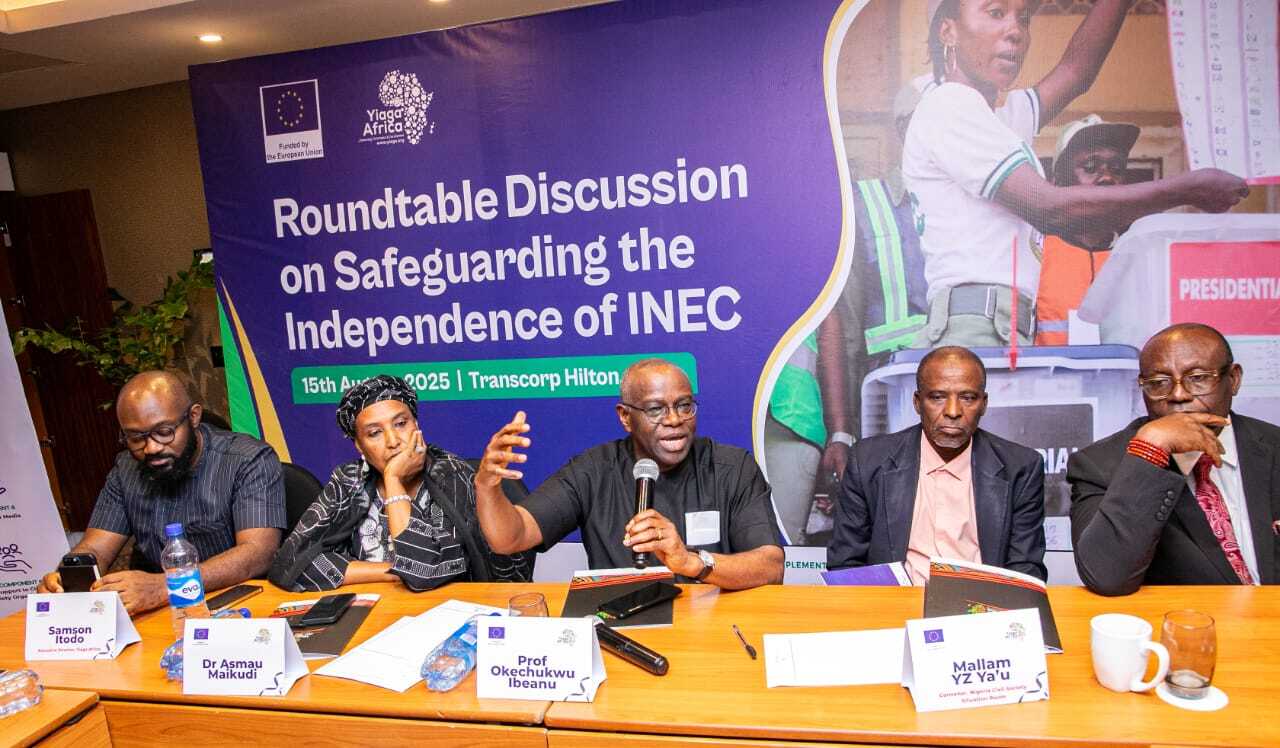
The organization made the call in Abuja during a recent high-level roundtable discussion in Abuja, it organised on ‘Safeguarding the Independence of INEC’.
Civil society leaders and elections experts who attended the event equally expressed their concerns, urging transparent and merit-based appointment process to prevent potential crisis and political uncertainties in the country.
The INEC Chairman, Prof. Mahmood Yakubu, is expected to step down from office later this year, after serving the maximum two terms, of 10 years as the INEC helmsman; while about 10 national commissioners are also expected to retire from the commission before the 2027 elections.
Speaking at the at the event, Executive Director of Yiaga Africa, Samson Itodo, a lawyer, expressed concern that the said the transitions would perhaps make INEC weaker and also impact the quality of the next elections.
According to him, this transition presents a significant threat to the nation’s democratic stability, if not handled with care.
“We have to be worried about the transitions happening in INEC. Because you do require a set of people with the competence to administer a very important component of democracy, which is elections,” Itodo said.
He stressed that a lack of investment in people with experience and knowledge could lead to a significant decline in the quality of the next elections, thus the critical need for President Bola Ahmed Tinubu to rethink the appointment process for the next INEC chairman and national commissioners.
He also urged a shift from political appointments to a system that prioritises experience, independence, and mental alertness.
He said, “The president has the power, but before he sends a nomination to the National Assembly, can he publish the list of people he’s considering? Ask citizens, civil society, and professional organisations to submit objections and memos on those people.”
“And so, we have said that aside from the constitutional requirements of questionable integrity and non-partisanship, there’s a great need to look for people who have experience in elections or in a related field because elections are a complex technical activity.”
Itodo added, “The second point is to look for individuals who are independently minded, individuals who cannot be swayed by any form of political persuasion, individuals who can withstand political pressure because it serves the interest of Nigeria, whether it is the incumbent or even the opposition.
“And for the third part, you need people with mental alertness. The INEC job is very complex and tasking, so you need people who are alert to manage elections.
If the next elections are really going to be credible and the perception of integrity is going to be high, it’s going to begin with the appointment process for the next INEC chairman and the national commissioners.
“And so, we are saying that the president has an opportunity, and the national assembly does have an opportunity to do what will inspire public confidence in this electoral process and let them not treat these appointments with any form of executive overreach or political manipulation.”
While the National Assembly is currently working on amendments to the Electoral Act, Itodo expressed hopes that the bill will be signed into law by October to allow sufficient time for implementation.
He said, “If this country can pass a national anthem bill in few hours, I see no reason why the electoral amendment and the bill cannot be concluded by October.”
Also speaking, the Africa Director of the MacArthur Foundation, Dr. Kole Shettima, said that a lack of public trust in state institutions, including the judiciary, legislature, and executive, demands a moral high ground from the presidency.
He proposed a televised, national screening of candidates as a way to rebuild public confidence.
“The public at this point feels that the whole institutions of state have been captured,” Shettima said.
On his part, a former INEC Commissioner, Barrister Festus Okoye, who was also a civil society advocate, before his INEC appointment, criticised the CSOs role, noting a lack of sustained advocacy and strategic engagement in the appointment process.
He recalled his own experience being screened for a national commissioner role, where no civil society groups were present to ask questions.
“We only wait and when other people are appointed, then we react. I think we must change strategy.” Okoye said.
He suggested that the judiciary itself, having been drawn into political disputes, can no longer be trusted to lead the appointment process for electoral officials, a position he previously supported but now believes is no longer tenable.
The roundtable also highlighted systemic flaws that continue to undermine the electoral process, with some of the participants highlighting judicial inconsistencies, where courts have often ignored INEC’s own regulations and guidelines, particularly concerning the use of technology like smart card readers and the IReV portal.
While others also spoke at the event, Mr Joseph Agama of the Rivers in the Desert Nigeria (RID Nigeria), who represented the Gen-Z at the event said that all the young generations wanted is to be brought into conversations like the Yiaga Africa’s roundtable.
“We know that there is a problem and we don’t know the roots of the problems an even the solutions. Then we are leaning and I have learnt more. I think we should be brought into rooms like this, not necessarily to make contributions. Let us just listen and you would be amazed by the kind of ideas that would come out of us,” Agama said.
For Ms Cynthia, the Yiaga africa’s Director of Programmes, said that the youths and other Nigerians should have their emotional attention to the cause to drive it so that the ‘trending online’ of the campaign can be leverage on.
“Also is to extend this campaign from the national to the state and local government levels. The demand for a public screening process should also be prioritized,” Mbamalu said.
Question and answer sessions:
In separate interviews some of the stakeholders also bear their minds on the matter….
*The Africa Director of the MacArthur Foundation, Dr. Kole Shettima:
You raised some salient points on issues that might mar Nigeria’s democratic stability and good governance including the concern the cerebral INEC Chairman, Prof. Mahmood Yakubu, is expected to complete his tenure by the end of this year, while half of the national commissioners too before the 2027 election. What do you think is going to happen to Nigeria’s democracy and good governance by 2027 and beyond?
Shettima: Well, what I think is first, the role of civil society itself, because I think that we as civil society, we owe the responsibility of drawing public attention to these timetables that are confronting us.
And try to organize and raise public education, awareness, do the campaign, so the public is also fully engaged with these conversations and those situations that we have.
The immediate one is the INEC Chairman, but, you know, it’s also possible that he can leave before his actual date of departure.
And then, of course, the next set of people (commissioners) would leave in September and then on the eve of the election in February of 2027, another set of people are also going to leave the place and other things.
So, I think we are grooming in darkness as far as the public is concerned. And I think that civil society needs to raise these issues so that people are, very much aware of the dangers, because if we don’t work hard to save this democratic process, however fragile it is, I think that we’ll be even going into a much, much more difficult situation.
So, for me, I think the task now is for civil society groups and organizations to mobilize a number of the sectors, the faith groups, the business community, the women’s organizations, the people with disability, and I think that we need a public campaign along those lines at this point.
The National Assembly have a mixed perception from the public. Some see them as robust, some see them as trying in some other areas and passing the Electoral Act or the Constitutional amendment is also on the front burner. What do you think they should do now to strengthen democracy, which is the basis for their being in the National Assembly in the first instance?
Shettima: Well, I suspect that we are not likely to see any law that will come into being between now and the 2027 election that will guide the 2027 election. I think that will be very, very difficult. So the question now is, what are the short-term things that we can do in order to at least provide some sense of credibility and trust among the Nigerian public?
I think that the public at this point feels that the whole institutions of state have been captured, whether it is the judiciary, whether it is the legislature or the executive, and therefore I think that the President ought to take the moral high ground to say that we will work within the existing legal framework, but we will work in a way that will provide a better and more transparent and more competitive process of doing that.
That may include the idea of having the position of the INEC Chair especially being advertised and then people can apply for those positions and the people can be screened and then people can also have the national televised screening of the candidates and then of course the ultimately appointment of that person. I think that will in so many ways at least make people relieved and people begin to have a sense that there is a hope for a better election in 2027.
Nigerians have seen the President appointed politically exposed or politically aligned persons including party members into sensitive positions in INEC. Despite the protests and outcry, including from CSOs and some people even going to court. The President ignored the protests and had his way. What do you think Nigerians should do or if this is repeated?
Shettima: I think that the President should be mindful of his legacy and I think he should be mindful of what he will be remembered.
I think late President Umaru Yar’Adua took the high moral ground because the 2007 election was seen as shambolic. People were disappointed about it, but he did what he did which was to appoint an independent committee to look into the elections.
That was what produced the Justice Uwais report. I think by doing that he recognized that yes, that his own election was bad but he was willing to take a high moral ground to see how he could correct the situation.
So, I’m hoping that Mr President could also behave the same way as Yar’Adua has done to say that yes, I have the power to do all that. But that I want to do these things differently in order to leave a legacy that I could be remembered for.
*On his part, Dr Hussaini Abdu, the President/CEO, Social Development Action Trust, bears his mind:
By the end of this year, the INEC Chairman is expected to leave office at the end of his eventful tenure and half of the national commissioners before the 2027 General Elections. Some Nigerians expressed apprehension that there might be a vacuum in INEC getting the 2027 elections on track. So how do you react to Nigerians’ fear over this development?
Abdu: Honestly, I don’t think there will be a vacuum. Probably the concern would rather be who is going to replace the current leadership of INEC. INEC is a very strategic institution and it’s quite important for our democracy. And the leadership itself is very, very fundamental for any elections that we are going to have in the country. And I believe that the President and the appointing authorities are very clear about the tenure issue. And surely we didn’t have a history of that gap in terms of appointment.
I think the only time this happened was probably in the current Chairman’s (Prof. Yakubu) second term. But again, it was the second term and somebody was acting. So you have a commission and surely you may have somebody who may be appointed, even if we are not able to get a successor before his departure.
From among the commissioners, there are six commissioners that can act until that. So, I don’t think the fear is about vacuum. I think the fear is more about the appointment process itself. And that over the last 25 years of our experience in this democracy, there has been concern about how INEC chairs are appointed and whether that guarantees non-partisanship or capture by politics and whether it insulates the commission from political capture or deepen professionalism and the integrity of our elections.
Those have been the concerns. And almost all the convergence, including the Uwais committee, had something to say or write about this. So, it is about the process. How do we get the right person? And how does the President commit to ensuring that we get the right person? And the right person means a competent person, a professional, someone of integrity, a very non-partisan.
And non-partisan here is somebody who is not politically aligned. It’s not simply about not being a member of the political party. It’s that you don’t have an alignment. And someone who is also interested in the job. And someone who has the energy to drive the job. It is not about just appointing. INEC is a difficult space. And if you ask anyone who has served in that institution, will tell you.
We just had a conversation around what you call ‘INEC disease’. And anyone who had left the commission, ends up in the hospital because of the stress of the work and poor remunerations associated with it. So, I think we need a system that can accommodate young, agile, energetic, professionals to drive and that’s the key issue.
Based on some of your interest in doing the job, there were three appointments you and other stakeholders raised that people who are party members should not be appointed but the President brushed aside those concerns and sent their name to National Assembly, they were cleared, and were eventually appointed. How do you react to that in the context of the fear of Nigerians that a partisan person might be appointed to take INEC Chair position?
Abdu: It’s part of the reason why we’re talking about process here, because again, we have seen previously how people are appointed, people who are non-partisan, a lot of people we have in the commission.
You can clearly tell that they are non-partisan. Some of them are not politically aligned but in the last two years we are beginning to see people with clear partisan identity being appointed and even when civil society complained, that’s not taken seriously.
The vetting authorities like the Senate does not even pay attention to some of those issues. So this is what undermines the integrity of the process and that is why people are now asking questions, particularly that the chair of the commission’s tenure would soon be expiring and people are now asking questions if it is the same way that we had this last three that you talked about were appointed? Is it the same way the chair is going to be appointed? And if it’s the same way then we’re in trouble, then forget about the next election.
That’s the kind of narrative you are hearing and this is part of the reason why process, must always be followed and done properly. The idea is for the President to sit on a higher moral ground and say, look, even though I have the power to make this nomination, I want to do it in a different way. I want to have it in a very transparent way, set up a committee, even allow people to apply for the job. That’s a way of getting people who are really interested in the job, when they apply for it, not that you just bring them in. It’s not a place for anybody. You take anybody into that place, you mess it up.
And already we have a system that is stressed. We have a democracy that is badly challenged and therefore, as a president, we want to see him doing it in a manner that revives the confidence in our elections, that strengthens the integrity of our elections and that also strengthen the independence and autonomy of the commission (INEC).
So what is your fear of the 2017 election as Nigerians are divided on the economy, insecurity, things that were there 8-10 years ago, are still with us in 2025?
Abdu: Unfortunately, my fear is that this election may not be any different from the previous ones. I think that’s a fear. We always have challenges with our elections.
We make two steps forward and get three steps backward, unfortunately, and therefore, we are dancing in the circles and that’s not too good for our elections. And it’s even worse with the security challenges and the economic stress that people are going through. And when you combine these two, you know that it’s going to impact negatively on the elections.
And so, we don’t want to compound it with a contested appointment or a very controversial appointment of the chair of the INEC. So we need to recognize that and ensure that it’s done well.
*Samson Itodo, Executive Director of Yiaga Africa:
As speakers at this forum said on the significant of the discuss not for the 2027 election but for the democratic development in the country. Now that half of the management of the INEC are likely to retire from this year December to next year before the 2027 election, where does that leave Nigeria’s democratic governance and the stability of democracy in the country?
Itodo: I think to a large extent we have to be worried about the transitions happening in INEC because you do require a set of Nigerians who need the competence to administer a very important component of democracy which is elections.
If you have these transitions happening and there isn’t any investment in people who have experience and knowledge, it becomes a problem.
The other point is how much have we documented some of the experiences that these people have built over the years and this is why the larger majority of civil society are calling on the president to rethink the appointments for the next INEC chairman and the national commissioners because keeping in mind that these transitions would perhaps make INEC weaker, it would also impact on the quality of the next elections.
And so we have said that aside the constitutional requirements of the unquestionable integrity and non-partisanship, there is a great need to look for people who have experience in elections or in a related field because elections are a complex technical activity.
The second point is to look for individuals who are independently minded, individuals who cannot be swayed by any form of political persuasion, individuals who can withstand political pressure because it serves the interest of Nigeria, whether it is the incumbent or even the opposition.
And the third part you need people with mental alertness. The INEC job is very complex and tasking so you need people who have mental alertness to manage the elections. But we have said that the president has the power, the power has not been removed him but before he sends a nomination to the National Assembly can he publish the list of people he is considering, ask citizens and civil society and professional organization to submit objections and memos on those people, interview them have a first screening process before you send those names. Because if the next elections are really going to be credible and they are and the perception of integrity is going to be high, he is going to begin with this appointment process for the next INEC Chairman and the national commissioners.
And what is even worthy of note is that the re-appointment