
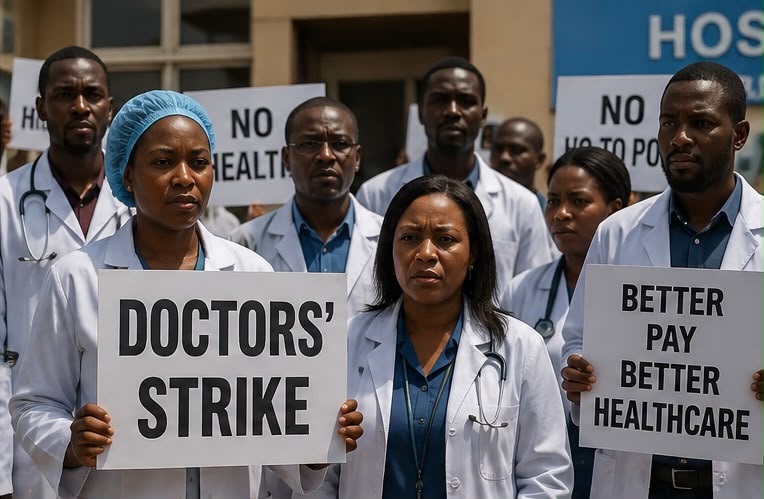
Nigeria’s public hospitals are facing another uncertain August as resident doctors threaten an indefinite strike, raising fresh questions about welfare, patient safety and the country’s struggling health system.
The latest warning came on Thursday, July 30, 2026, when the Nigerian Association of Resident Doctors (NARD) announced that its members would begin an indefinite nationwide strike from August 10 if the Federal Government fails to resolve outstanding issues affecting their welfare and working conditions.
The decision followed NARD’s National Executive Council meeting and Annual National Scientific Conference in Gombe. According to the association, unpaid salaries and allowances, delays in the release of the 2026 Medical Residency Training Fund, excessive workloads, inadequate infrastructure and violence against healthcare workers remain unresolved.
Addressing journalists after the meeting, NARD National President Dr. Muhammed Usman Suleiman said the association had reached a point where another industrial action appeared unavoidable. “The strike is unavoidable due to circumstances beyond the control of the association. Our members can no longer continue to work under conditions that undermine their welfare, safety and professional dignity.”
For patients who depend on public hospitals, however, the announcement raises a different concern: what happens when the people expected to provide care withdraw their services?
That question is not new. Nigeria has experienced repeated disputes between doctors and government, with similar complaints about unpaid entitlements, working conditions, training funds and staffing appearing in previous rounds of industrial action. In September 2025, NARD staged another nationwide warning strike over unresolved welfare issues. Reuters reported at the time that the association represented about 15,000 resident doctors, who play an important role in frontline services in public hospitals.
The consequences of a doctors’ strike are most visible far from negotiation rooms and government offices. They are visible in hospital waiting rooms.
During the NARD strike in November 2025, patients in several public hospitals experienced delays as outpatient and specialist services were disrupted. At Kubwa General Hospital in Abuja, a patient identified as Ishaya Gabriel told Premium Times that he had remained at the hospital hoping someone would attend to him despite being informed that doctors were on strike. “I have been hinted by the nurses that the doctors are on strike but I’m waiting and hoping someone would attend to me,” he said.
At the time, other patients were also forced to postpone consultations or seek alternatives. The experience illustrates the difficult position of patients during healthcare disputes. Many Nigerians who use public hospitals do so because private treatment is too expensive or unavailable in their communities. When services are interrupted, they cannot simply move to another hospital.
For a person waiting for specialist care, another delay may mean more transport expenses, more days away from work and, in some cases, a worsening medical condition.
This is what makes industrial disputes in healthcare particularly sensitive. A factory can stop production for a period and resume later. A hospital can reduce services, but illness does not wait for negotiations to end.
The demands of resident doctors extend beyond salary. NARD is asking for the payment of outstanding arrears from the 25 and 35 per cent CONMESS salary review, professional allowance arrears, promotion arrears and the release of the 2026 Medical Residency Training Fund. The association has also complained about excessive duty hours, poor infrastructure, workplace intimidation and physical attacks against doctors.
These concerns come as Nigeria continues to struggle with shortages and migration of health workers. The World Health Organization’s 2026 State of the Health Workforce in Africa report projects a needs-based shortage of 5.85 million health workers in the African Region by 2030, while warning that migration, unemployment and uneven distribution remain major challenges.
Nigeria is part of this wider workforce problem. When doctors leave public hospitals for better opportunities elsewhere, the pressure on those who remain increases. Fewer doctors can mean longer hours, heavier workloads and less time for rest. Over time, the pressure can affect both the wellbeing of health workers and the quality of care available to patients.
The problem can therefore become a cycle. A shortage creates heavier workloads. Heavy workloads increase frustration and exhaustion. Poor working conditions make retention more difficult. When more workers leave, those who remain carry an even greater burden.
The Federal Government says it has not ignored the concerns of resident doctors. In January 2026, Minister of State for Health and Social Welfare Dr. Iziaq Adekunle Salako said the government had approved an upward review of health workers’ professional allowances that would add about ₦90 billion annually to government spending. He described the dispute with NARD as involving structural and policy issues rather than deliberate neglect and said negotiations had reduced the association’s outstanding demands from 19 to nine at that point.
The Ministry has also pointed to previous releases for residency training and the payment of outstanding health-worker arrears as evidence of progress.
But NARD’s latest announcement suggests that the association believes implementation remains too slow.
That difference is at the heart of the present dispute. Government may point to approvals, committees and released funds, while doctors look at what has actually reached their accounts, hospitals and training programmes. For patients, neither argument is as important as whether services remain available when they need them.
The concern about working conditions is also linked to patient safety. During the 2025 NARD strike, a consultant at Ahmadu Bello University Teaching Hospital, Zaria, told Premium Times that the withdrawal of resident doctors had sharply reduced the number of patients being treated.
“We only treated four patients today with minimal cases and didn’t admit them,” the consultant said.
The statement showed how dependent many public tertiary hospitals are on resident doctors. These doctors are not simply trainees standing on the sidelines. They are medical graduates undergoing specialist training while taking part in the daily care of patients. Reuters described them as pivotal to frontline healthcare in Nigeria, particularly in emergency services.
This is why NARD’s concerns about excessive duty hours and staffing shortages carry consequences beyond doctors’ personal welfare.
A tired and overworked health professional is operating within a system already under pressure. The longer such conditions continue, the more difficult it becomes to maintain a stable workforce and provide consistent care.
The deeper problem is that Nigeria’s health-sector disputes often return to familiar ground. Doctors complain about unpaid entitlements and poor working conditions. Government negotiations produce commitments. Some payments are made and some problems are resolved. But other issues remain, and another dispute eventually emerges.
The latest July 30 announcement shows that the cycle has not been fully broken. Preventing the August 10 strike would therefore be important, but avoiding this particular strike would not by itself solve the larger problem.
Nigeria needs a system in which agreements with health workers are followed by clear implementation, rather than repeated negotiations whenever another strike deadline approaches.
Residency training funds must arrive on time. Salary and promotion arrears need predictable payment systems. Hospitals need enough medical personnel to reduce excessive workloads. Healthcare workers also need protection from violence and intimidation.
NARD has raised concerns about attacks on doctors several times this year. In June 2026, the association issued a 21-day ultimatum over assaults and other forms of violence against healthcare workers, describing the situation as a serious threat to the country’s already strained health system.
The immediate task is to prevent another nationwide shutdown through serious negotiations before the proposed strike date.
But the longer-term task is bigger. Nigeria needs to retain the doctors it trains, create better working conditions in public hospitals and make agreements with healthcare workers more predictable and credible. The government also needs to recognise that funding the health workforce is not merely a wage issue. It is part of maintaining a functioning healthcare system.
Doctors, on the other hand, also have a responsibility to consider the patients who often have no alternative when public hospitals stop functioning. Industrial action may be a legitimate way to press for change, but patients should not continually become the unintended victims of disputes between workers and government.
The real solution lies in preventing those disputes from reaching breaking point in the first place.
The August 10 deadline is now a warning to both sides. For NARD, it is a warning that frustration among resident doctors has reached a level the association says it can no longer ignore. For government, it is another opportunity to demonstrate that agreements reached with health workers can be implemented before industrial action becomes inevitable.
For patients, however, the matter is much simpler. They need hospitals that remain open, doctors who are available, medicines that can be accessed and treatment that is not delayed by disputes they have no part in.
Nigeria cannot build a dependable healthcare system on exhausted doctors, repeated strikes and promises that take too long to become reality.
The best outcome before August 10 would therefore not simply be the suspension of another strike. It would be a credible agreement, followed by visible action, that gives doctors confidence in their workplace and gives patients confidence that when they enter a public hospital, someone will be there to care for them.
By Abigail Ijai Ijapari, Student of mass communication University of Maiduguri.