

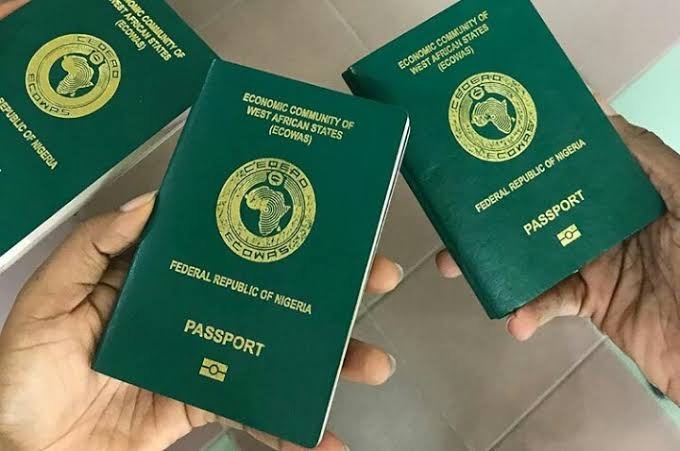
The federal government has announced ongoing initiatives to ensure that the processing time for Nigerian passports will not exceed one week after the application submission.
During a mid-tenure performance retreat held on Thursday in Abuja, Interior Minister Olubunmi Tunji-Ojo provided this assurance.
He outlined that the expedited processing timeline is part of the federal government’s reforms aimed at enhancing the passport issuance procedure.
The Nigeria Immigration Service (NIS) recently declared a 100% increase in passport fees, effective September 1, 2025. According to the NIS, the cost for a 32-page passport valid for five years will now be N100,000, while the 64-page booklet for ten years will be priced at N200,000.
“Our objective is clear: every Nigerian should receive their passport within one week of enrollment,” the minister stated. “Our commitment is not only to expedite delivery but also to ensure that the passports we issue uphold our national integrity.”
He emphasized that the new system is designed to eliminate the extensive delays and corruption that previously forced citizens to endure six to seven months of waiting and pay exorbitant fees for expedited services.
Mr. Tunji-Ojo explained that a centralized personalization center would facilitate quicker processing and enhance security measures.
“With this facility, we can produce five times the number of passports needed; once you enroll, it takes no more than 24 hours for vetting, as our printing capacity is now sufficient,” he noted.
Furthermore, he highlighted that his administration has successfully addressed the backlog of passport applications, which had accumulated over six months, clearing it in just two and a half weeks.
“Previously, Nigerians faced endless waits for passport applications or were pressured to pay hundreds of thousands of Naira,” he remarked.
The minister announced that passport control officers (PCOs) would no longer have the authority to approve or delay passport applications.
“This reform is aimed at combating corruption, minimizing delays, and restoring trust in Nigeria’s travel documents. We recognized that reducing human interaction is crucial to tackling corruption effectively.
“Passport approvals will no longer depend on the discretion of officers; my priority is to ensure efficiency and make Nigerians happy,” he added.
Mr. Tunji-Ojo also asserted that the reforms would help eliminate the illegal possession of Nigerian passports by foreigners.
He recounted an incident where a Ugandan woman was arrested at Lagos Airport while carrying a Nigerian passport, having paid $1,000 for its acquisition.
“That situation cannot persist, as our passport must remain a genuine representation of Nigerian identity,” he declared.
(NAN)