By Ankeli Emmanuel, Sokoto
The Sokoto State Commissioner for Religious Affairs has issued a direct appeal to the Nigerian media, urging outlets to consciously deny terrorists and bandits what he termed the “oxygen of publicity” by ceasing to glorify their activities. This urgent call comes amidst escalating national insecurity and growing concerns over the weaponisation of misinformation.
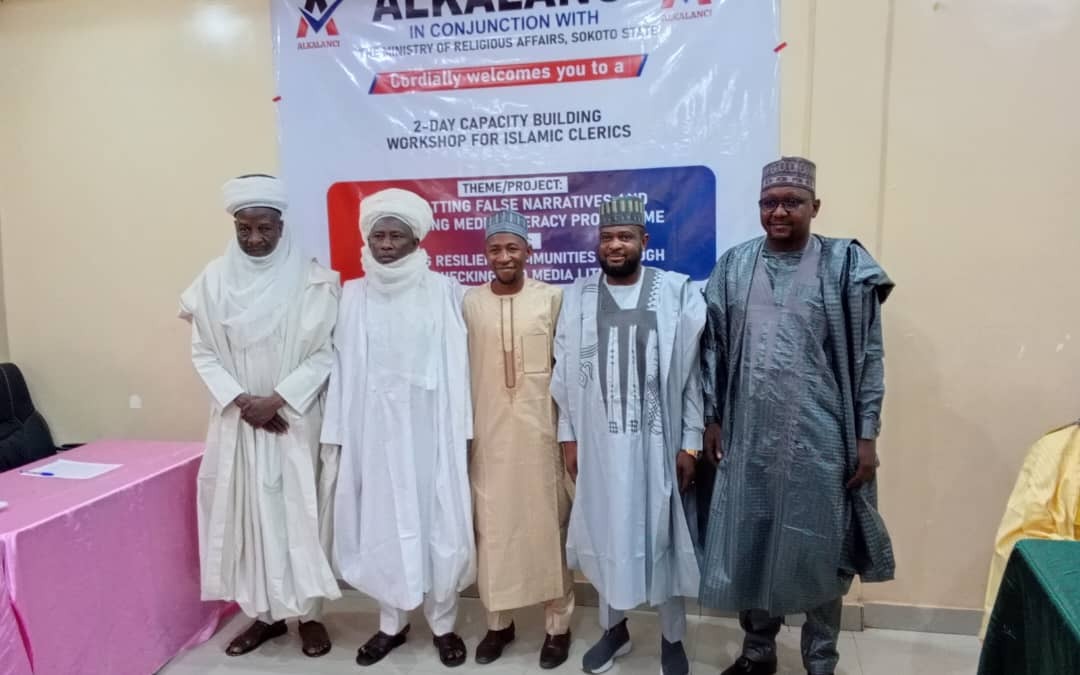
Associate Professor Jabir Maihula made the plea in Sokoto on Monday at the opening of a significant two-day workshop. The event, themed “Combatting False Narratives And Promoting Media Literacy,” was organised by the fact-checking organisation Alkalanci in collaboration with the Sokoto State Ministry for Religious Affairs. It brought together highly respected Islamic clerics from across the state.
Professor Maihula argued that extensive media coverage of insurgent attacks inadvertently fuels their notoriety and objectives. “It is imperative that our media institutions deliberately shift away from the pattern of free publicity given to these actors,” he stated. “Their thrive on attention; by constantly amplifying their atrocities, we provide them with the very oxygen they need to survive and intimidate. Responsible reporting must focus on the victims, national resilience, and security forces’ successes, not the macabre spectacle of violence.”
The commissioner emphasised that this media pivot is a critical component of a broader strategy to build resilient communities. Speaking on the topic “Building Resilient Communities Through Fact-Checking and Media Literacy,” he concurrently urged religious leaders to exercise extreme caution in their communications. He stressed the profound impact of sermons and the necessity for clerics to verify information rigorously before dissemination.
“This workshop is vital,” Maihula said. “Educating our revered religious leaders on how to authenticate information before spreading it is a cornerstone of social stability. Their words carry immense weight, and in an age of digital falsehoods, they must be armed with the tools to discern truth.”
The workshop gained further gravitas with the contribution of His Eminence, the Sultan of Sokoto and President-General of the Nigerian Supreme Council for Islamic Affairs (NSCIA), Muhammad Sa’ad Abubakar III. Represented by the Sarkin Malaman Sokoto, Ahmad Umar Helele, the Sultan underscored the pervasive threat posed by misinformation, disinformation, and malinformation.
The Sultan, a pivotal religious and traditional leader, framed national unity as a shared journey. He called on all Nigerians, particularly media professionals, to let caution, objectivity, and national interest guide their actions. “We must remember that we are all together in a moving vehicle,” the Sultan’s message conveyed. “We must continue to love and pray for the driver. If our attitudes while in this moving vehicle cause an accident, the driver is most likely to escape, while we, the passengers, suffer the brunt.”
This metaphor served as a powerful warning against rhetoric and reporting that could destabilise the nation, implying that elites often evade the worst consequences of chaos that affect ordinary citizens.
Setting the context for the gathering, Alhassan Bala, the Editor of Alkalanci, explained in his opening remarks that such initiatives were both timely and necessary. He highlighted the imminent danger as Nigeria approaches a period of heightened political activity. “The risk of misinformation and disinformation will significantly increase during an election year,” Bala noted. “Beyond local actors, Foreign Information Manipulation and Interference (FIMI) are also expected, as several countries have strong interests in Nigeria’s elections.”
Bala further pointed to the sophisticated new tools available to purveyors of falsehoods. “At the same time, artificial intelligence has made the creation of fake content more advanced. AI-generated images, videos, and audio—commonly known as deepfakes—are becoming increasingly difficult to detect.”
He stressed that in an era where information travels instantaneously, influential community leaders like clerics must understand the mechanics of falsehoods. “We live in an era where information travels faster than ever before,” he said. “This makes it even more important for clerics to understand how falsehoods are created and spread, and how influential individuals like them can protect their reputations and communities from being misled.”
Addressing the specific dangers of unverified social media content, Bala stated that much of what is shared is “inaccurate, misleading, divisive, and harmful,” posing a direct threat to peace, unity, and trust within communities. “That is why we are gathered here today in Sokoto to take a stand against falsehood and to equip ourselves with the knowledge and skills needed to build resilience through truth,” he concluded.
Analysis: A Converging Crisis of Security and Information
This workshop in Sokoto highlights a critical intersection between two of Nigeria’s most pressing challenges: physical insecurity and informational insecurity. The commissioner’s appeal recognises that the war against banditry and terrorism is not only fought on the ground but also in the narrative space. Continuous, graphic detailing of attacks can breed public despair, embolden perpetrators seeking recognition, and sometimes even provide them with tactical intelligence.
Concurrently, the focus on media literacy for religious leaders addresses a potent vector for misinformation. In communities where clerical authority is paramount, a sermon based on a false premise—a doctored video, a rumoured policy, or inflammatory fake news—can trigger real-world consequences, from social discord to violence.
The mention of impending election-year disinformation and foreign interference raises the stakes further. It signals an awareness that the information landscape is about to become more toxic, requiring proactive inoculation of key societal pillars. The inclusion of AI-generated deepfakes as a specific threat shows the workshop was engaging with cutting-edge risks, not just traditional rumours.
The Path Forward: Responsibility in Reporting and Receiving
The consensus from Sokoto is clear: a multi-pronged approach is essential. Media houses are called to adopt ethical frameworks that report on insecurity without sensationalism, prioritising context, solutions, and human dignity over graphic headlines that serve terrorist agendas.
For religious and community leaders, the mandate is to become nodes of verification, slowing the spread of falsehoods by applying critical thinking before amplifying any message. For the public, it is a reminder to consume media critically, especially in the hyper-charged atmosphere of an election cycle.
As Nigeria navigates complex security and political landscapes, the lessons from this Sokoto workshop resonate nationally. Building a resilient society requires not only security operations but also a disciplined, patriotic information ecosystem where truth is prioritised, and those who seek to destroy the nation are denied the oxygen of publicity they crave. The Sultan’s allegory of the moving vehicle remains a poignant reminder: the safety of the journey depends on the conduct of every passenger.