
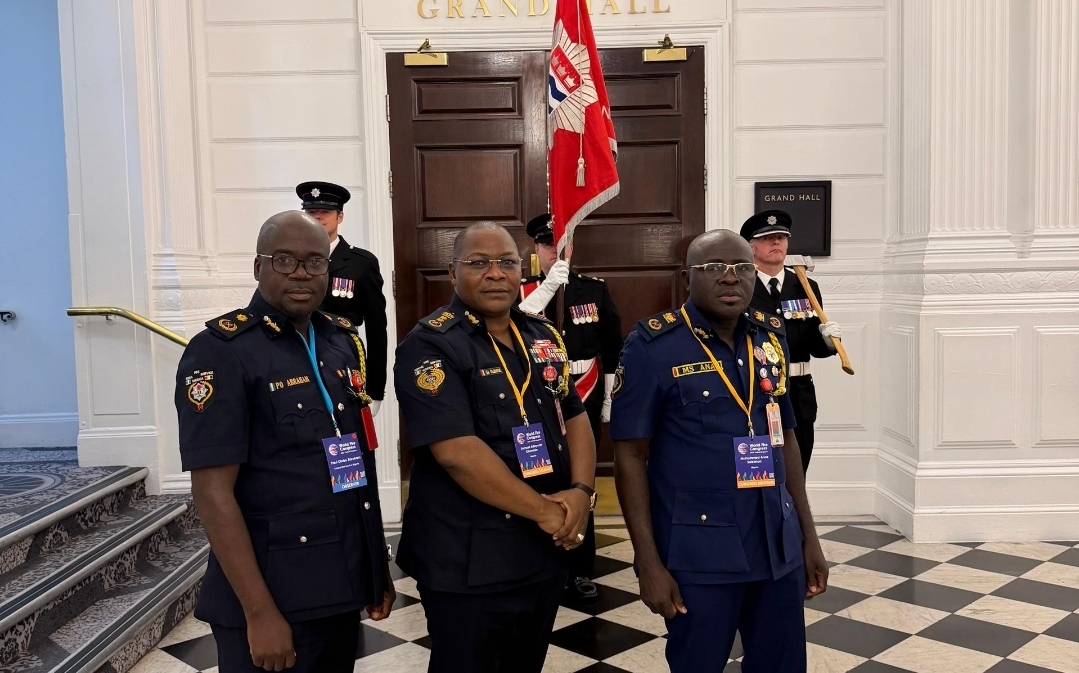
At the World Fire Congress in London, global emergency leaders are charting new paths to make communities safer and more resilient.
In a statement on Monday, DCF P.O. Abraham of the Federal Fire Service said Nigeria joined conversations on the full disaster management cycle from prevention to recovery and on how countries can adapt to emerging risks.
The forum also provided an opportunity for nations to learn from each other and build stronger partnerships for global safety.
The delegates at this first meeting of the World Fire Congress (WFC) comprise a diverse gathering of firefighting agencies that share common goals of protecting our communities and our shared environment.
Communities throughout the world face common evolving challenges, including firefighter health and safety, fire risks associated with emerging technologies, climate-change-driven wildfires, and structural fires.
The partner agencies of the WFC share responsibilities to gather and analyze information on all types of firefighting activities, including technical information related to building construction; the fire properties of materials; information on fire prevention and control laws, systems, methods, techniques, and administrative structures; and information on the causes, behavior, and best methods of control for other types of fire, including forest fires.
In a spirit of friendship, and for the common benefit of each community represented within the WFC, its delegates intend to share their collected knowledge with other WFC partner communities.
WFC delegates plan to meet to build relationships that will allow for more open, transparent, and effective sharing of information through communities of practice; to enable experts within our ranks to gather regularly to share strategies; to bring forward possible solutions to common challenges; to identify emerging problem areas and set priorities; and to monitor the progress of cooperative efforts and programs to reduce fire losses.
It is to the common benefit of all delegates and the communities they represent to share this information voluntarily, and in accordance with the principles of Dignity, Respect, and Equality for all delegates, partner communities, and their people, without restrictions on participation or the sharing of information on the basis of gender, race, color, nationality, language, disability, or sexual orientation.