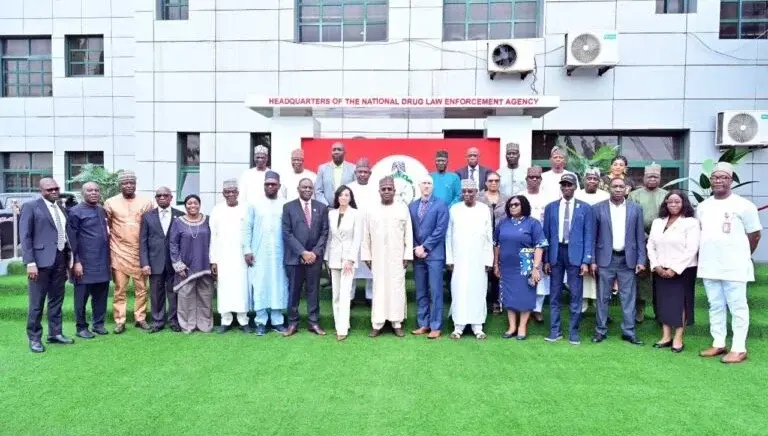
The National Drug Law Enforcement Agency (NDLEA) and the United States Drug Enforcement Administration (U.S.-DEA) have reaffirmed their commitment to strengthening collaboration to counter drug cartels and narco-terrorism.
The agencies made the commitment at a bilateral strategic counter-narcotics workshop held on Tuesday in Abuja.
Speaking at the event, the NDLEA chairman, retired Brig.-Gen. Buba Marwa said the workshop was strategic and timely.
Mr Marwa said it aligned law enforcement leadership from Nigeria and the United States on major drug-related threats affecting both countries and the global community.
“Our shared objective is to engage in frank, solution-driven discussions that will culminate in a joint declaration of shared priorities and a coordinated action plan for the next 12 months,” he said.
Mr Marwa noted that the global drug problem continued to evolve in complexity and scale, stressing the growing nexus between illicit drug trafficking and terrorism.
According to him, proceeds from drug trafficking have become a major source of funding for terrorist networks and violent extremist groups.
“This dangerous linkage, rightly described as narco-terrorism, poses a grave threat to global peace, security, and stability.
“The proceeds from the poison sold on our streets are the same funds used to purchase weapons that destabilise our regions. By attacking the drug trade, we are simultaneously starving the engines of terrorism,” Mr Marwa said.
The NDLEA chairman also said Nigeria’s strategic geographic location had made it a target for international drug trafficking organisations.
He added that increasing enforcement pressure on drug cartels in Latin America had led to a shift of operations towards Africa, with Nigeria emerging as a key transit hub.
“Today, a significant proportion of illicit drugs entering Nigeria is not intended for local consumption but for onward trafficking to Europe, North America, and Asia.
“This underscores the transnational nature of the threat and the urgency for coordinated international action,” he said.
Mr Marwa further said the workshop provided an opportunity to deepen collaboration, enhance intelligence-driven operations, and build a unified front against drug cartels.
He reaffirmed the agency’s commitment to the partnership, expressing confidence that sustained cooperation with the U.S.-DEA would yield measurable outcomes.
“The outcome of this workshop will serve as our operational guide for the coming year, with NDLEA prepared to lead the execution of the agreed action plan,” he added.
The NDLEA boss expressed appreciation to the U.S. government for its continued support to Nigeria.
He said the workshop would produce a clear framework for cooperation, with Nigeria taking the lead in implementing agreed actions within its jurisdiction, while the United States aligned with its national priorities.
“This partnership is not merely symbolic but operational, practical, and results-oriented. It is not just a diplomatic exercise but a strategic necessity,” he said.
He therefore urged participants to remain focused on delivering actionable outcomes.
In her remarks, the DEA Country Attaché, Daphne Morrison, commended NDLEA for its achievements under Mr Marwa’s leadership.
“The record-breaking seizures, arrests, and convictions in recent years are a testament to the agency’s dedication to the fight against drug abuse,” she said.
Ms Morrison described the workshop as a demonstration of a unified stand against transnational criminal organisations.
She added that the engagement would strengthen intelligence sharing, enhance joint operations, and provide training to address emerging challenges.
(NAN)