


The Federal High Court in Akure is set to hear a contentious suit filed by the Minister of Interior, Olubunmi Tunji-Ojo, against a social crusader, Emorioloye Owolemi, over allegations of cyberstalking—a move that has sparked a heated debate on the limits of free speech in Nigeria.
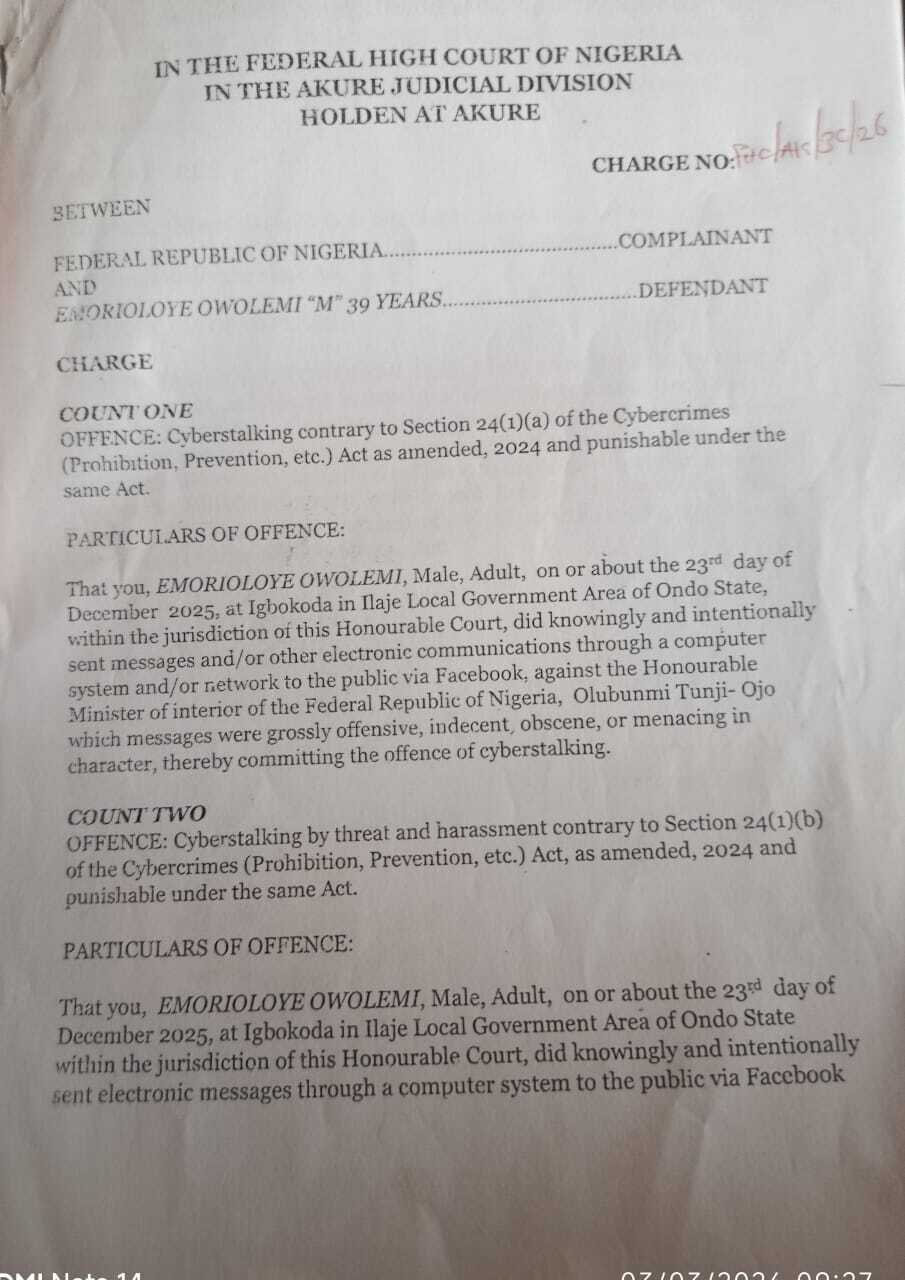
The lawsuit, which has been filed under case number FHC/AK/3C/26, accuses Owolemi of making “grossly offensive” statements against the minister on his Facebook page. The legal action comes amid swirling controversies regarding the authenticity of the Minister’s National Youth Service Corps (NYSC) certificate, a matter that has itself become the subject of a separate court inquiry.
The Allegations: What Did the Activist Post?
According to the charge sheet, the defendant, Emorioloye Owolemi, is facing a two-count charge bordering on cyberstalking and harassment. The alleged offences are said to have occurred on or about December 23, 2025, in the Igbokoda area of Ilaje Local Government Area, Ondo State.
Count one alleges that Owolemi “did knowingly and intentionally send messages and/or other electronic communications through a computer system and/or network to the public via Facebook” against the Minister. The said communications are described in court documents as being “grossly offensive, indecent, obscene, or menacing in character.”
The second count specifically addresses the issue of cyberstalking via threats and harassment. Prosecutors allege that the messages transmitted by the defendant via the social media platform contravene the provisions of the Cybercrimes (Prohibition, Prevention, etc.) Act, as amended in 2024 .
If found guilty, the activist could face severe penalties under the Act. Legal experts note that Section 24 of the amended Act provides for significant fines and imprisonment terms for individuals convicted of sending offensive or threatening messages online .
The Legal Framework: A Contentious Law
This case brings the 2024 amendment to the Cybercrimes Act back into the public spotlight. The amended legislation was designed to strengthen Nigeria’s legal framework against evolving digital threats, granting security agencies expanded surveillance powers and imposing stricter controls over online speech .
Specifically, the law criminalises the sending of messages that are deemed “false” or “misleading,” a provision that critics argue could be weaponised to silence government critics and activists . The police have previously clarified that comments constituting an insult or causing annoyance via digital platforms could fall under the purview of the Act .
However, the law is not without its challengers. Human rights lawyer Femi Falana (SAN) has previously argued that the now-amended sections of the Cybercrime Act were declared illegal by the ECOWAS Court for violating fundamental rights to freedom of expression. He has consistently called for the discontinuation of cases based on these provisions . This legal dichotomy—between national security laws and constitutionally guaranteed free speech—lies at the heart of the current dispute.
The Broader Context: The NYSC Certificate Controversy
The defamation suit cannot be divorced from the wider political context surrounding the Minister. For months, Tunji-Ojo has faced public scrutiny and allegations regarding his National Youth Service Corps (NYSC) certificate. Critics have raised questions about its authenticity and the timing of his service, leading to widespread debate on social media and traditional news platforms .
In a significant development just weeks before this lawsuit, a Federal High Court in Abuja granted an exparte application filed by the very same activist, Emorioloye Owolemi, seeking judicial permission to investigate the academic and NYSC credentials of the Minister. Justice Binta Nyako granted the motion on February 14, 2026, allowing Owolemi to approach the court for what he termed “an inquiry into the educational qualifications” of the public officer .
This earlier ruling sets the stage for a complex legal battle: the activist is now being sued by the Minister over comments related to the very issue he has received judicial permission to investigate.
Defenders of the Minister, however, have dismissed the certificate saga as a political witch-hunt. The Deputy Spokesman of the House of Representatives, Hon. Philip Agbese, has previously described Tunji-Ojo as a “super-performing minister” and labelled the allegations as “mere political noise by enemies of progress” . Furthermore, the NYSC has reportedly issued a statement confirming the authenticity of the Minister’s discharge certificate, pushing back against claims of forgery .
Legal analysts point out that while forgery is a criminal act, possessing an NYSC certificate is not a constitutional requirement for holding a ministerial position in Nigeria, a fact already established in Nigerian jurisprudence regarding political appointments .
Civil Society Reacts: “An Attack on Dissent”
The legal action has drawn sharp criticism from civil society organisations, who view it as a regression in democratic governance. The Concerned Citizens Leadership Integrity and Transparency Advocacy Initiative (CLITA) has condemned the Minister’s decision to seek legal redress, arguing that it represents an attempt to stifle legitimate dissent.
In a statement released in Abuja, the Executive Director of CLITA argued that Nigeria operates a democratic society where constructive criticism should be tolerated, not litigated. “What this step by Olubunmi Tunji-Ojo has shown is that he’s not learning anything from President Bola Tinubu, who has accepted constructive criticism as part of the recipe for good governance,” the statement read.
The group maintained that since serious issues have been raised regarding the Minister’s credentials, the appropriate and civil response should have been clarification and transparency, rather than resorting to legal intimidation. They accused the Minister of using “state apparatus” to silence dissenting voices .
CLITA is not alone in this stance. Other coalitions have previously warned against the “weaponisation of social media to smear public officials,” but they also caution that due process must not be abandoned in favour of “mob hysteria,” urging that legitimate queries be handled by state institutions .
What Next?
The Federal High Court in Akure has fixed March 26, 2026, for the hearing of the substantive suit. As the date approaches, all eyes will be on the judiciary to see how it balances the protection of public officials from defamation with the constitutional rights of citizens to freedom of expression and social criticism.
For now, the case of Federal Government vs. Emorioloye Owolemi stands as a critical test for Nigeria’s democratic resilience and the application of its cyber laws in an era of intense political scrutiny.