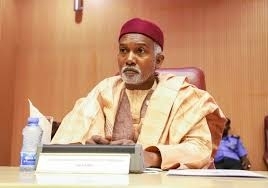

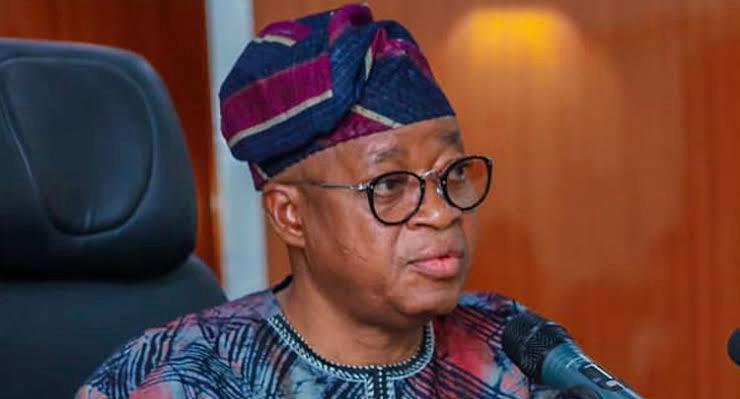
The minister of marine and blue economy, Adegboyega Oyetola, says Nigeria’s maritime sector is currently experiencing a remarkable resurgence, driven by deliberate reforms and a renewed policy direction.
Mr Oyetola said this in a statement issued on Wednesday in Abuja by his special adviser, Bolaji Akinola, adding that this was after decades of neglect and underinvestment.
He said that the revitalised sector was now contributing significantly to economic growth, job creation and overall national development.
The minister noted that the sector had unlocked genuine growth and development by systematically dismantling long-standing structural, regulatory and operational obstacles that had constrained it for decades.
He said the sector had been decisively repositioned for sustainable growth and competitiveness, adding that several entrenched challenges had also been addressed.
Mr Oyetola attributed the achievements to focused leadership, institutional reforms and improved coordination across key maritime agencies.
He noted that since he assumed office the sector had restored investor confidence, improved operational performance, and repositioned as a critical pillar of Nigeria’s economic diversification and industrialisation agenda.
“Foremost among these achievements was the resolution of the notorious Apapa gridlock, which for several years paralysed the Lagos port corridor, disrupted supply chains, and imposed severe costs on trade and logistics.
“In early 2024, sustained policy coordination, strict operational discipline and targeted infrastructure optimisation delivered lasting relief to Apapa and its surrounding areas, significantly improving traffic flow and port accessibility,” he said.
The minister said that the clearing of the Apapa gridlock reduced cargo dwell time, lowered logistics costs, enhanced port efficiency and removed a major disincentive to investment.
This, he said, effectively restored Lagos ports as functional gateways for national and regional commerce.
“Another major breakthrough recorded by the sector is Nigeria’s return to the International Maritime Organisation (IMO) Council after a 14-year absence from the global maritime decision-making body,” Mr Oyetola said.
According to him, the return marks a major restoration of Nigeria’s international maritime standing and strengthened its influence in shaping global maritime regulations.
He highlighted the approval secured for Nigeria’s first comprehensive port upgrade and modernisation programme in over 50 years, describing it as a historic milestone in the sector’s transformation journey.
He said the approval broke another long-standing jinx that had left Nigerian ports operating on obsolete infrastructure, signalling the beginning of a transformative era aligned with global standards and enhanced operational competitiveness.
“This initiative will attract larger vessels, improve cargo handling capacity and position Nigeria as a maritime and logistics hub for West and Central Africa,” the minister said.
Mr Oyetola also recalled the issuance of compliance certificates for the Bakassi Deep Sea Port and the Ondo Deep Sea Port to the governors of Cross River and Ondo, respectively.
He said the issuance of the certificates represented a critical regulatory breakthrough that cleared the way for accelerated investment, construction and eventual operations of the two ports, thereby expanding national port capacity.
Mr Oyetola said other notable achievements included the establishment of the Regional Maritime Development Bank (RMDB), and resolution of a 16-year stalemate that had long stifled access to affordable maritime finance.
He said that in 2025, approval was also granted for the Nigerian Maritime Administration and Safety Agency (NIMASA) to commence the long-awaited disbursement of the Cabotage Vessel Financing Fund (CVFF).
He said: “For over two decades, the fund has remained idle. Its activation now represents a major turning point for indigenous ship ownership, enabling operators to acquire modern vessels, expand capacity and compete more effectively,” he said.
(NAN)