
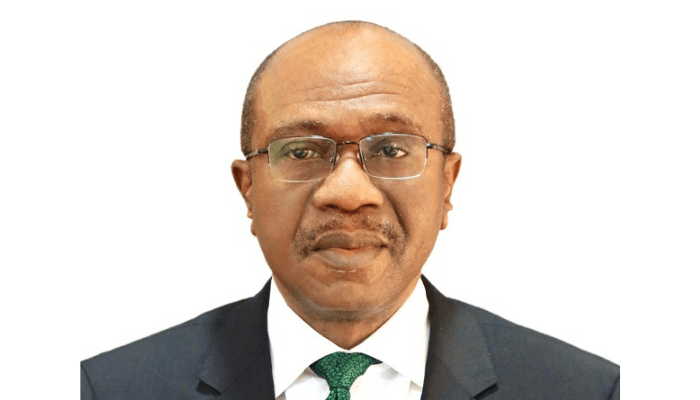
The Federal Capital Territory High Court has scheduled a ten-day period to conclude the trial of former Central Bank of Nigeria Governor Godwin Emefiele, who faces corruption charges related to the naira redesign initiative.**
Justice Maryanne Anenih announced the timeline following discussions with counsel for the Economic and Financial Crimes Commission (EFCC), Rotimi Oyedepo (SAN), and Emefiele’s lawyer, Olalekan Ojo (SAN). The trial, which commenced in 2024, is set to resume on specific dates: February 3 and 10, April 1 and 2, May 11, 12, 13, and 14, as well as June 9 and 10.
During the proceedings, Justice Anenih urged both legal teams to adhere to the scheduled dates, assuring them of the court’s commitment to accommodating their needs throughout the trial.
A key moment in the hearing involved testimony from EFCC operative Emere Chinedu, who confirmed that the Presidency, under former President Muhammadu Buhari, had granted approval for the naira redesign. Chinedu indicated that the approval included a directive that the printing of new notes be conducted domestically rather than abroad, contradicting Emefiele’s actions as the former CBN governor.
Chinedu, who led the Inter-Agency Probe Panel investigating Emefiele, stated that the former governor had provided six extra-judicial statements in his defence during the investigation, recorded on October 26, 27, 30, and 31, as well as November 1 and 2, 2023.
“In the course of our investigation, we sought records of the State House’s approval for the naira redesign. The response from the State House confirmed approval, but stipulated that the process must take place locally,” Chinedu explained.
When cross-examined by Emefiele’s counsel, Chinedu refrained from commenting on Emefiele’s claim that Abdulrasheed Bawa, a former EFCC Executive Chairman, was the first to propose the naira redesign to President Buhari. Chinedu clarified that the EFCC does not possess the authority to initiate changes to the naira’s design, stating that any such recommendations must be advisory in nature.
Additionally, the witness acknowledged that a series of video clips, showcasing public grievances regarding the hardships caused by the naira redesign, were available prior to the establishment of his probe panel. Chinedu confirmed that these clips were sourced from the internet and presented to illustrate the difficulties faced by Nigerians during the redesign process. However, he admitted to having no knowledge of the television staff who produced the content and did not interview anyone from the stations involved.
Further cross-examination of Chinedu has been scheduled for February 3, as the trial continues to unfold.
The outcome of this high-profile case could have significant implications for Nigeria’s financial governance and the integrity of its banking system. As the court prepares to delve deeper into the allegations against Emefiele, public interest remains high, with many watching closely to see how the judiciary will navigate this complex issue.
This trial not only highlights concerns about corruption and accountability within Nigeria’s financial institutions but also raises questions about the broader impact of policy decisions on the lives of everyday citizens. As the proceedings progress, the hope for transparency and justice in the country’s governance remains paramount.
As the trial dates approach, the legal teams will undoubtedly prepare for intense scrutiny, with the future of Emefiele and the credibility of Nigeria’s economic policies hanging in the balance. The court’s commitment to a thorough examination of the facts will be crucial in determining the outcome of this significant case.
As this story develops, Nigerians will be eager to see how the judiciary addresses the allegations and what this means for the future of financial policy in the country. The trial serves as a reminder of the ongoing struggle for integrity and accountability in Nigeria’s governance, an issue that resonates deeply within the nation’s collective consciousness.
In conclusion, the timeline set by the Federal Capital Territory High Court marks a critical phase in the ongoing legal battle against corruption in Nigeria. With the dates fixed and both sides prepared for the next steps, the nation watches closely, hoping for a resolution that reinforces the rule of law and transparency in governance.