
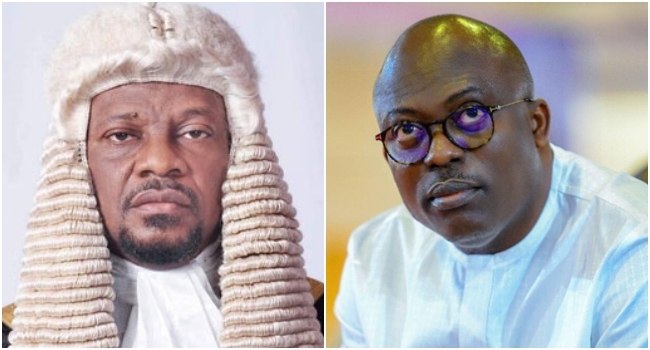
A fresh political crisis appears to be brewing in Rivers State as the Speaker of the State House of Assembly, Martin Amaewhule, accuses Governor Siminalayi Fubara of reigniting tensions in the oil-rich region.
Amaewhule specifically alleges that Fubara has been dishonest, denying the governor’s claim of being unable to meet with the lawmakers.
“It is crucial that I clarify this: the governor lied when he stated he hadn’t been able to meet with members of the Rivers State House of Assembly,” Amaewhule asserted.
“Shortly after the State of Emergency was lifted, the FCT Minister convened a meeting with the governor and principal officials of the Assembly. I can confirm I was present at that meeting.”
The Speaker maintained that lawmakers had met with the governor on several occasions, directly contradicting Fubara’s public assertions. He described the governor’s comments as “insincere” and indicative of what he termed “poor leadership.”
Amaewhule further alleged that Fubara’s statements were a deliberate attempt to create the impression of a breakdown in communication, a move he believes is paving the way for yet another political crisis in the state.
He urged the people of Rivers to disregard the governor’s remarks and to remain vigilant as political tensions continue.
### ‘No Rift With Lawmakers’
In response, Governor Fubara dismissed speculations of a rift between himself and federal or state lawmakers from Rivers, insisting that claims of strained relations are unfounded.
The governor made this statement during the commissioning of the extended and dualised 28.4-kilometre Ahoada–Omoku Road.
He stated that, contrary to insinuations of avoiding the lawmakers, arrangements were already in place for a meeting with them.
Having recently defected from the PDP to the APC, Fubara called upon the people of Rivers to continue their support for President Bola Tinubu.
He explained that the plan was for his predecessor and FCT Minister, Nyesom Wike, along with elder statesman Ferdinand Alabraba and other leaders, to convene the session.
According to him, anyone claiming that he refused to meet with the lawmakers or rejected proposals concerning them “is not telling the truth.”
The governor communicated to his supporters that his decision to join the APC was not driven by personal ambition but was intended to foster peace in the state and ensure steady progress.
He urged them to remain steadfast, avoid divisive politics, and support both the President and the state government.
### Political Rift
Fubara succeeded Nyesom Wike as governor of Rivers State following the 2023 governorship election, but less than two years into his term, tensions arose between the governor and his predecessor over the control of the state’s political structure.
Amid the ongoing political crisis, which also involved the Martin Amaewhule-led House of Assembly, President Tinubu imposed a state of emergency in Rivers State on March 18, 2025, suspending the governor, his deputy, and the Assembly members for an initial six months.
Citing Section 305 of the 1999 Constitution, Tinubu stated that he could not stand by as the political situation in Rivers deteriorated.
He appointed and swore in retired naval chief, Vice Admiral Ibok-Ete Ibas (rtd), as the sole administrator for the oil-rich Niger Delta state.
### Reconciliation
However, in June, the President met with Fubara, Wike, Amaewhule, and other members of the Assembly, signalling a reconciliation among key figures.
Fubara and Wike, now the Minister of the Federal Capital Territory, were later seen attending a ceremony together in the state.
On September 17, President Bola Tinubu announced the suspension of emergency rule in Rivers State, explaining that, based on available intelligence, there was a new spirit of understanding, “a robust readiness, and potent enthusiasm among all stakeholders in Rivers State for an immediate return to democratic governance.”
This development was viewed as a positive outcome and a significant achievement for the country.