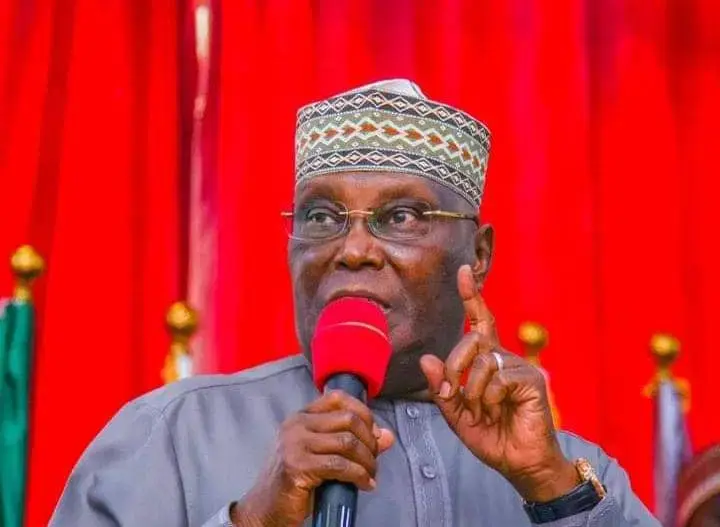
Former Vice-President Atiku Abubakar and Africa’s richest man, Aliko Dangote, on Friday, urged for a revival of Northern unity and consistent policy-making.
The pair also advocated a return to the region’s historical development priorities as the Arewa Consultative Forum (ACF) celebrated its 25th anniversary in Kaduna.
Speaking at the event, Mr Abubakar congratulated the ACF for what he termed “shouldering the mantle of Northern leadership through thick and thin” over the past quarter-century, despite political shifts and socio-economic pressures that have tested the organisation’s resilience.
He paid heartfelt tributes to the former ACF leaders who have passed away, stating that their sacrifices helped to anchor the North during uncertain times.
“May God shower His mercies upon them,” Mr Abubakar prayed.
He remarked that anniversaries like the ACF’s serve as moments not only for celebration but also for serious reflection on the founding vision of organisations and their current relevance.
The former vice-president recalled that in 1999, the region was deeply divided along political lines, prompting efforts to rebuild cohesion. He explained that he convened a committee led by the Emir of Ilorin, Ibrahim Sulu-Gambari, to harmonise various Northern political blocs into a single platform.
This effort, he noted, ultimately led to the establishment of the ACF as a united regional voice under the leadership of former Head of State, retired General Yakubu Gowon, and the late M.D. Yusufu, former Inspector-General of Police.
Mr Abubakar stated that the formation of the ACF aimed not only at fostering unity but also at reviving the region’s core development agenda as articulated by the late Premier Sir Ahmadu Bello in the 1960s.
He asserted that the original Northern priorities—education, agriculture, and industry—remain relevant even today.
He outlined initiatives undertaken under the National Development Programme (NDP) during his tenure, including the Northern Educational Project led by Adamu Baikie, which aimed to rebuild schools, retrain teachers, and restore dignity to the teaching profession.
Mr Abubakar also highlighted the NDP’s agricultural reforms, which involved experts formulating new policies to enhance yields, strengthen value chains, and integrate climate-resilient strategies into farming.
Industrial mapping exercises, he noted, revealed persistent challenges such as energy shortages, financing issues, and multiple taxation.
He warned that many of the obstacles identified two decades ago remain unresolved, cautioning that the region could not afford complacency if it hopes to unlock its latent potential. “We must not stagnate,” he urged.
On the topic of unity, he remarked that the North’s greatest weakness has been its inability to manage diversity effectively, despite examples of highly diverse countries like India and China that have leveraged pluralism for development.
Mr Abubakar cited Ahmadu Bello’s famous assertion that Northern strength lies in its diversity. He warned against external forces attempting to sow division within the region through misinformation and fear-mongering, adding that only just and inclusive leadership could ensure the North’s stability.
Looking to the future, Mr Abubakar expressed concerns about demographic pressures, food insecurity, educational deficits, and unemployment, warning that Nigeria’s projected population growth necessitates urgent strategic planning.
The 21st-century landscape, he stated, would not tolerate “absentee leadership or leadership without vision.”
In his remarks, Mr Dangote echoed Atiku’s concerns, stressing the need for deliberate policy frameworks to reposition the North economically.
He recounted previous studies commissioned to understand the failures of industries and business leaders in the region, revealing that policy inconsistency and inadequate electricity supply were significant constraints.
Mr Dangote noted that these challenges persist and continue to undermine industrial growth, stating that his companies avoid reliance on the national grid due to power instability.
“There is no way you can have growth without electricity,” he warned.
He asserted that while industrialisation is essential, it is difficult under current economic conditions, including high interest rates and inflation.
Mr Dangote urged Northern political leaders to develop new policies that would make education, industry, and agriculture the pillars of development, insisting that the region possesses sufficient resources to lead West Africa in food production.
He attributed rising insecurity and banditry partly to the failure to industrialise and modernise agriculture. He emphasised that all leaders, including himself, share responsibility for the region’s current challenges and must collaborate to reverse the trend.
“If we don’t resolve these issues, they will consume every one of us,” he stated.
Both Messrs Abubakar and Dangote appealed to Northern elders, policymakers, and stakeholders to recommit to the ideals of unity, purposeful leadership, and socio-economic transformation.