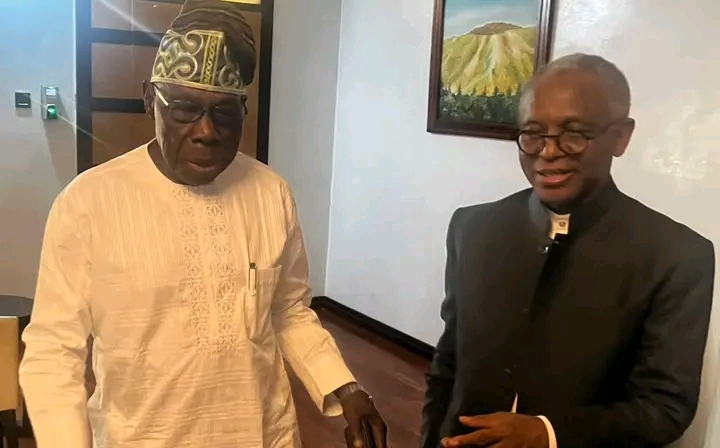
Former President Olusegun Obasanjo revealed on Friday that he turned down a proposal to endorse former Kaduna State Governor, Malam Nasir El-Rufai, as his successor.
During Obasanjo’s administration, El-Rufai served as the Director-General of the Bureau of Public Enterprises (BPE) before becoming the Minister of the Federal Capital Territory (FCT) from 2003 to 2007.
As he was preparing to leave office in 2007, Obasanjo endorsed the late President Umaru Musa Yar’Adua as his successor.
While speaking in Abeokuta, Ogun State, at the second edition of the annual symposium of the Ajibosin Platform, themed “Importance of Leadership in Governance,” Obasanjo disclosed that former Minister of Aviation, Osita Chidoka, had suggested El-Rufai as his successor, a recommendation that he dismissed.
Chidoka, the keynote speaker at the event, recounted how El-Rufai had recommended him to Obasanjo when he was just 34, a move that propelled him closer to the presidency and ultimately led to his appointment as the Corps Marshal of the Federal Road Safety Corps (FRSC).
During his address, Obasanjo took a swipe at Chidoka for not fully disclosing the circumstances surrounding the recommendation of El-Rufai.
“Let him tell you. He didn’t mention that he was advocating for his friend, El-Rufai, to succeed me when I was leaving government,” Obasanjo remarked.
Turning to Chidoka, who was seated among the panelists, Obasanjo asked, “Is that not true?” to which the former minister nodded in agreement.
Obasanjo explained that he disregarded the suggestion to appoint El-Rufai as his successor because he believed that the former minister required further maturity.
“I did not yield to the pressure. Later, he said, ‘I suggested this person, why didn’t you agree?’ I responded that El-Rufai needed to mature. Do you remember?”
“Years later, after I left government and witnessed El-Rufai’s performance, he returned to me and admitted, ‘You were absolutely correct. El-Rufai needed to mature,’” Obasanjo added.
Nevertheless, Obasanjo commended Chidoka, El-Rufai, and others for their “special attributes,” which he identified as significant contributors to his administration.
In his remarks on the theme, the Ota farmer highlighted character, exposure, experience, and training as essential qualities of effective leadership.
Obasanjo stated, “It is only in politics that I discovered there is no formal training for leadership. Even among armed robbers, I was informed there is an apprenticeship.
“But in politics, there is no training in leadership, and that is unacceptable.”
In his keynote address, Chidoka attributed Nigeria’s challenges to what he termed excuses and a culture of alibi in politics.
“Leadership finds its true measure not in rhetoric or charisma but in the systems it establishes.
“Moral conviction must translate into the everyday mechanics of governance—rules, routines, and institutions that ensure competence is predictable and corruption is minimised.
“Nigeria’s issue has never been a lack of ideas; rather, it is the absence of systems robust enough to endure beyond their creators,” he explained.
He advocated for a transition from excuses to action and personal accountability.
“We must therefore make leadership answerable not to rhetoric but to results: this can be achieved by constructing national dashboards and accountability systems that monitor every promise, every budget, every outcome. We must bolster the institutions that assess government performance and reveal complacency,” he stated.
The convener of the symposium, Aare Olanrewaju Bakinson, noted that the lecture aimed to explore the pivotal role that effective leadership plays in shaping societies and nations.
“Leadership is not merely about power; it encompasses responsibility, vision, and service. In exploring this theme, we will examine the qualities of good governance, the impact of leadership on development, and strategies for promoting ethical leadership,” he remarked.
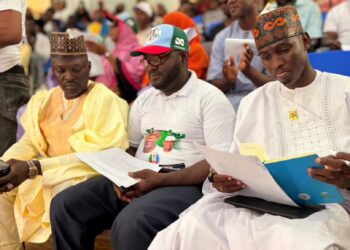
Prominent personalities in attendance included Senator Shuaibu Salis, representing Ogun Central; the Olowu of Owu Kingdom, Oba Saka Matemilola; the Olota of Ota, Oba Adeyemi Obalanlege; and former Ogun First Lady, Mrs. Olufunsho Amosun.