
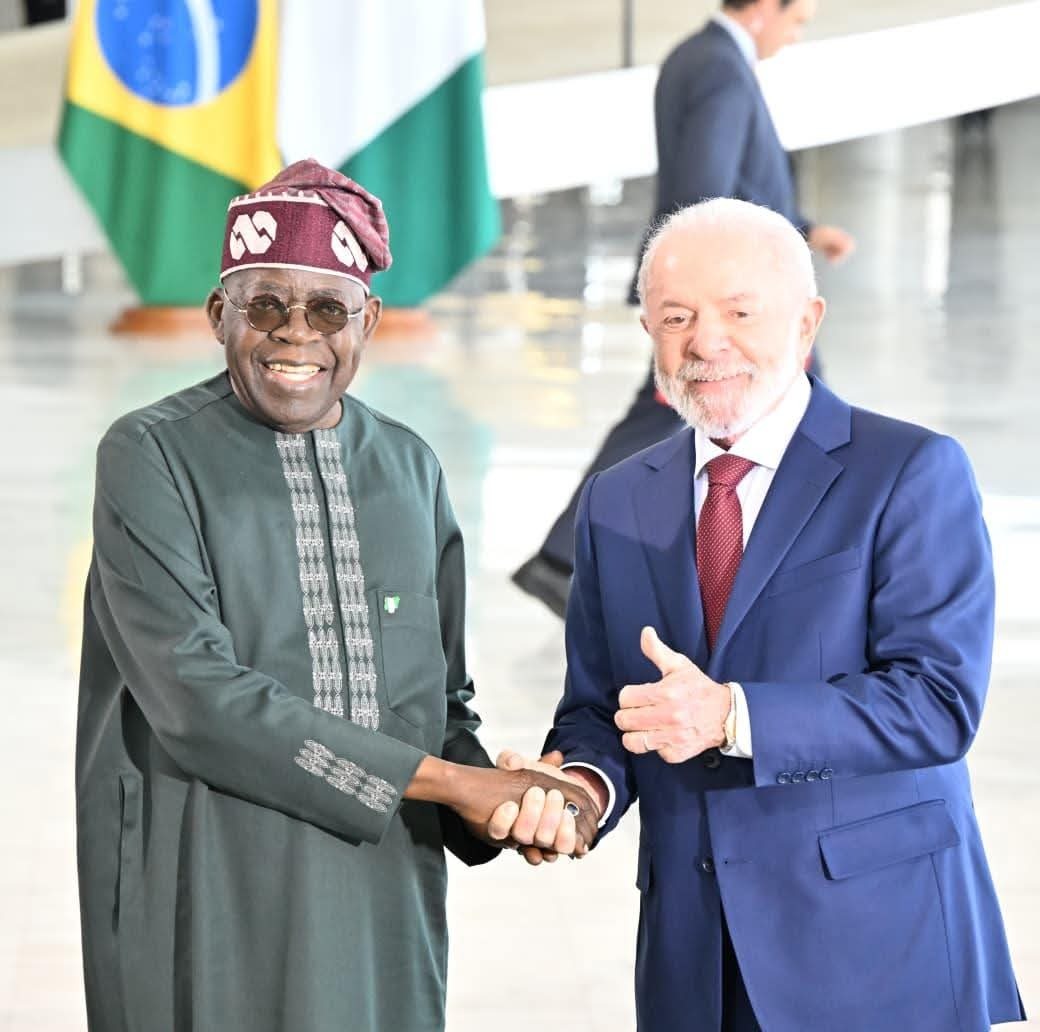
During President Bola Tinubu’s official visit to Brazil, Nigeria and Brazil solidified their economic partnership by signing five Memoranda of Understanding (MoUs) aimed at bolstering cooperation in trade, diplomacy, science, aviation, and finance. The agreements were formalized in a meeting between President Tinubu and Brazilian President Luiz Inácio Lula da Silva.
President Tinubu expressed enthusiasm for Petrobras’ planned return to Nigeria, marking a significant development five years after the Brazilian state-owned oil company ceased its joint venture operations. He stated, “We possess the largest gas reserves, and I see no reason why Petrobras should not re-enter Nigeria as a partner at the earliest opportunity,” while acknowledging President Lula’s commitment to facilitating this process.
He commended President Lula’s dedication to revitalizing bilateral relations, emphasizing that Nigeria’s economic landscape is ripe with opportunities for Brazilian enterprises. Additionally, he recognized Embraer’s initiatives to tackle the pressing challenges faced by local airlines in Nigeria, particularly through the establishment of a Service Centre aimed at providing essential repair and maintenance services for the growing fleet in the region.
President Tinubu underscored the necessity of transitioning from symbolic connections to tangible economic collaboration. He remarked, “Honourable Ministers from both nations and members of the Brazil Business Group, I have attentively listened to President Lula. Our discussions delved into our shared history and the rich cultural heritage of Africa and Brazil.” He continued, “We explored the reasons for our current standing and recognized that Nigeria, as the most populous and dynamic nation, should be in a position to share knowledge—be it in technology, energy, or economic growth—with Brazil to expand opportunities across Africa, which is an emerging frontier.”
He identified key areas for collaboration, including technology transfer, food security, manufacturing, and renewable energy, stating, “Embracing these elements through technological advancement, rapid development, research, food sovereignty, and manufacturing is imperative.” He also highlighted the importance of investment and knowledge sharing in healthcare and pharmaceuticals.
“We have elevated our commitments to a tangible reality, as evidenced by the various MoUs signed,” he said. “I see no reason why Nigeria cannot engage in the manufacturing of generic drugs, a sector where Brazil has excelled. It is essential that Brazil’s technological advancements are shared with Africa, as only we can drive the development of our economies to enhance our sovereignty.”
In response, President Lula welcomed the renewal of the Brazil-Nigeria partnership, asserting, “In an era marked by protectionism and unilateralism, Nigeria and Brazil reaffirm our commitment to free trade and productive integration.” He also addressed the BASA agreement, emphasizing the significance of enhancing direct connections between Nigeria and Brazil to fortify societal ties.
The signing of the agreements and MoUs took place at the Palácio do Planalto in Brasília, with Nigeria recognized as Brazil’s 49th largest export market, with bilateral trade reaching nearly US$2.1 billion in 2024. Brazil’s exports to Nigeria amounted to almost US$1 billion, primarily in sugar and jams, while imports totaled US$1.1 billion, predominantly in fertilizers.
President Tinubu reassured investors that Nigeria’s economic reforms are yielding positive outcomes, stating, “The reforms I have initiated have been impactful. Though initially challenging, the results are now becoming apparent.” He added that these reforms have facilitated a more favorable business environment in Nigeria, marked by increased foreign exchange availability and a reduction in corruption.