
By Pam Ayuba
Nigeria’s 2027 politics is beginning to reveal its real character.
Beneath the familiar language of APC, PDP, NDC, ADC, Labour and the rest lies a much deeper struggle – a contest for political structures, electoral influence, succession, legislative control and, perhaps most importantly, the political architecture of post-2027 Nigeria
Again, it is not simply a contest between the APC and the opposition. It is not merely President Bola Ahmed Tinubu seeking another term. Neither is it simply the struggle of a fragmented opposition attempting to find a common platform.
Something deeper is happening.
The political class is quietly renegotiating the structure of power that will emerge after the 2027 elections.
That is why the controversy surrounding the so-called Rainbow Coalition deserves much closer scrutiny than the usual partisan arguments suggest.
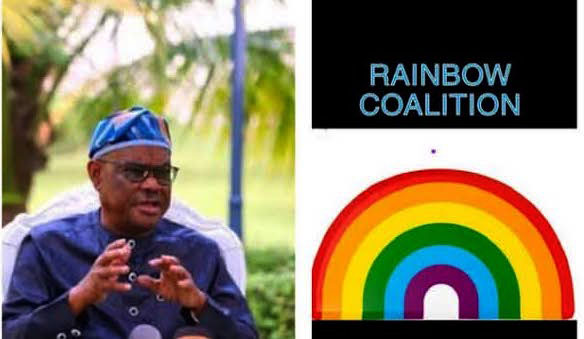
The coalition, promoted by the Minister of the Federal Capital Territory, Nyesom Wike, has presented itself principally as a cross-party platform for the re-election of President Tinubu. Wike has repeatedly made the point that his commitment is to Tinubu’s presidential bid, not necessarily to every APC candidate contesting governorship, Senate, House of Representatives or State Assembly elections.
That distinction is not a minor technicality.
It is the heart of the matter.
And it explains why the Rainbow Coalition has become a source of unease within sections of the APC.
Wike has now declared that the Rainbow Coalition has come to stay. At the same time, some APC governors have insisted that political loyalty cannot be divided – if a politician supports the APC at the presidential level, he should support APC candidates all the way down the ballot.
That disagreement exposes the fundamental fault line.
Is 2027 going to be an election in which the President’s supporters must necessarily support the APC at every level?
Or can Nigeria enter an era of deliberate split-ticket politics in which a voter, politician or political bloc supports Tinubu for President while backing different candidates for governor, Senate and House of Representatives?
The answer may determine the political architecture of the next four years.
THE RAINBOW IS NOT WHAT EVERYBODY THINKS IT IS
The first mistake in analysing the Rainbow Coalition is to assume that it is simply another opposition coalition.
It is not.
It is also not, strictly speaking, an APC coalition.
It is a cross-party political arrangement built around one central objective – securing the re-election of President Tinubu.
That distinction matters.
Wike remains a member of the PDP while serving in an APC-led federal administration. He has made no secret of his decision to support Tinubu in 2027.
The APC Governors Forum, however, has drawn a different line. Its position is that APC governors will campaign for APC candidates at all levels and will not support arrangements that weaken the party or its candidates.
This is not merely a disagreement over campaign strategy.
It is a disagreement over the meaning of political loyalty.
The governors are looking at the election through the prism of party organisation.
Wike is looking at it through the prism of political influence.
Those are two very different calculations.
THE WIDENING GAP BETWEEN PARTY AND POLITICIAN
Nigeria’s political system has always been dominated by personal networks.
Political parties provide the platform, but candidates often provide the real machinery.
A governor may command more loyalty in his state than his party chairman.
A former governor may retain influence years after leaving office.
A senator may have a political network that cuts across party boundaries.
A local political leader may deliver a ward without ever occupying a formal party position.
The Rainbow Coalition is exploiting this reality.
Its implicit proposition is simple:
You do not have to change your party to support the President.
That proposition is politically attractive to politicians who want to preserve their own platforms while maintaining access to the federal political establishment.
It is equally attractive to politicians who have fallen out with their party’s hierarchy but do not want to surrender their political relevance.
This is where the Rainbow becomes more than a campaign arrangement.
It becomes an instrument of political accommodation.
WHY ARE SOME APC GOVERNORS WORRIED?
The APC Governors Forum has publicly rejected any political arrangement capable of weakening the party or adversely affecting APC candidates.
That position is entirely understandable from the perspective of governors.
A governor does not contest only to occupy the Government House.
He wants a political structure capable of protecting his influence after leaving office.
That structure includes senators, members of the House of Representatives, state assembly members, local government leaders, party officials and, in many cases, a preferred successor.
A governor who loses control of these structures can quickly become politically vulnerable.
This is why the fight over the Rainbow Coalition should not be reduced to a quarrel between Wike and some APC governors.
There is a much larger struggle underneath it.
It is a struggle over who controls the political machinery after 2027.
THE NATIONAL ASSEMBLY QUESTION
Wike has alleged that some governors are uncomfortable with the Rainbow because they want to influence the emergence of the leadership of the next National Assembly.
That remains Wike’s allegation and should not be presented as established fact.
But politically, the issue deserves attention.
The next National Assembly will be crucial to the post-2027 balance of power.
The Senate President, Deputy Senate President, Speaker and other principal officers will not emerge in a political vacuum.
Governors will have interests.
The Presidency will have interests.
National party leaders will have interests.
Senators and members-elect will have interests.
Former governors will have interests.
Political blocs will have interests.
Therefore, whoever controls the legislators controls an important part of the bargaining table.
This is why the battle over legislative candidates may eventually become more consequential than the public argument over the Rainbow itself.
THE REAL WEAPON: SPLIT-TICKET VOTING
There is an important political possibility that Nigerians should watch closely.
A voter can vote for Tinubu for President and vote for another party’s candidate for governor.
The same voter can support a different candidate for Senate and yet another candidate for the House of Representatives.
Nothing prevents such a voting pattern.
The real question is whether political organisations can deliberately mobilise it.
That is what makes Wike’s position consequential.
If the Rainbow Coalition succeeds in encouraging a significant number of voters to separate their presidential preference from their subnational preferences, it could produce an unusual electoral outcome.
Tinubu could win the presidency in a state while APC candidates lose some legislative or even governorship contests in that same state.
This would fundamentally challenge the traditional Nigerian model of political mobilisation.
For decades, political parties have tried to present the ballot as a single package.
The Rainbow idea potentially breaks that package apart.
THE POLITICAL CLASS HAS SEEN THIS MOVIE BEFORE
Nigeria has experienced versions of this phenomenon before.
The political lesson from the 2003 elections is particularly relevant.
Governors and political actors can support a presidential candidate while their own political structures face entirely different electoral realities.
The current situation therefore has historical resonance.
The difference is that today’s political environment is even more fragmented.
Party loyalty is weaker.
Personal political networks are stronger.
Social media has reduced the ability of party structures to control political messaging.
And voters are increasingly capable of making independent choices across different electoral contests.
The Rainbow Coalition may therefore be riding a wave that is larger than Wike himself.
BUT WHAT EXACTLY DOES Wike WANT?
This is where the political analysis becomes uncomfortable.
Wike says his objective is to support Tinubu.
That should be taken seriously.
But serious political analysis must also examine the structure of incentives.
Wike is an experienced political operator.
He understands the difference between presidential power and subnational power.
He also understands that political relevance is not necessarily dependent on holding a party leadership position.
By constructing a cross-party network around the President, he creates political space for himself and for others who may not be fully comfortable within the formal APC structure.
That does not automatically make the project sinister.
It makes it strategic.
And politics is, above all, about strategy.
THE PRESIDENT’S DILEMMA
President Tinubu is in a particularly delicate position.
He needs the APC.
But he also needs every credible political structure capable of delivering votes.
That means he cannot afford to reject politicians simply because they are not APC members.
At the same time, he cannot afford to allow a parallel political machine to become stronger than the party that nominated him.
This is the delicate balance.
The President wants the broadest possible electoral coalition.
The APC wants the broadest possible electoral victory for its candidates.
Those two objectives overlap at the presidential level.
They can diverge at the state and legislative levels.
That is the contradiction the Presidency must manage.
WHERE NENTAWE YILWATDA FITS INTO THE EQUATION
There has been considerable speculation about the position of APC National Chairman Professor Nentawe Yilwatda on the Rainbow Coalition.
His actual position requires careful reading.
Yilwatda has not endorsed the Rainbow Coalition as an APC arrangement.
Nor has he authorised APC governors or party members to support opposition candidates.
His argument is more pragmatic.
The APC, as a political party, cannot dictate whom politicians belonging to other parties should support for President.
If a politician outside the APC chooses to support Tinubu, that politician has the right to do so.
But the APC itself remains committed to its own candidates.
That distinction is important.
It means Yilwatda is not contradicting the APC Governors Forum on the question of party candidates.
Rather, he is drawing a boundary between what the APC can control and what it cannot control.
The APC can instruct its own structures to support APC candidates.
It cannot instruct PDP, Labour, APGA or other political actors whom to support.
That is a more defensible position than the suggestion that the APC leadership has embraced the Rainbow Coalition.
Indeed, Yilwatda’s recent public position makes it clear that the party expects its governors and structures to support APC candidates across the ballot.
At the same time, he recognises the political reality that outsiders may support Tinubu.
That is the distinction that should guide the debate.
THE NENTAWE FACTOR
There is also a larger political significance to Yilwatda’s position.
As APC National Chairman, he must protect the party.
As a national political figure from Plateau and the North-Central, he must also understand the complexities of regional politics.
The two responsibilities are not necessarily contradictory.
In fact, his recent North-Central mobilisation activities demonstrate that the APC leadership is actively building a regional structure around the Tinubu-Shettima ticket.
The North-Central political establishment has publicly rallied around the President’s re-election bid.
That is significant.
But it does not automatically mean that every politician or voter in the region will vote APC at every level.
That is where the real electoral contest begins.
THE MIDDLE BELT WILL BE A CRITICAL TEST
The Middle Belt may become one of the most important theatres of the Rainbow experiment.
The region is politically diverse.
It does not operate as a single electoral bloc.
Personalities matter.
Ethnic interests matter.
Religious considerations matter.
Local grievances matter.
Governorship performance matters.
Federal appointments matter.
Development matters.
Security matters.
And the identity of the candidate matters enormously.
Consequently, the assumption that presidential support automatically translates into support for every APC candidate could prove dangerous.
The APC may win the presidential contest in a constituency and lose the governorship or legislative election.
Conversely, an opposition candidate may win a governorship election while his supporters contribute significantly to a Tinubu victory at the presidential level.
That is the kind of political arithmetic the Rainbow Coalition is encouraging.
PLATEAU IS PARTICULARLY INTERESTING
Plateau State offers perhaps one of the clearest examples of this emerging complexity.
The state has a politically sophisticated electorate.
It also has a history of strong candidate-based politics.
Professor Nentawe Yilwatda is from Plateau.
Governor Caleb Mutfwang is the incumbent.
The APC has now positioned itself for a major contest in the state.
At the presidential level, Plateau APC is firmly mobilising behind Tinubu.
The North-Central mobilisation around the Tinubu-Shettima ticket has included Yilwatda and other regional leaders.
But presidential politics should not be confused with the governorship or legislative contests.
The ballot will contain different candidates.
The interests of the candidates will not always be identical.
And the loyalties of political actors may not necessarily move in one direction.
That is precisely where 2027 could become fascinating.
A politician may support Tinubu and still oppose another APC candidate.
A voter may support Tinubu and reject an APC legislative candidate.
A political leader may mobilise for the President but negotiate independently over the governorship.
This is not political hypocrisy.
It is the emerging reality of Nigerian electoral politics.
THE QUIET BATTLE FOR PLATEAU
The Plateau contest will therefore require more than party slogans.
The APC will have to determine how to balance national presidential mobilisation with local candidate management.
It cannot afford to assume that support for Tinubu automatically means support for every APC candidate.
At the same time, opposition parties cannot assume that opposition to the APC at the state level automatically translates into opposition to Tinubu.
The electorate may separate the two.
That is the challenge.
And that is where political sophistication will matter.
THE OPPOSITION IS ALSO IN TROUBLE
The opposition should not celebrate the Rainbow Coalition too quickly.
The APC has problems.
But the opposition has perhaps a bigger problem – fragmentation.
PDP remains divided.
The wider coalition-building project has experienced disagreements over leadership, platform, presidential ambition and political direction.
ADC’s attempt to become a major opposition vehicle has faced internal complications.
Other opposition actors are simultaneously trying to establish their own relevance.
The result is an opposition landscape populated by strong individuals but weak collective discipline.
This is the greatest advantage the APC currently possesses.
Nigeria’s opposition may have enough votes to defeat the ruling party.
But it has not yet demonstrated the organisational capacity to bring those votes together.
That is the difference between political popularity and electoral victory.
THE MATHEMATICS OF 2027
The opposition’s problem is not simply whether Nigerians are dissatisfied with the government.
The question is whether those dissatisfied voters will vote for the same alternative.
If Atiku supporters vote one way, Obi supporters another, Kwankwaso supporters another and regional political blocs pursue separate arrangements, the anti-APC vote can become numerically impressive but electorally ineffective.
The APC understands this.
That is why its most important strategy may not be defeating every opposition politician.
It may simply be preventing the opposition from becoming one coherent electoral machine.
The Rainbow Coalition complicates that calculation because it takes some politicians who might otherwise be naturally aligned with an anti-APC coalition and places them inside a pro-Tinubu network.
THE MOST IMPORTANT PEOPLE MAY BE THE LOSERS
There is another silent dimension of this politics.
The politicians who lost party primaries may become decisive.
Every primary election creates disappointed aspirants.
Some accept defeat.
Some defect.
Some become independent political operators.
Others seek alternative platforms.
If the Rainbow Coalition gives such politicians a route to support Tinubu while contesting against APC candidates under another platform, the APC could face an unusual problem.
It could win the presidency while losing seats it expected to win.
That would be the ultimate expression of split-ticket politics.
And it is probably one reason why the APC Governors Forum has been so emphatic about supporting APC candidates at all levels.
WHAT HAPPENS AFTER 2027?
This is where the analysis becomes even more interesting.
The real question is not whether the Rainbow Coalition can help Tinubu win in 2027.
The question is what happens to the coalition if Tinubu wins.
Will it dissolve?
Will its members return to their parties?
Will Wike become an even more powerful political broker?
Will the coalition seek formal recognition?
Will it become an internal bargaining bloc within the governing establishment?
Or will its members begin negotiating separately for the next phase of Nigerian politics?
These questions cannot be dismissed.
Political coalitions are usually created around immediate objectives.
But politicians rarely build national networks for one election alone.
The political capital accumulated in 2027 will have value in 2028, 2029, 2030 and beyond.
THE 2031 SHADOW
The 2031 election is already lurking behind 2027.
Nobody in serious politics can ignore it.
Every politician who is positioning himself today is also thinking about tomorrow.
Who controls the APC after Tinubu?
Who controls the National Assembly?
Who controls the states?
Who controls the governors?
Who controls the party’s national machinery?
Who controls the political structures in the North?
Who controls the Middle Belt?
Who controls the South?
Who has the financial and organisational capacity to negotiate a presidential nomination?
These questions may not be asked openly today.
But they are already being asked privately.
That is why the current alliances should not be interpreted solely through the language of 2027.
They are also positioning for the politics that comes after 2027.
THREE POSSIBLE OUTCOMES
There are at least three broad scenarios.
The first is that the Rainbow becomes absorbed into the APC after Tinubu’s victory.
In that scenario, the coalition would have achieved its immediate objective and its major figures could become part of the wider governing structure.
The second is that the Rainbow survives as an independent political bloc.
That would be more consequential.
It would create a political structure capable of supporting the Presidency while maintaining independent influence over legislative and subnational contests.
The third is that the coalition fractures after victory.
This may be the most familiar Nigerian outcome.
Before an election, everybody needs everybody.
After victory, everyone begins