

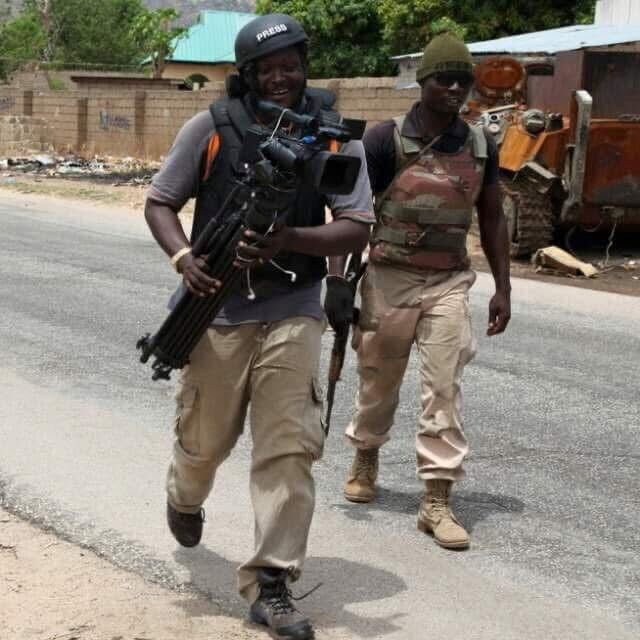
By Isaac Abrak
More than a decade after the Benisheik massacre, the same road, the similar tactics, and the same town are still making headlines.
News of another attack on Benisheik in Borno State has stirred painful memories of my closest encounter with Boko Haram fighters on September 18, 2013, on the road to Maiduguri.
That day remains unforgettable.
We had set out by road, as flights into Maiduguri had been suspended due to security concerns. From Damaturu, the tension was palpable. Passengers—both Christians and Muslims—prayed aloud throughout the journey, united by fear and uncertainty.
At a military checkpoint in Damaturu, our 18-seater commercial bus was stopped. Soldiers ordered everyone to disembark. In a move that initially seemed unusual, women wearing hijabs were asked to lift them and squat. The soldiers later explained that insurgents had begun using women to smuggle rifles hidden under hijabs into cities.
The atmosphere was tense. The soldiers, visibly agitated, questioned our driver about the official checkpoints between Damaturu and Maiduguri. He answered correctly. Then came a chilling warning: any other checkpoint along the road would be fake—set up by Boko Haram.
They instructed the driver not to stop under any circumstances, even if threatened with gunfire.
“If you stop, they will kill all of you,” one soldier warned.
For over an hour, we drove in silence and prayer.
Then we saw them
A long convoy of vehicles—armed, organized, and imposing. Fighters dressed in full military gear, faces masked, weapons mounted. To us, they looked like Nigerian troops.
Relieved, we waved, clapped, and even stretched our hands out in greeting as we drove past.
We did not know who they truly were.
It was only later, in my hotel room in Maiduguri, that the horrifying truth began to unfold: Benisheik had been attacked. Scores were dead.
The next morning, I met a my guy—Zaks, a native of Chibok—who had travelled the same road hours behind us. His account confirmed our worst fears. He described how travellers were stopped at what appeared to be a checkpoint, ordered out of their vehicles, and then shot at close range.
As more accounts emerged, a clearer picture formed. The convoy we had passed were not Nigerian soldiers—they were Boko Haram fighters.
After we drove by, they reportedly mounted fake checkpoints on both sides of the road. Vehicles were flagged down, passengers separated, and many taken into the bush or executed by the roadside.
By evening, about 160 people had been killed.
The attackers had also overrun the military base in Benisheik and moved into the town. Survivors recounted how some soldiers, caught off guard, fled into nearby homes, changed into civilian clothing, and escaped into the bush. Many others were killed. The base was destroyed.
That night, journalists gathered at the Borno State Government House to file their reports under pressure and exhaustion. The Borno State TVC crew was still new at the time—late Dala of blessed memory as reporter, alongside
Dala, clearly exhausted, suggested he would file his report the next morning.
I refused.
I told him plainly to sit down and write and file that story that night—or I would personally report him to Dapo Okunbanjo, then Head of TVC Abuja and the Northern Region. It may have sounded tough, but that moment demanded urgency. Lives had been lost on a massive scale—delay was not an option.
(Truth be told, journalism ginger was fully in my body at that time o😃.)
Benisheik became a symbol of vulnerability—a stark reminder of the cost of underestimating insurgency.
Years later, hearing of another attack in the same town—and the reported killing of a senior military officer alongside his men—is deeply troubling. It suggests that the lessons of the past have not been fully learned.
Benisheik is not just another location on the map. It is a place marked by repeated bloodshed. From mass killings of travelers to brutal attacks on farmers, its history demands serious attention.
The recurring narrative that insurgent attacks rise during election cycles should not serve as an excuse—it should be a call to action.
This is where a new approach becomes urgent. President Bola Ahmed Tinubu should move decisively to properly implement the Forest Guard as a national security framework—one that recruits and empowers people from forest communities and surrounding villages to protect their own terrain. Those who live within these environments understand the pathways, patterns, and movements that outsiders do not.
The current situation, where some states operate variants of forest guard systems while others do not, creates dangerous gaps that terrorists can easily exploit. It also undermines uniformity in operations, coordination, and commitment. A fragmented approach cannot effectively confront a networked threat. What is required is a standardized, nationally coordinated structure that integrates local knowledge with federal security architecture.
From years of reporting in hostile environments, I strongly believe this community-based forest security model—properly implemented—could provide the new momentum needed to turn the tide against terrorism in Nigeria.
Benisheik has suffered enough. Nigeria must not just remember Benisheik—we must finally learn from it.
Isaac Abrak is a hostile environment journalist and winner of the Reuters Mohammed Amin Award for Africa’s Best Hostile Environment Journ