
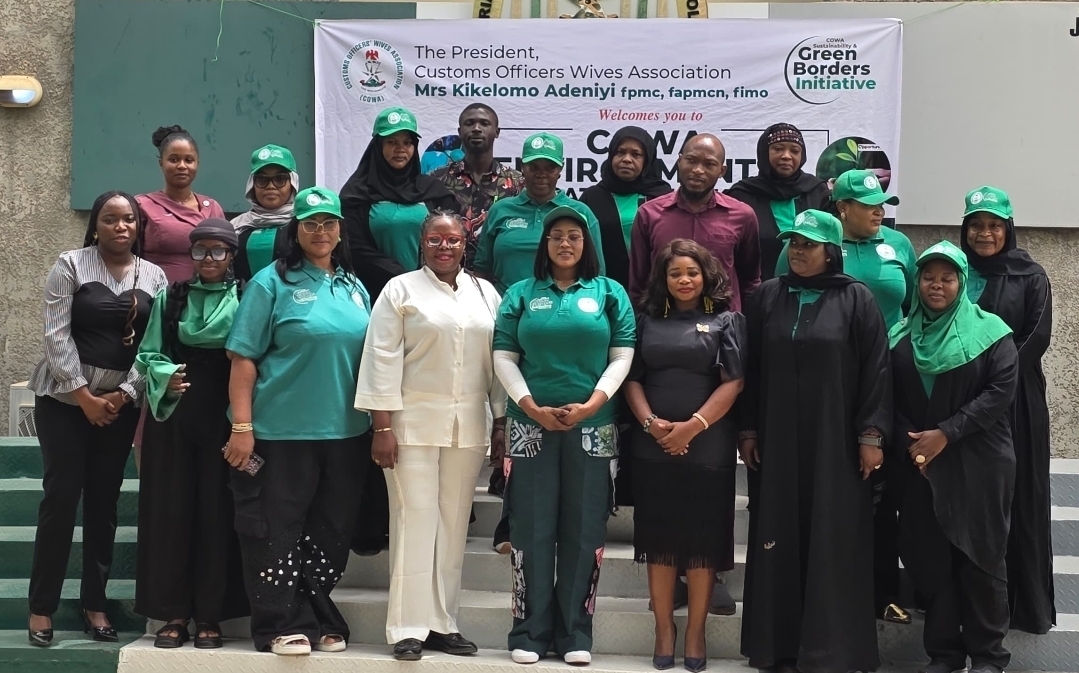
The Customs Officers’ Wives Association (COWA) has lauunched a climate action across state commands in the country
The green border action was taken at the Environmental Education Workshop in Abuja under its flagship Green Borders Initiative, reinforcing its commitment to environmental stewardship, climate awareness, and sustainable community development.
The workshop held in Gwagwalada, Abuja formally launched a coordinated national climate action framework to be implemented across State Commands, aligning with national priorities advanced by the Federal Ministry of Environment and the National Council on Climate Change.
Speaking at the event, the COWA President, Mrs Kikelomo Adeniyi, described environmental responsibility as an extension of national service, noting that sustainable communities are essential to national prosperity. She emphasised that the Green Borders Initiative institutionalises structured environmental action across Customs communities and remains open to strategic partnerships to scale impact nationwide.
Delivering the keynote address, the Minister of Environment, Balarabe Abbas Lawal, commended COWA for aligning its theme, “Green Barracks, Green Borders: Advancing Environmental Stewardship for a Sustainable Future,” with the nation’s environmental restoration agenda.
The Minister highlighted nationwide sensitisation campaigns, land restoration efforts under the ACReSAL project, investments in recycling infrastructure, and the issuance of a Sovereign Green Bond as evidence of structured environmental financing and public trust in sustainable initiatives.
In a goodwill message delivered on behalf of the Director-General of the National Council on Climate Change, the Council underscored Nigeria’s climate commitments under the Paris Agreement and the implementation of its Nationally Determined Contributions (NDC 3.0) targeted at achieving net-zero emissions by 2060.
The Council described the Green Borders Initiative as a practical citizen-led model capable of advancing sustainability, promoting green economy principles, and strengthening resilience in border communities.
The workshop addressed three core thematic areas: understanding climate change and its local impacts; the importance of trees in carbon absorption, flood prevention, and air purification; and the 3Rs of waste management: (Reduce, Reuse, and Recycle), supported by practical demonstrations on waste separation and responsible consumption.
The engagement marks the commencement of a coordinated national rollout across State Commands, where structured tree planting programmes, waste management initiatives, environmental education workshops, and youth engagement platforms will be implemented, contributing toward a national target of planting 50,000 trees, COWA reaffirmed its resolve to drive measurable, women-led environmental action, emphasising that clean and green communities strengthen institutions, improve public health, and advance national development.