
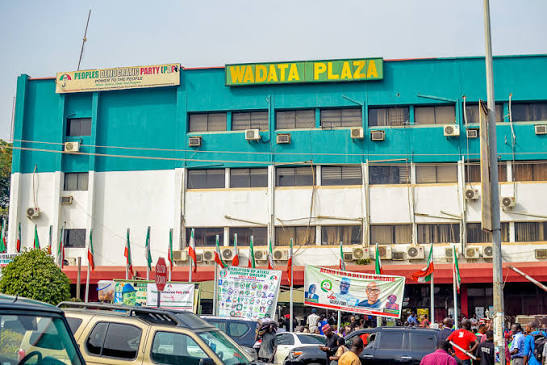
The protracted leadership crisis within Nigeria’s main opposition party, the Peoples Democratic Party (PDP), has reached a critical juncture. The party’s national secretariat, Wadata Plaza in Abuja, sealed for months following violent clashes, is set to be officially reopened this coming Monday under the authority of the Abdulrahman Mohammed-led National Caretaker Committee.
The announcement was made authoritatively by Senator Samuel Anyanwu, the acting National Secretary, following the Independent National Electoral Commission’s (INEC) quarterly meeting with political parties on Thursday. This development signals a potential return to normality for the party as it prepares for crucial forthcoming elections.
A Timeline of Turmoil and Resolution
The secretariat was locked down by the Nigeria Police Force on 19 November 2025, after a physical confrontation erupted between factions loyal to the Taminu Turaki-led National Working Committee (NWC) and the factional acting National Chairman, Abdulrahman Mohammed. The clash represented the tangible manifestation of deep-seated internal disputes over the party’s legitimate leadership and the validity of its November 2025 convention.
In an exclusive statement to Elanza News, Senator Anyanwu clarified the path to resolution. “We wrote to the police. Remember that the police sealed the place and then the other group went to court to ask the police to open it,” he explained. “The matter was dismissed because they have no locus standi. So by Monday, we are taking over the office.”
This legal affirmation forms the bedrock of the caretaker committee’s move. Anyanwu pointed to a definitive ruling by the Federal High Court in Ibadan the previous Friday, which declared the contentious convention of 15-16 November 2025 “a nullity.” The court further stipulated that “no other person should parade himself or herself as a member of the NWC of the PDP,” effectively vesting full administrative powers in the National Caretaker Committee led by Hon. Abdulrahman Mohammed.
Unified Leadership and Electoral Preparedness
Senator Anyanwu was emphatic in dismissing notions of a persisting faction, positioning the committee as the sole legitimate authority. “There is no faction in PDP,” he insisted. “The party remains under the leadership of Mohammed, the reason we attended INEC meeting with other political parties.”
This move to reclaim Wadata Plaza is framed as the first step in stabilising the party’s operations and accelerating its preparations for imminent electoral contests. “People are happy that normality has returned to the party now,” Anyanwu stated, addressing concerns about the PDP’s ability to field candidates. “For those who were afraid that PDP would not have candidates in the forthcoming elections, it is now settled that the party will field candidates for all positions.”
Highlighting the experience within the caretaker committee, he added, “You can see something different because you have old hands who have been managers of this party for the last 25 years. We are still involved. So, we are going to fast-track everything.”
Immediate Focus: FCT Elections and Democratic Landscape
The committee’s immediate focus is the upcoming Area Council elections in the Federal Capital Territory (FCT). Anyanwu confirmed that an interim caretaker committee for the FCT would be mobilised immediately to campaign for the party’s victory. “We are going to hit the ground running with our campaign until 18 February, the last day for campaign,” he declared.
Commenting on INEC’s registration of two new political parties, which brings the total number of registered parties in Nigeria to 21, Anyanwu welcomed the development. “For us, it’s a good development. What it means now is that we have 21 political parties in Nigeria, which is a good development for the country’s democracy,” he remarked, underscoring the PDP’s commitment to operating within a robust multi-party system.
Analysis: A Critical Step, But Challenges Remain
The reopening of Wadata Plaza is undeniably a significant symbolic and practical victory for the Mohammed-led caretaker committee. It provides them with the physical headquarters from which to coordinate party activities, project an image of unity, and engage with institutions like INEC from a position of recognised authority.
However, political analysts suggest that while the court ruling has provided clarity, the path to complete internal harmony may be longer. The resolution of deep-seated grievances among various power blocs within the party, particularly those aligned with the Minister of the Federal Capital Territory, Nyesom Wike, who backs the Mohammed faction, and other legacy stakeholders, will be crucial. The true test will be the committee’s ability to manage candidate nominations for future elections transparently and inclusively, a process often fraught with tension in Nigerian politics.
Furthermore, the party must rapidly transition from crisis management to effective political opposition and electioneering. Rebuilding morale at the grassroots, formulating compelling policy alternatives, and launching cohesive campaigns will demand decisive leadership from the reclaimed secretariat.
Conclusion
The scheduled reopening of the PDP national secretariat this Monday marks the end of a disruptive chapter of physical closure and legal ambiguity. It represents a court-sanctioned attempt to draw a line under a period of internal conflict and to re-establish a central command structure for Africa’s largest opposition party. As Senator Anyanwu and the caretaker committee “take over the office,” the political landscape will be watching closely to see if this move translates into a genuine, unified resurgence of the PDP, or merely a pause in its internal struggles. The coming weeks, particularly the management of the FCT elections, will provide the first clear indicator of the party’s recovered health and operational capacity under its new-old leadership.