In a shocking revelation that has sent ripples through Nigeria’s religious and political spheres, Professor Abdullahi Saleh Pakistan, the Chairman and Chief Executive Officer of the National Hajj Commission of Nigeria (NAHCON), has reportedly spent over N45 billion without President Bola Tinubu’s approval during the 2025 Hajj operation. This financial mismanagement has sparked calls for his immediate removal and raised serious concerns about the integrity of the commission.
Financial Misconduct: The Breakdown
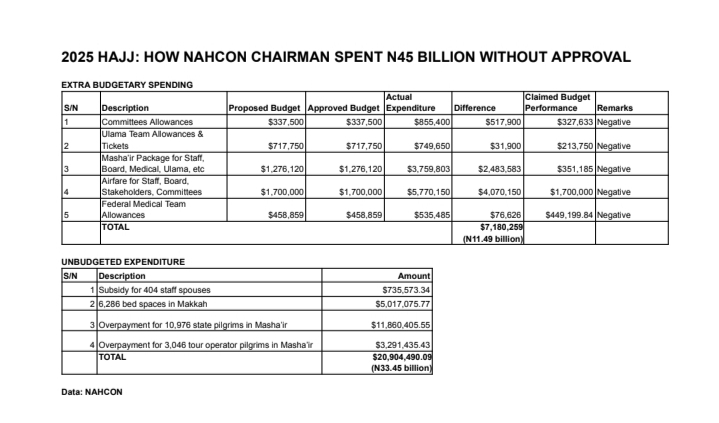
An extensive investigation, based on official financial documents from NAHCON, has exposed a staggering level of unauthorised expenditures. It has been revealed that Mr Pakistan spent approximately $28.08 million (equivalent to N45 billion) during last year’s Hajj operation without the necessary presidential consent. The illicit spending comprises $7.18 million (around N11.48 billion) on five budget lines and an additional $20.90 million (approximately N33.44 billion) on four unapproved items.
The investigation has also uncovered claims that the 2025 Hajj Budget Performance report submitted to the Vice President’s office was manipulated to obfuscate the actual financial discrepancies. An insider disclosed, “The report was ‘cooked up’ to mislead and hide the actual extra-expenditure contrary to financial regulations and presidential approval.”
A Vote of No Confidence
The ramifications of these financial irregularities have been immediate and severe. All eleven board members of NAHCON, alongside state pilgrims board chief executives, private tour operators, and Hajj commission staff, have expressed their lack of confidence in Mr Pakistan’s leadership. The alarming situation has led to calls for his resignation and further scrutiny from the Economic and Financial Crimes Commission (EFCC).
An insider remarked, “The 2025 Hajj report has yet to be submitted to President Tinubu, more than eight months after the pilgrimage. This delay is indicative of the ongoing financial turmoil within the commission.”
Detailed Examination of Expenditures
A meticulous review of financial records shows that while President Tinubu approved $12.9 million for offshore operations during last year’s pilgrimage, Mr Pakistan’s actual expenditure ballooned to $28.08 million. This discrepancy raises serious questions about the governance and oversight mechanisms within NAHCON.
The breakdown of extra-budgetary expenditures reveals alarming patterns of financial mismanagement, including:
– **Ad hoc committee allowances**: $517,900
– **National ulama tickets and allowances**: $31,900
– **Masha’ir package for staff and board members**: $2,483,683
– **Airfare for staff and committees**: $4,070,150
– **Federal medical team members**: $76,625
Additionally, unbudgeted expenditures included a subsidy for NAHCON staff spouses, unutilised bed spaces in Makkah, and overpayments for state pilgrims and tour operators.
## Allegations of Corruption and Mismanagement
The ongoing investigation by the EFCC has reportedly identified Mr Pakistan as a central figure in a web of corruption. Sources suggest that he has embezzled over N25 billion, with the potential for this figure to rise as inquiries progress. The commission is currently examining numerous petitions against him, highlighting the gravity of the allegations.
In a startling turn of events, a family dispute has emerged, with Mr Pakistan reportedly blaming his brother, Sirajo Salisu Usman, for his alleged financial missteps. The dysfunction within the leadership has raised questions about accountability and transparency at NAHCON.
## Media Manipulation and Public Relations Strategy
In a desperate bid to salvage his reputation, Mr Pakistan has allegedly resorted to creating two online news platforms aimed at countering negative press. Hajj Chronicles and Hajj Gazette have been established to project a favourable image of the embattled chairman, often attacking journalists and media outlets that report unfavourably on him.
Insiders have revealed that these publications operate as extensions of Mr Pakistan’s office, further muddying the waters regarding ethical journalism and accountability within the commission.
## The Call for Accountability
Alhaji Abba Jato, a NAHCON board member, has publicly condemned Mr Pakistan’s leadership, stating that his actions threaten the integrity of the Hajj operation in Nigeria. “His spending habits run counter to public service rules and financial regulations,” he declared. “We have exhausted all avenues to encourage him to adhere to proper governance, but to no avail.”
Financial experts have echoed these sentiments, describing Mr Pakistan’s actions as gross misconduct that necessitates investigation and prosecution. They have called for comprehensive forensic audits to scrutinise the commission’s financial dealings thoroughly.
## Conclusion: A Call for Change
As the scandal unfolds, the future of NAHCON hangs in the balance. The growing outcry from board members, industry stakeholders, and the public demands a robust response from President Tinubu’s administration. The revelations of financial mismanagement and corruption shed light on the urgent need for reform within the commission.
With the integrity of Nigeria’s Hajj operations at stake, the time for decisive action is now. The fate of Mr Pakistan and the future of NAHCON remain uncertain as the investigation continues, but one thing is clear: accountability must prevail.