

Introduction
The digital revolution has fundamentally transformed the way information is gathered, processed, distributed and consumed. Across the world, traditional newspapers are confronting declining print circulation, changing audience preferences, shrinking advertising revenues and growing competition from digital media platforms. In Nigeria, these developments have compelled established newspaper organisations to rethink their editorial practices, business models and relationships with readers.
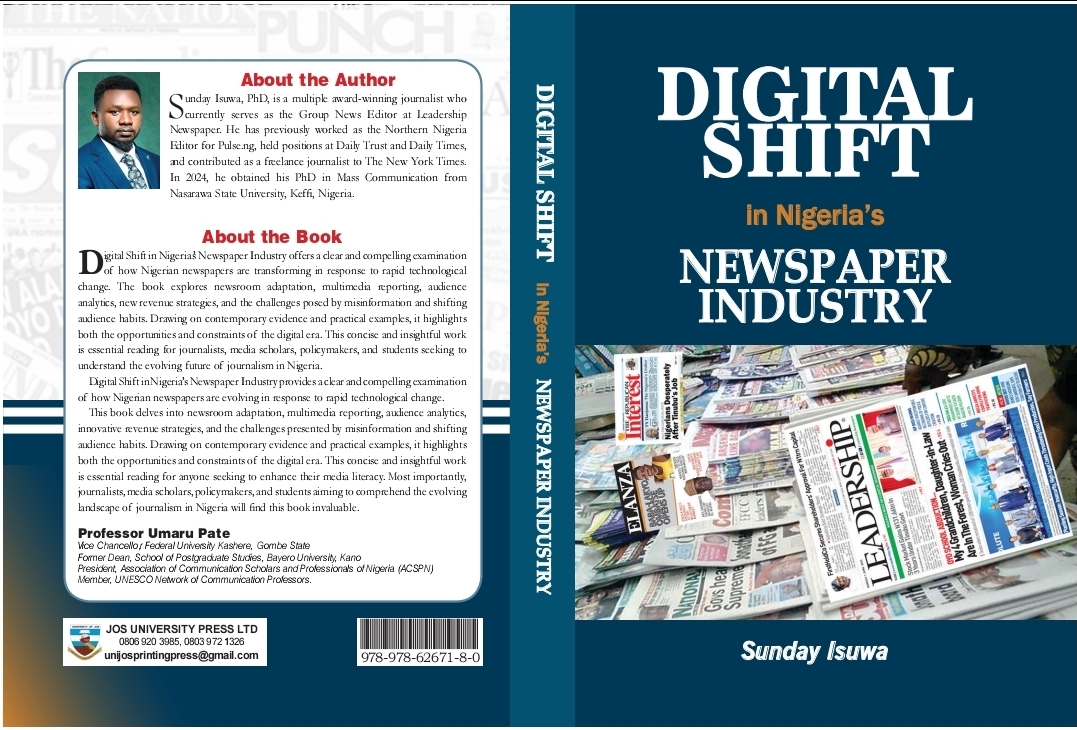
It is against this background that Sunday Isuwa’s Digital Shift in Nigeria’s Newspaper Industry, published in 2026 by Jos University Press Ltd., makes a timely contribution to scholarship on journalism, media transformation and communication studies. The book examines the transition of Nigeria’s newspaper industry from traditional print-oriented operations towards an increasingly digital media environment.
Drawing on the author’s doctoral research and professional experience in journalism, the book seeks to explain the opportunities, challenges and implications of digital transformation for Nigerian newspaper organisations and the wider media landscape.
Structure and Scope of the Book
The book comprises sixteen chapters, covering the historical development of newspaper publishing in Nigeria, the global and local digital revolution, newsroom transformation, artificial intelligence, business sustainability, audience behaviour, digital distribution, misinformation, professional ethics and the future of journalism.
The early chapters establish the historical and conceptual foundations of newspaper publishing and digital transformation. They provide a basis for understanding how technological changes have disrupted established patterns of news production and consumption.
The subsequent chapters explore the political economy of digital newspaper production, technological changes in newsroom operations, artificial intelligence and automation, and the revenue challenges confronting newspaper organisations. These discussions are particularly relevant at a time when media institutions must balance technological innovation with financial sustainability and professional responsibility.
The book also examines audience dynamics, algorithms, digital news distribution, credibility, misinformation and the legal and ethical questions associated with online journalism. Its later chapters address international comparisons, selected Nigerian newspaper case studies, journalism education, capacity building and the future of the industry.
This broad coverage makes the book relevant to journalism and communication scholars, media practitioners, policymakers, university students and managers of media organisations.
Major Contributions of the Book
1. Contextualising digital transformation within Nigeria
One of the book’s principal strengths is its focus on the Nigerian media environment. Rather than treating digital transformation solely as a technological phenomenon, it situates the transition within the country’s economic, infrastructural, regulatory and professional realities.
The challenges facing Nigerian newspapers cannot be understood simply by borrowing models from technologically advanced countries. Infrastructure, investment capacity, audience purchasing power, digital literacy and the structure of the advertising market all influence the pace and character of change. By concentrating on Nigeria, the book contributes to a more context-sensitive understanding of digital journalism in Africa.
2. Connecting technology with media economics
A particularly important aspect of the book is its attention to the business implications of digital transformation. Establishing an online newspaper or maintaining a social media presence does not automatically guarantee financial sustainability.
Newspaper organisations must contend with changing advertising patterns, competition for audience attention and the difficulty of converting digital readership into reliable revenue. By including business models, monetisation strategies and revenue challenges, the author recognises that the future of journalism depends not only on technological adoption but also on viable economic arrangements.
This perspective is valuable for media owners, editors and policymakers seeking to preserve professional journalism in a rapidly changing information economy.
3. Recognising artificial intelligence and automation
The inclusion of a dedicated chapter on artificial intelligence and automation is particularly significant. AI is changing the possibilities for news gathering, transcription, translation, data analysis, content production and audience engagement.
For Nigerian newspapers, these technologies offer opportunities to improve efficiency, expand multilingual reporting and serve audiences across different platforms. However, their adoption also raises concerns about accuracy, transparency, employment, accountability and the preservation of editorial independence.
By incorporating AI into the discussion of the newspaper industry’s digital transition, the book addresses a development that is increasingly central to contemporary journalism and media education.
4. Emphasising credibility, ethics and public trust
Digital platforms have accelerated the circulation of information while making it easier for misleading or unverified content to reach large audiences. The book’s treatment of news credibility, misinformation, legal issues and professional ethics therefore addresses an important democratic concern.
Newspapers remain valuable not merely because they distribute information quickly, but because professional journalism is expected to provide verification, context, fairness and accountability. The ability of traditional newspapers to maintain these standards in a competitive digital environment is essential to their continued relevance.
The book’s attention to these questions reinforces the argument that technological modernisation must be accompanied by ethical and professional renewal.
5. Highlighting journalism education and capacity building
The chapter devoted to digital skills, journalism education and capacity building is especially relevant to universities and professional training institutions. Digital journalism requires competencies that extend beyond conventional news writing and editing. Journalists increasingly need to understand multimedia production, data, digital distribution, audience analytics and emerging technologies.
The implication for higher education is clear: journalism curricula must evolve alongside professional practice. Universities should equip graduates not only with operational skills but also with critical thinking, verification abilities, ethical judgement and the capacity to adapt to technological change.
Critical Assessment
The breadth of Digital Shift in Nigeria’s Newspaper Industry is one of its principal strengths. Its sixteen-chapter structure brings together historical, technological, economic, ethical and educational dimensions of digital transformation. This multidisciplinary approach helps readers appreciate that the digital shift is not an isolated change in publishing technology but a restructuring of the newspaper industry as a whole.
The book’s Nigerian focus is another important strength. Its subject is particularly relevant to a country where digital media offer opportunities for wider access to information, while newspaper organisations continue to face financial and infrastructural constraints.
Nevertheless, several areas merit attention in evaluating the book’s contribution.
First, the effectiveness of such a comprehensive work depends on the depth of empirical evidence supporting its arguments. Comparative data on print circulation, digital readership, advertising income, subscription models and newsroom productivity would help readers assess the scale and consequences of transformation. The book’s detailed case studies and empirical analysis are therefore important to its overall scholarly value.
Second, the rapidly changing nature of digital media presents a continuing challenge. Technologies, platform policies, audience behaviour and AI capabilities evolve quickly. The book’s long-term usefulness will depend partly on how its analysis distinguishes enduring principles from developments that may soon change.
Third, the relationship between digital innovation and institutional sustainability deserves continuing investigation. Newspaper organisations may successfully adopt new technologies without necessarily improving profitability, journalistic quality or staff welfare. A useful direction for further research would be to establish which digital strategies produce measurable improvements and under what organisational and economic conditions.
Finally, the digital transition raises questions about employment, editorial autonomy, ownership concentration and the distribution of power between publishers and technology platforms. These issues warrant sustained attention because technological efficiency alone cannot serve as a sufficient measure of progress in journalism.
These observations should be understood as areas for further assessment and research rather than definitive shortcomings established through a detailed examination of every chapter.
Relevance to Nigerian Universities and Open and Distance Learning
The book has particular relevance to higher education institutions in Nigeria. Universities responsible for journalism, communication and media studies can draw on its subject areas when reviewing curricula and designing professional development programmes.
For open and distance learning institutions, the themes of digital distribution, audience engagement, AI, multimedia communication and capacity building are also instructive. They demonstrate how digital transformation requires institutions to reconsider not only the technologies they use but also their operational structures, professional competencies and relationships with their audiences.
The book can support classroom discussions, postgraduate research and policy debates on the future of Nigerian journalism. It may also serve as a useful reference for media managers and educators seeking to connect technological innovation with institutional strategy, professional ethics and sustainable practice.
Conclusion
Sunday Isuwa’s Digital Shift in Nigeria’s Newspaper Industry addresses a significant transformation in contemporary Nigerian journalism. Its broad coverage of historical development, newsroom technology, artificial intelligence, business sustainability, audience behaviour, misinformation, professional ethics and journalism education provides a useful framework for examining the changing newspaper landscape.
The book’s most important contribution lies in bringing these interconnected issues into a distinctly Nigerian context. It encourages readers to view digital transformation as more than the migration of news from paper to screens. Rather, it is a fundamental reconsideration of how journalism is produced, financed, distributed and trusted.
For scholars, students, media practitioners and policymakers, the work offers a valuable basis for understanding the pressures confronting traditional newspapers and the choices available to them. Its themes also invite further empirical research into effective digital strategies, institutional resilience and the future of credible journalism in Nigeria.
Ultimately, the future of the Nigerian newspaper industry will depend not simply on its ability to embrace new technologies, but on its capacity to combine innovation with financial sustainability, professional competence, editorial integrity and public trust. Digital Shift in Nigeria’s Newspaper Industry makes a timely contribution to this important conversation.